sadh.app · photoing · street

Seeing the street.

The camera guides teach a body; this one teaches a way of seeing. Street photography punishes exactly the habits that landscape and graphic work reward — composing first, standing back, finishing a scene in three frames.

Lesson 01

Distance is the medium

Perspective belongs to where you stand, not to the lens. A street frame shot from across the road on a telezoom carries the geometry of a spectator.

X100VI §Focus — zone focusing · OM-1 §Glass — the 12–40

The optics first: perspective — the size relationship between a subject and what’s behind them — is fixed by camera-to-subject distance and nothing else. The focal length only decides how much of that perspective gets cropped into the frame. Stand 2.9 m from a person with a 35mm-e lens and someone ten metres behind them renders at 23% of their size: the person dominates, the street recedes, the viewer stands where you stood — inside the scene. Back up to 25 m with a 300mm-e and that same background figure renders at 71% of the subject’s size: everything flattens into one plane, and the frame announces that the photographer was somewhere else entirely.

Same subject size (2 m frame height), what changes with distance
LensYou stand atBackground slice (10 m back)Background renders at
28mm-e2.3 m15.9 m wide19% of subject
35mm-e2.9 m13.3 m wide23%
50mm-e4.2 m10.2 m wide29%
150mm-e12.5 m5.4 m wide56%
300mm-e25.0 m4.2 m wide71%

Read the middle column again. At 28–35mm-e the frame swallows a 13–16 m slice of the world behind the subject — context arrives for free, and the composition problem is exclusion. At 300mm-e the frame holds a 4 m sliver — context is gone, and what remains is a specimen on a compressed stage. That is why long-lens street frames read as observations of people rather than photographs with people: the geometry itself is third-person.
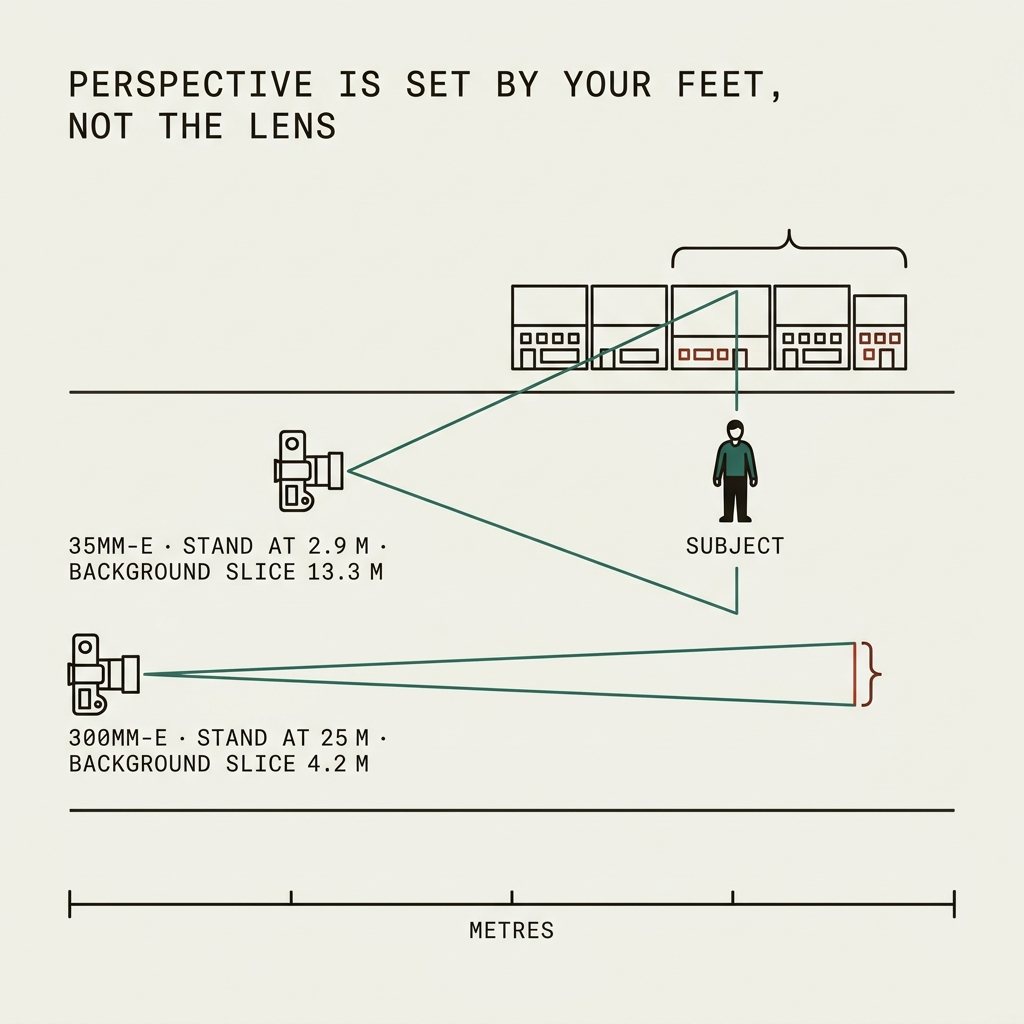
Top-down diagram: a camera 2.9 metres from a subject with a wide cone admitting a 13.3 metre slice of the buildings behind, and a second camera 25 metres away whose narrow cone admits only 4.2 metres
The geometry, drawn Both cameras render the subject the same size. Only the cone changes — and with it, how much of the world behind arrives in the frame. Diagram drawn for this guide
Working-distance visualizer — same person, same frame height
TOP-DOWN you subject bg +10 m WHAT THE FRAME HOLDS
Lens35mm-e
You stand at2.9 m
Bg slice, 10 m back13.3 m
Bg renders at23%

The person is held at the same size in the frame; only your feet and the lens change. Watch the background figures grow from set-dressing into a wall — that growth is what a viewer reads as “shot from across the street.” Arrow keys work on the slider.

The archive shows both geometries, made by the same government project within a few years of each other — one frame from inside the scene, one from far above and away. Neither is wrong. Only one is a photograph of a person.

Close black-and-white frame of a gaunt older man in a hat and worn suit on a city sidewalk, a younger man passing behind him
Participant geometry Made from inside conversational distance: the man’s face carries the frame, the walker a few paces behind already renders half his size and soft, and the street shrinks to context. That size falloff is the wide-lens-up-close signature — read it in anyone’s frame and you know where they stood. John Vachon · Man on the street, Washington, D.C. · 1937 · LoC
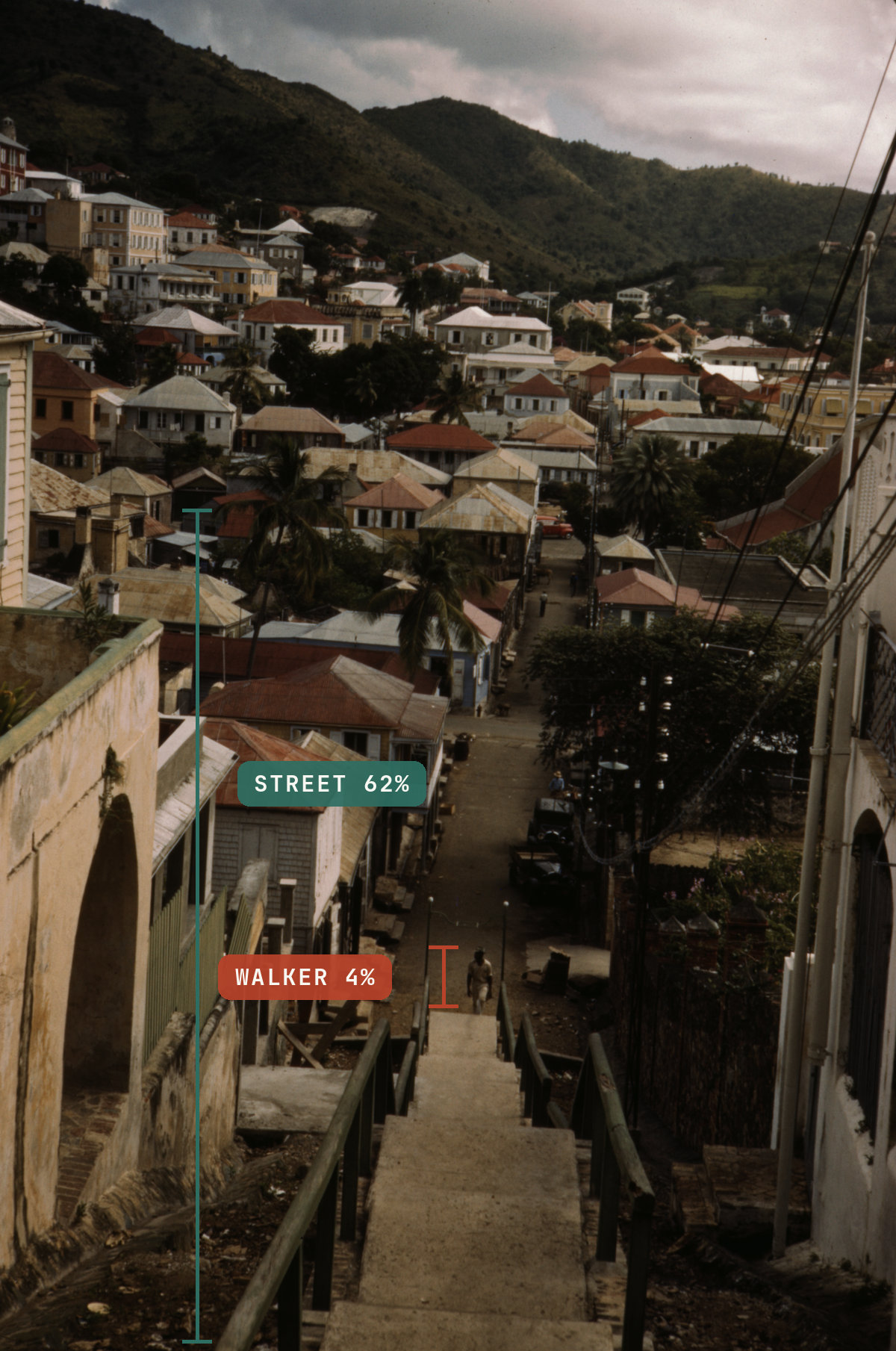
Kodachrome of a long staircase street in the Virgin Islands, houses on both sides, one tiny figure at the center
Spectator geometry, used honestly The opposite choice: the figure is a scale mark at the foot of a staircase street, and the photograph is about the street. The walker stands 4% of the frame high where the street runs 62% of it — fourteen to one in favour of the place. Distance is a medium, not a mistake; the failure mode is only using spectator geometry while believing you photographed a person. Jack Delano · One of the steep hillside streets, Charlotte Amalie, St. Thomas Virgi… · 1939 · LoC · heights measured off the frame

The kit answer

The general rule: a fixed wide-normal lens removes the zoom decision entirely, leaving your feet as the only variable — which is the variable that needs training. This site’s instance of the rule: the X100VI (fixed 35mm-e, leaf-shutter quiet) is the street camera; the alternative is the OM-1 with the 12–40 held at 14–25mm (28–50mm-e). The 40–150 stays home. Not because long lenses are immoral — Lesson 08 has the honest counterexample — but because a telezoom in the bag lets the composing-from-across-the-road habit keep breathing, and a habit dies only when the option does.

Prefocus kills the last excuse for hanging back. Zone focus on a 35mm-e APS-C at f/8: set focus to 3.3 m (the hyperfocal) and everything from 1.7 m to infinity is acceptably sharp; set it to 2.5 m and the zone runs 1.4–10 m. On Micro Four Thirds at 17mm f/8, focus at 2.5 m holds 1.2 m–∞. Autofocus latency stops mattering when nothing needs to focus — the same logic behind Matt Stuart’s film-era practice of f/11, 1/500, and two memorized focus positions.

The canon confirms the geometry with feet, not theory. Cartier-Bresson worked a 50mm and found the 35 “extremely difficult” for his compositions; Winogrand carried two bodies with 28mms after rejecting the 21 for distortion; Gilden shoots a 28 with a flash at arm’s length, invoking Capa’s line — “If your pictures aren’t good enough, you’re not close enough.” Meyerowitz is the instructive conversion: he started on a 50, felt it choking him within a month, and switched to a 35 — “I can see now!” Every one of them lives inside 28–50mm-e, which is to say: inside conversational distance. Nobody’s canon includes a 300.

Close black-and-white frame of a weathered man in a bucket hat filling the frame, the crowd behind him thrown completely out of focus
Arm’s length, now Gilden works at a distance most people find rude — close enough that the face fills the frame and the street behind dissolves. Compare the Vachon opposite: same geometry, ninety years apart. The discomfort you feel looking at it is the photograph telling you exactly how far away he stood. Bruce Gilden · New York, 2011 · © the photographer, shown here for critical commentary · see more
A face in profile seen through a bus window streaming with condensation, colour smeared into bands of violet, orange and green
The counter-argument Turpin shoots this series with a long lens from across a dark street, through the window of a lit bus — everything Lesson 01 warns against. It works because the glass is the subject: condensation turns the passenger into pigment and the distance buys a privacy that closeness would destroy. The rule holds; know why you are breaking it. Nick Turpin · from On the Night Bus, 2017 · © the photographer, shown here for critical commentary · see more
Shallow-focus black-and-white crowd of shaven-headed bare-torsoed men with palms pressed together; one weathered face at the centre turns back and looks directly into the lens while everything nearer and further dissolves
Inside the crowd, not across it He is not watching this from the edge — he is in it, close enough that the men in front of and behind his subject fall out of focus entirely. That razor-thin plane of sharpness is only available from a metre or two away; from across the street the whole crowd would render as one flat mass. The man turning back to meet the lens is what you get for being close enough to be noticed. Rohit Vohra · New Delhi · © the photographer, shown here for critical commentary · see more
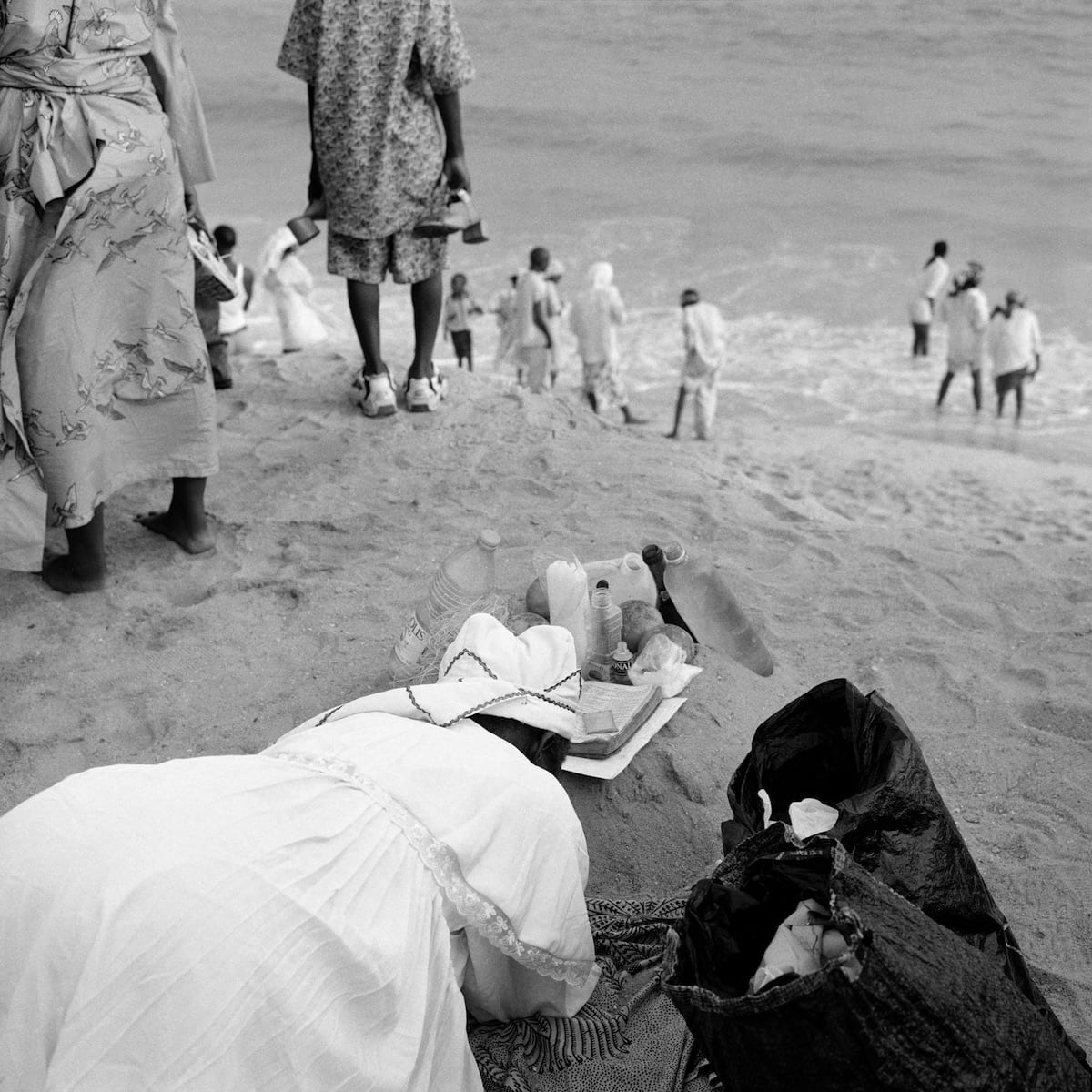
Square grainy frame on a beach: a woman in a white church robe and lace-edged headwrap bowed fully face-down in prostrate prayer on the sand, in front of an improvised altar of plastic water bottles, oil bottles and an open book; other women's legs cut the top edge, white-robed worshippers and bathers scattered in the surf behind
Inside it, at waist level Akinbiyi walks with a twin-lens Rolleiflex held at his waist, composing down into the hood rather than raising a camera at anyone — a posture that lets him stand this close to a woman at prayer without the frame becoming an intrusion. Worship and bathing share the same sand, and the low square viewpoint puts you on the ground with the altar rather than looking down at it. Akinbode Akinbiyi · Bar Beach, Victoria Island, Lagos, 2003 · from Sea Never Dry · © the photographer, shown here for critical commentary · see more
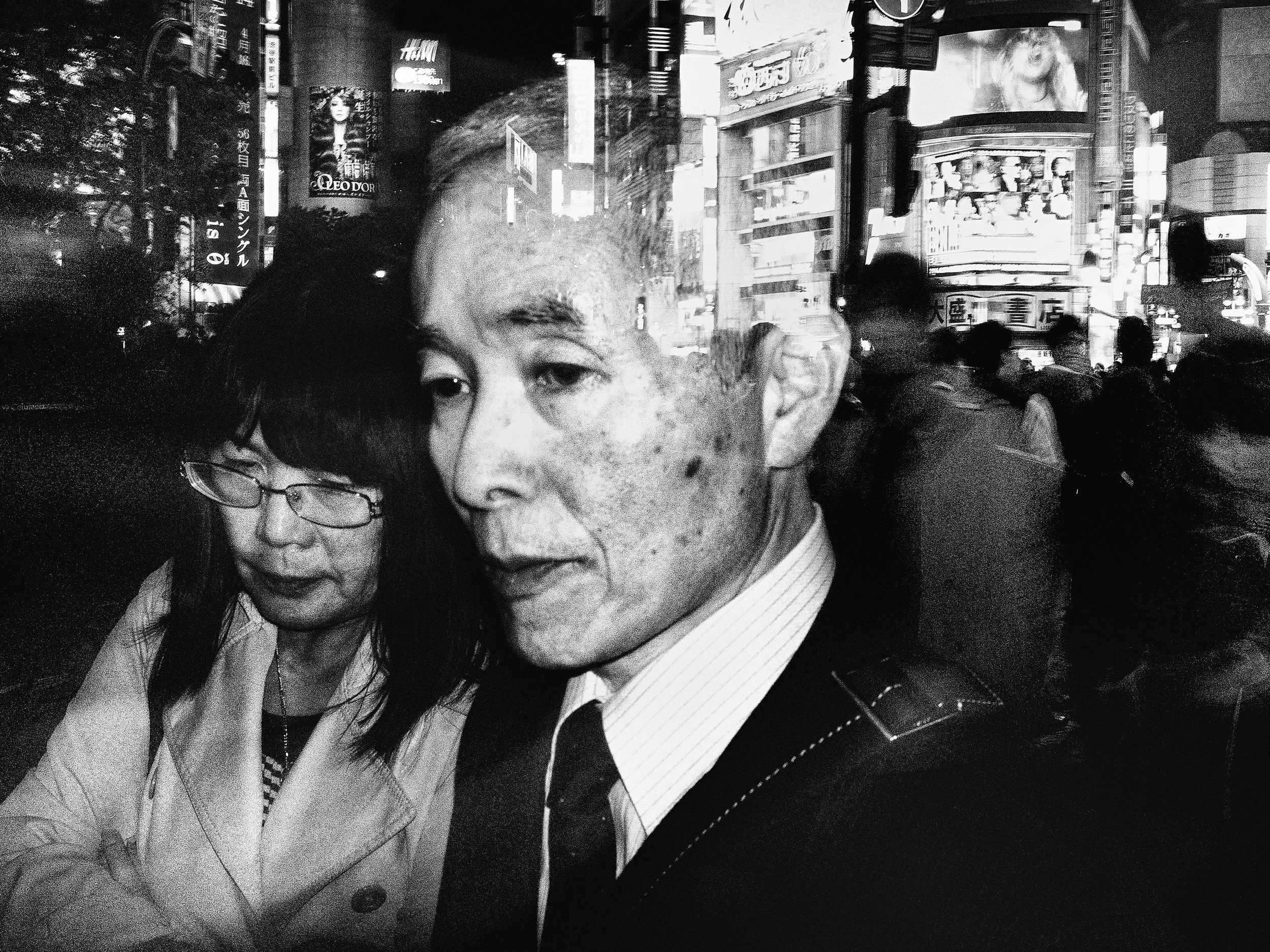
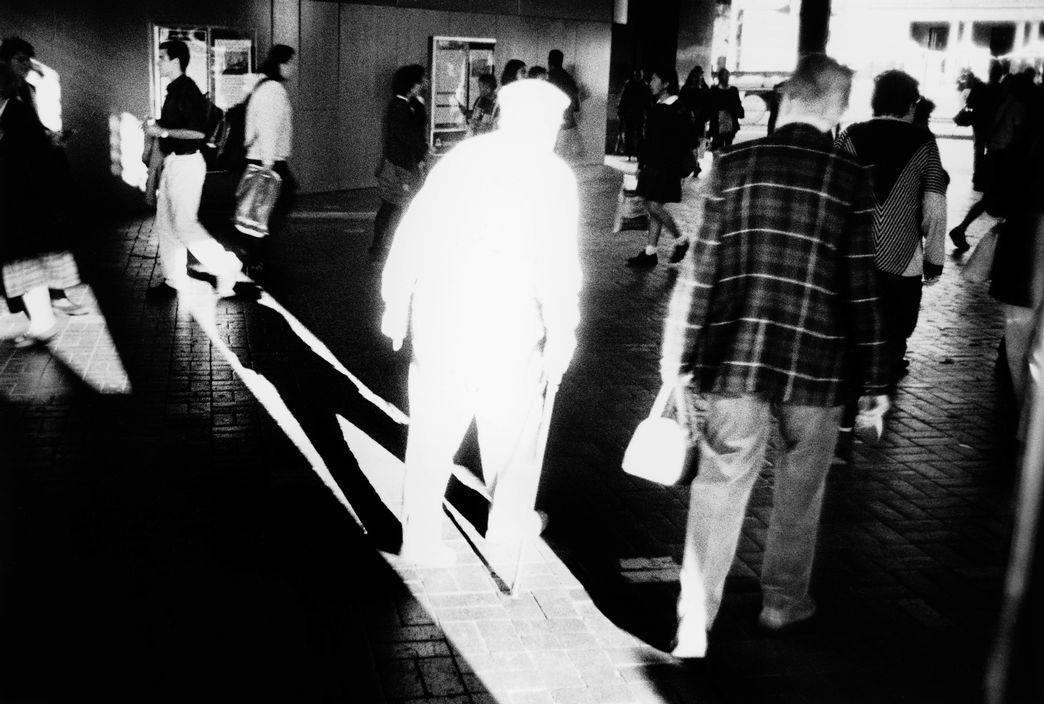
Grainy high-contrast night frame shot from arm's length in a crowd: an elderly man in suit and tie fills two-thirds of the frame, close enough that pores and liver spots read; a woman in glasses presses against his shoulder; behind, a wall of backs dissolving into blown-out neon
As close as it gets This is the work the 2020 Fujifilm controversy was about — a camera at arm’s length in a moving crowd, close enough to resolve skin. Whatever you conclude about it, look at what the distance buys: the man occupies two-thirds of the frame and the entire city behind him reduces to blown neon. No focal length produces that. Only standing there does. Tatsuo Suzuki · Tokyo · from Friction / Tokyo Street · © the photographer, shown here for critical commentary · see more
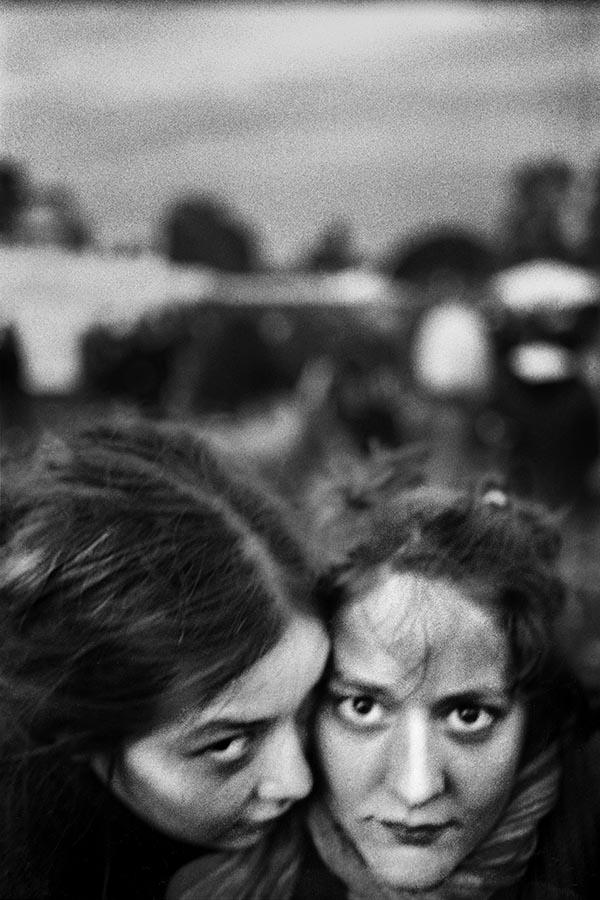
Heavy grain and crushed contrast: two women's faces at very close range in a night crowd, cheek to cheek, the right-hand one staring straight down the lens
Grain as a decision Sevinçli restricted himself to the few streets around his own flat and shot them at night for four years, pushing contrast and grain until description gives way to mood. The proximity is the same as Suzuki’s; the treatment is the opposite. Note that the technical “faults” — noise, blocked shadows, no detail — are the entire content. Yusuf Sevinçli · Istanbul · from Good Dog, 2005 · © the photographer, shown here for critical commentary · see more
A woman in a magenta headband, wraparound sunglasses and a green-and-orange batik top strides straight toward the lens down a crowded Chinatown market street, teeth bared in a wide grin; a masked man carrying produce crowds her left, another man stands against a graffitied wall at right
Head-on, in the flow Arnold walks for hours shooting from belly level while appearing not to photograph. This is head-on into oncoming foot traffic — the hardest position to hold, and the one that produces a stranger arriving at speed and filling the frame with the market closing in on both sides. Nothing about it is polite, which is the point. Daniel Arnold · Forsyth and Division, New York, 2022 · © the photographer, shown here for critical commentary · see more
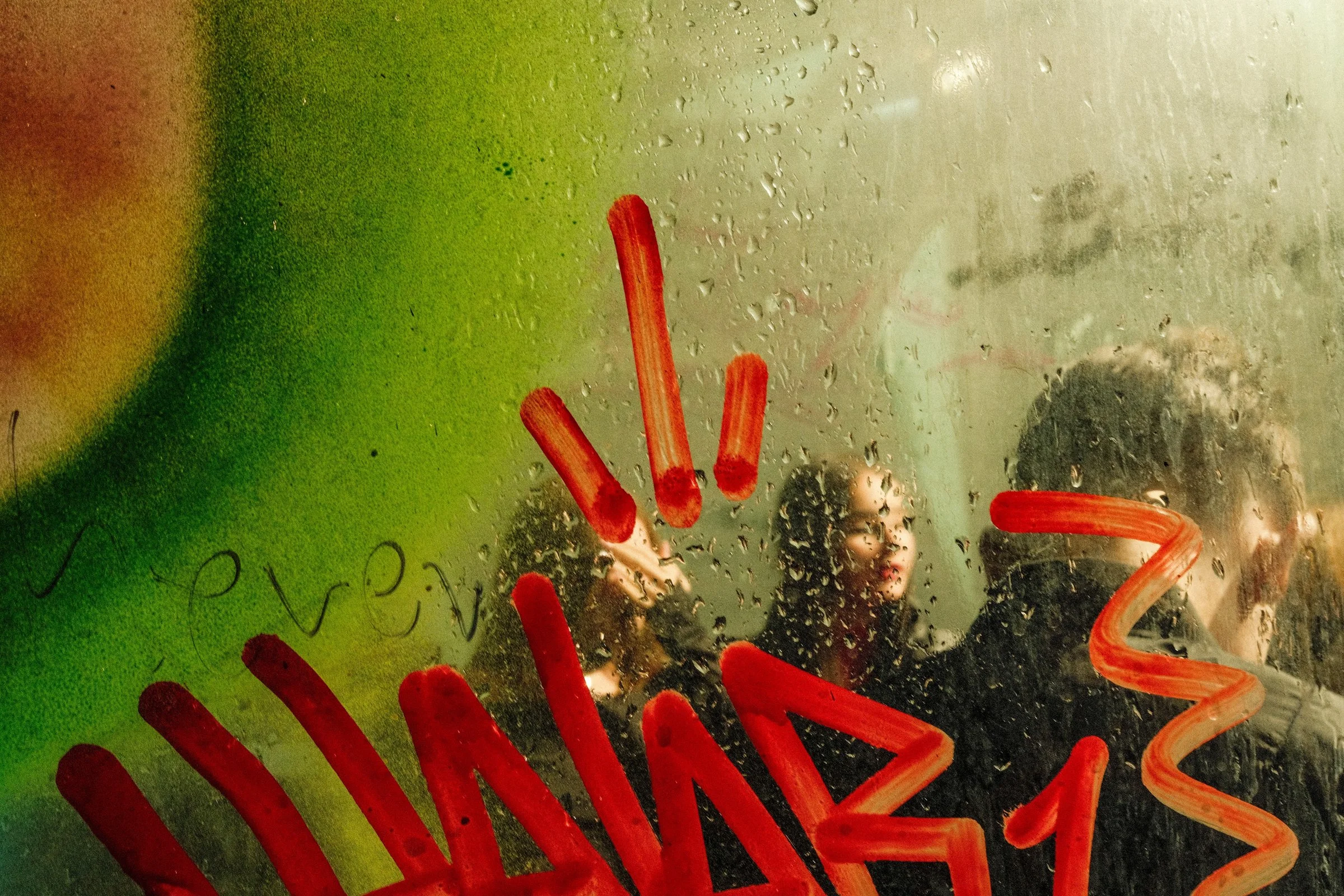
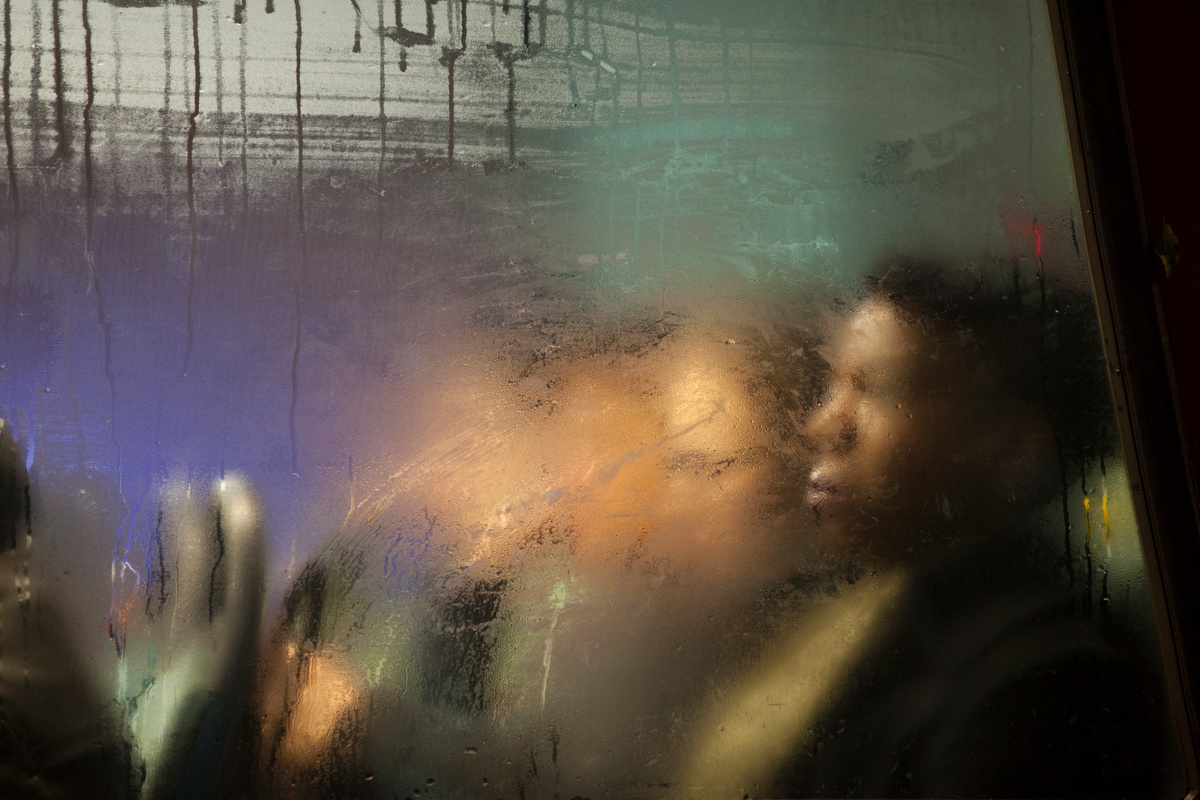
Shot through a steamed, rain-beaded pane scribbled with thick red finger-strokes and the word "even"; behind the glass a green-and-orange wash and three or four blurred passengers, one woman's face readable through a clear patch
Put something between you A steamed window with somebody’s finger-drawing still on it, shot from the far side. The glass does three jobs at once: it hides the photographer, it abstracts everyone behind it, and it leaves exactly one clear patch through which a single face resolves. Turpin does this from a street; Baudet does it at arm’s length. Latife Solak Baudet · Paris · Leica Women Foto Project grant · Women Street Photographers 2023 · © the photographer, shown here for critical commentary · see more
The same collection, the whole distance range
A steep hillside street, white stucco house at the corner, figures small on the slope
Jack Delano · One of the steep streets on the hillsides, Charlotte Amalie, St. Thom… · 1939 · LoC
Looking down a main street from a hotel balcony, arcades on both sides
Jack Delano · View down the main street from the Grand Hotel, Charlotte Amalie, St… · 1939 · LoC
A church tower filling the right of the frame, a man in a hat walking the sunlit street
Jack Delano · [St. John's Anglican Church, King Street, St. Croix, Virgin Islands · 1939 · LoC
A woman stands on a brownstone stoop looking down a long Harlem street
Gordon Parks · New York, New York. A Harlem street scene · 1943 · LoC
Carry this

Before raising the camera, close half the distance you think is right. If the frame gets uncomfortable, it is starting to be a street photograph. The lens restriction is the training wheel; the reflex is the goal.
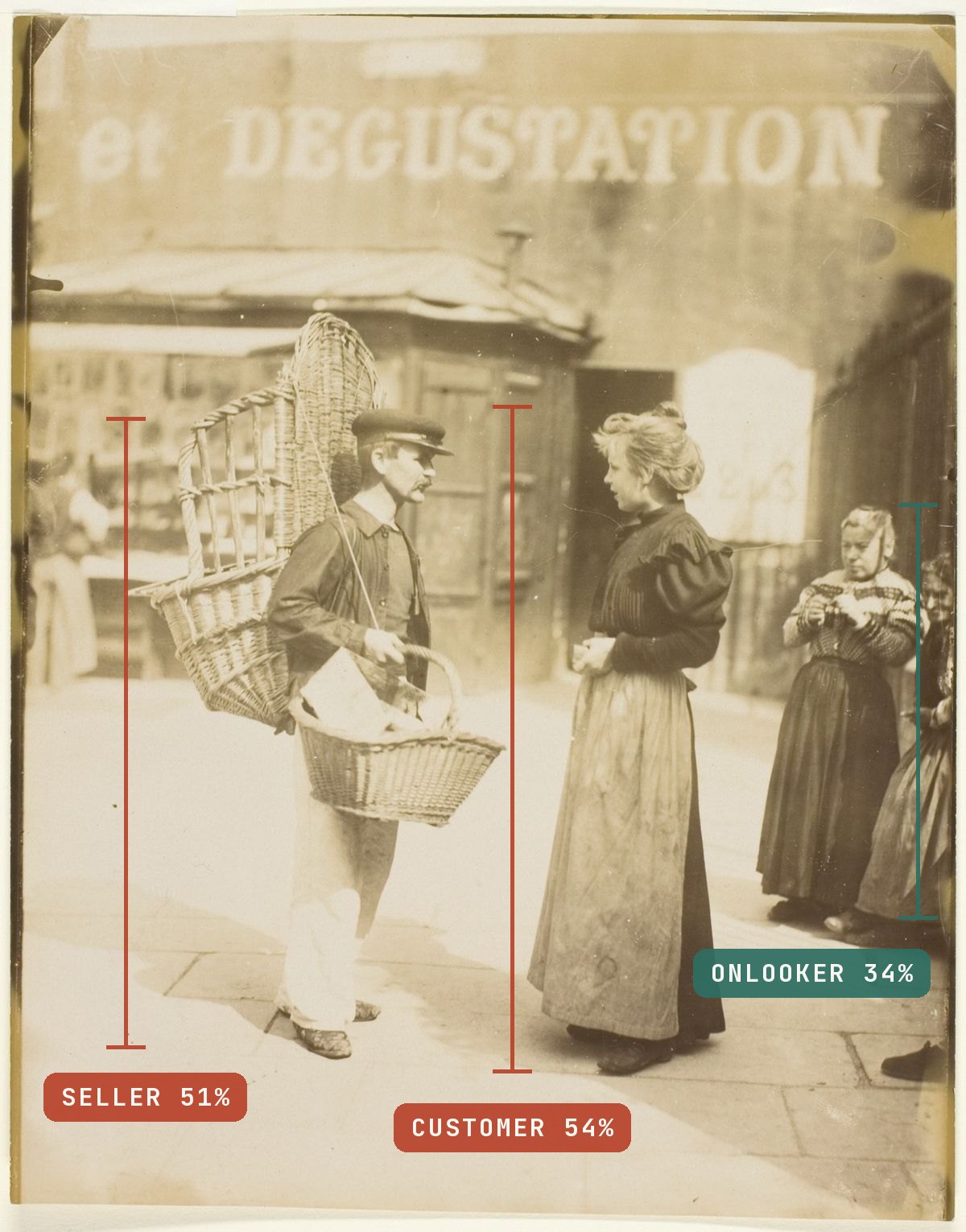
A basket seller with a wicker frame on his back and a basket in his hand stops to talk to a woman on a Paris pavement, two more women watching from a doorway
Annotation study — what standing close buys Both principals run about half the plate from head to sole: the seller 51%, the customer 54%. Neither is a figure in a street scene. The pavement, the shopfront and the DÉGUSTATION sign are what was left over after two people were given the full height of the frame. The woman watching from the doorway is only a few paces further back, and she measures 34% — roughly two thirds of the customer. That fall-off across a few paces is the whole record of where the camera stood: from across the road the same two paces would cost almost nothing, everyone would render near the same size, and the frame would go flat. Eugène Atget · Marchand du Panier · c. 1899–1900 · Art Institute of Chicago · CC0 · heights measured off the frame
Lesson 02

The person is the photo

The landscape reflex is to build a stage and wait for a figure to complete the composition. Street that holds a viewer works the other way: the person is chosen first, with intent, and the environment answers. The test — if this person were someone else, would the photo change?

Run the test on the two frames below. In each, the answer is no — replace the subject and there is no photograph left. That is what subject-first looks like in practice: not portraiture, but a specific person doing a specific thing that the photographer chose, with the street arranging itself around that choice.

A man in a three-piece suit pauses under a theater marquee, wiping the band of his hat with a handkerchief
A found character, met The picture is the wiping of the hatband — a private grooming gesture performed in public, caught from close enough that the handkerchief and the vest buttons read. The sidewalk crowd behind is small, soft, and context. Nothing about the frame survives if this is a different man merely standing there. John Vachon · Man on the street, Washington, D.C. · 1937 · LoC
Two women at a covered street cart, one with a long braid examining pottery, a hatted vendor behind
The exchange, not the observation A pottery cart, a buyer mid-decision, a braid that runs the full height of the frame. The photographer stands at the cart — a participant’s position — so the viewer joins the transaction instead of watching it from across the street. The vendor’s hat brim entering at the left edge is the kind of “flaw” that proves presence. Russell Lee · Mexican women buying pottery from street peddler, San Antonio · 1939 · LoC

There is a failure subtler than missing the person — finding a genuinely good subject and then treating them like scenery: photographing a character from spectator distance, recording the costume and missing the man. The subject gets found and then kept at arm’s length, and what reaches the frame is the costume.
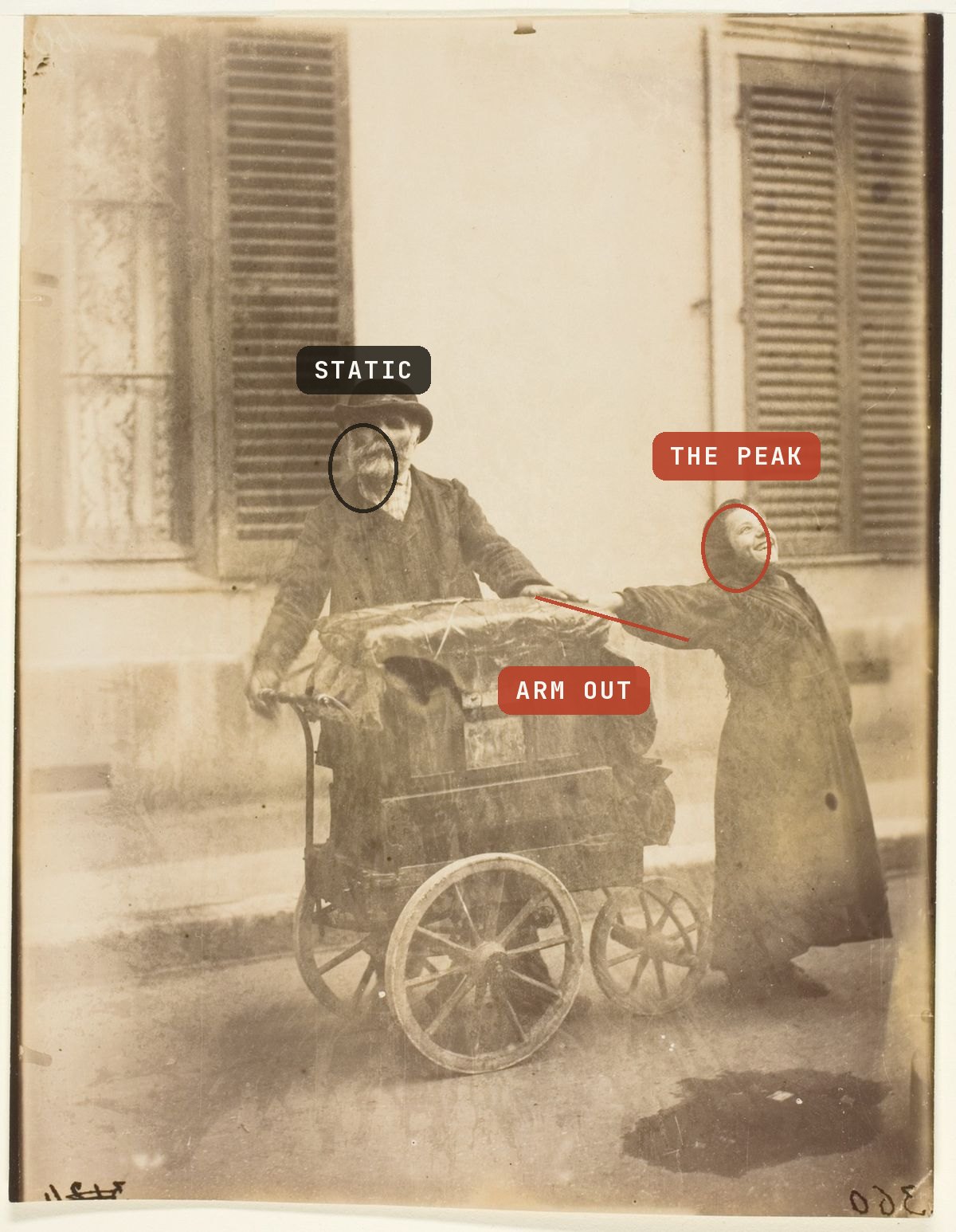
An elderly organ grinder stands at his barrel-organ cart while a young woman beside him throws her head back, singing, one arm flung out
Annotation study — one of them is peaking Atget photographed Paris for thirty years and is usually taught as the man who shot it empty. Here he is close enough to catch a street singer mid-note beside her organ grinder — the frame is entirely about her, and it dies if she stops singing. Two people, one moment: her head is thrown back on a held note and her arm is flung out along the organ, a single line from her hand to her shoulder. He is looking at the lens and would look identical a second either side. That is the difference between a subject who is present and a subject who is peaking. Eugène Atget · Joueur d’orgue · 1898–1899 · Art Institute of Chicago · CC0
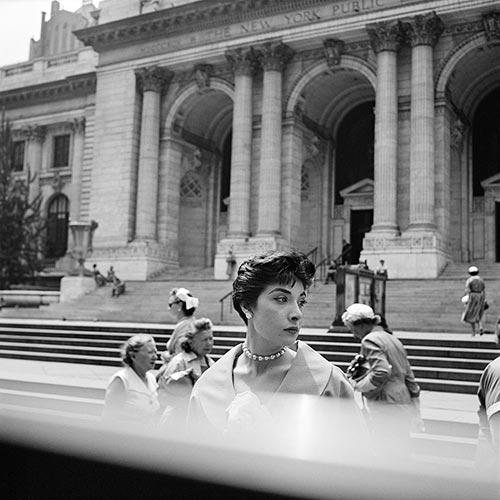
Square black-and-white frame: a woman with dark hair and a pearl necklace glances sideways as she passes the steps of the New York Public Library, other figures behind her
Chosen, from waist level The Rolleiflex is at her waist, so no camera came up to her face — which is likely why she is this close to a stranger and has a sideways glance rather than a reaction to being photographed. The library columns behind are pure setting. Remove the woman and nothing remains. Vivian Maier · New York · © Maloof Collection · © the photographer, shown here for critical commentary · see more
Black-and-white vertical: a moustached man wearing only a white thong, a headband and large feathered angel wings leans against a lamppost on a city pavement, one arm raised holding a toy sword, in scuffed work boots and white socks
Las alas del deseo Run the test: could anyone else be standing here? No — and not because of the wings. It is the work boots and white socks under them, the scuffed pavement, the ordinary lamppost he is leaning on like any bored man waiting. Andrade has photographed Mexico City’s queer public life for forty years, and this is why the frame reads as a portrait of a person rather than a costume. Yolanda Andrade · Ciudad de México, 1993 · © the photographer, shown here for critical commentary · see more
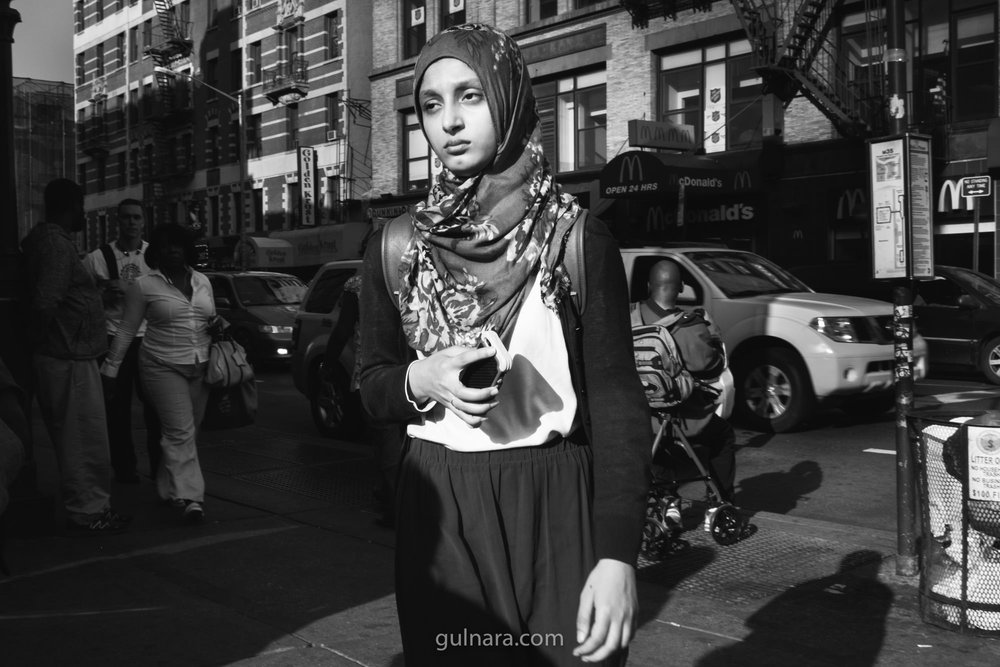
A young woman in a floral hijab walks into hard low sun on a Lower Manhattan pavement, looking straight into the lens; McDonald's signage and fire escapes behind, a stroller and long cast shadows at right
Photographed openly Samoilova’s stated method is to make no secret of the camera — and the returned look is the evidence. She is walking into low sun, so the light is doing the separation for free while the photographer only has to choose the moment the gaze arrives. Compare Lesson 02’s hatband frame: same decision, ninety years and one continent apart. Gulnara Samoilova · New York · © the photographer, shown here for critical commentary · see more
A marriage proposal in a Roman piazza: a man's hands slide a ring onto a beaming woman's finger while a grinning crowd applauds; on the building behind, a Dior billboard of a woman mirrors her tilted head and raised arm
Two events, one frame The proposal alone would be a nice picture. What makes it a photograph is the billboard behind repeating the woman’s exact posture at ten times the scale — tilted head, raised arm — so a private moment and an advertisement rhyme. You cannot pose that. You can only recognise the backdrop first and be standing there when the street supplies the rest. Julia Coddington · Rome · © the photographer, shown here for critical commentary · see more
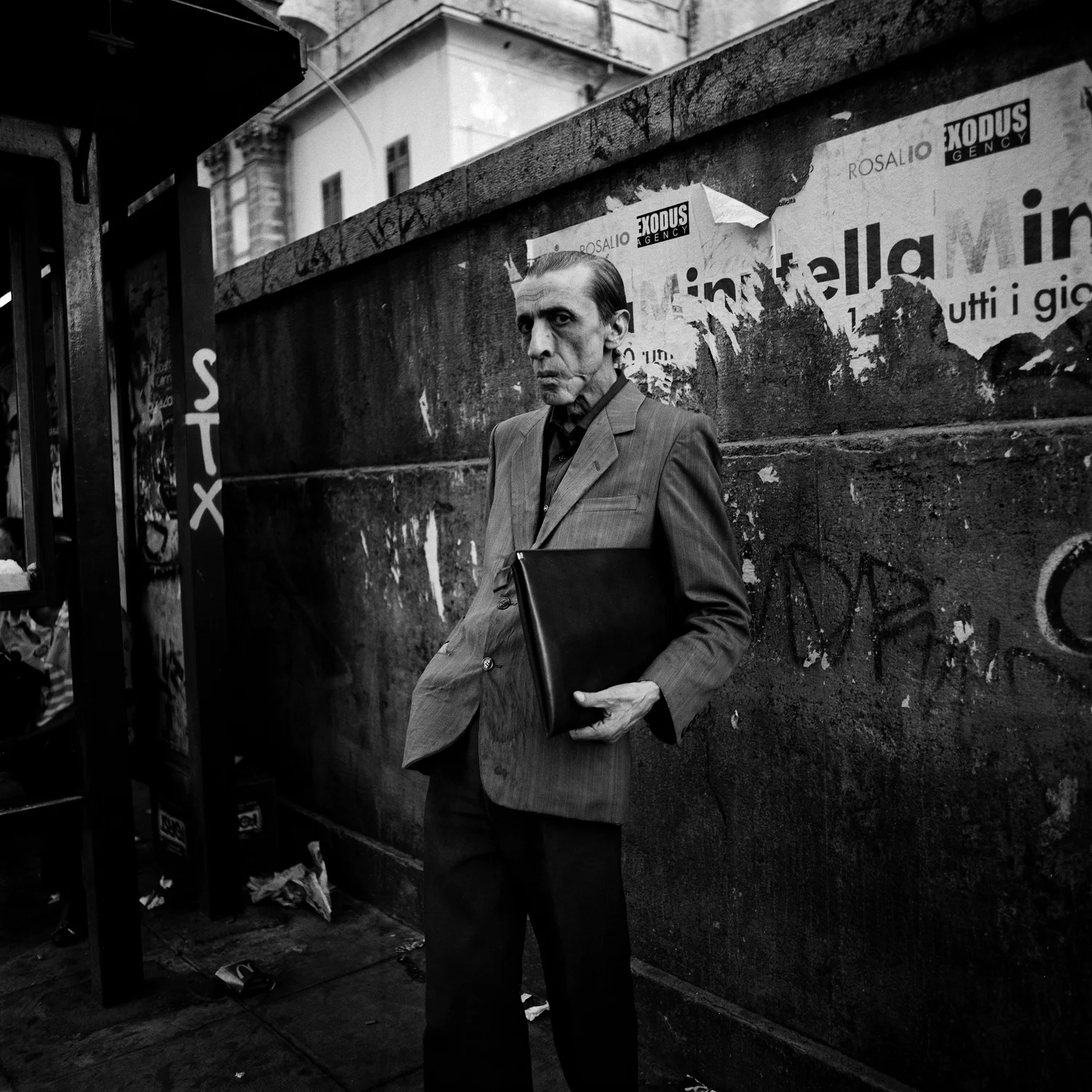
A gaunt hollow-cheeked older man in a rumpled wide-lapelled grey suit stands pressed against a filthy concrete wall clutching a black document folder to his chest, staring flat past the lens; the wall is scabbed with torn advertising, stickers and graffiti, the rusted frame of a bus shelter cutting the left edge
The wall is the biography Everything you need is in the pairing: a man dressed carefully in a suit, holding a document folder like it matters, standing against a wall of torn adverts and graffiti. Neither element means much alone. Mollica went back to Sicily to photograph what everyone there had agreed not to look at, and the series works because it is built from ordinary street frames like this rather than from dramatic events. Mimi Mollica · Palermo, March 2009 · from Terra Nostra · © the photographer, shown here for critical commentary · see more
Square, soft and slightly off-level: a young woman in a black-and-white windowpane-check dress and heavy boots has climbed a green metal pole, her hair swung across her face; at the left edge a man in a red fleece watches, half-smiling; long tangled shadows fall across gravel
Framed without looking Hara shoots a 1930s Zeiss Ikonta at waist level and does not look through the viewfinder at all — which is why this is off-level, soft, and far closer than a raised camera would ever get. The watching man at the edge is the second subject, and he is only in it because she was not visibly composing. Mikiko Hara · Tokyo · Untitled, 2010 · © the photographer, shown here for critical commentary · see more
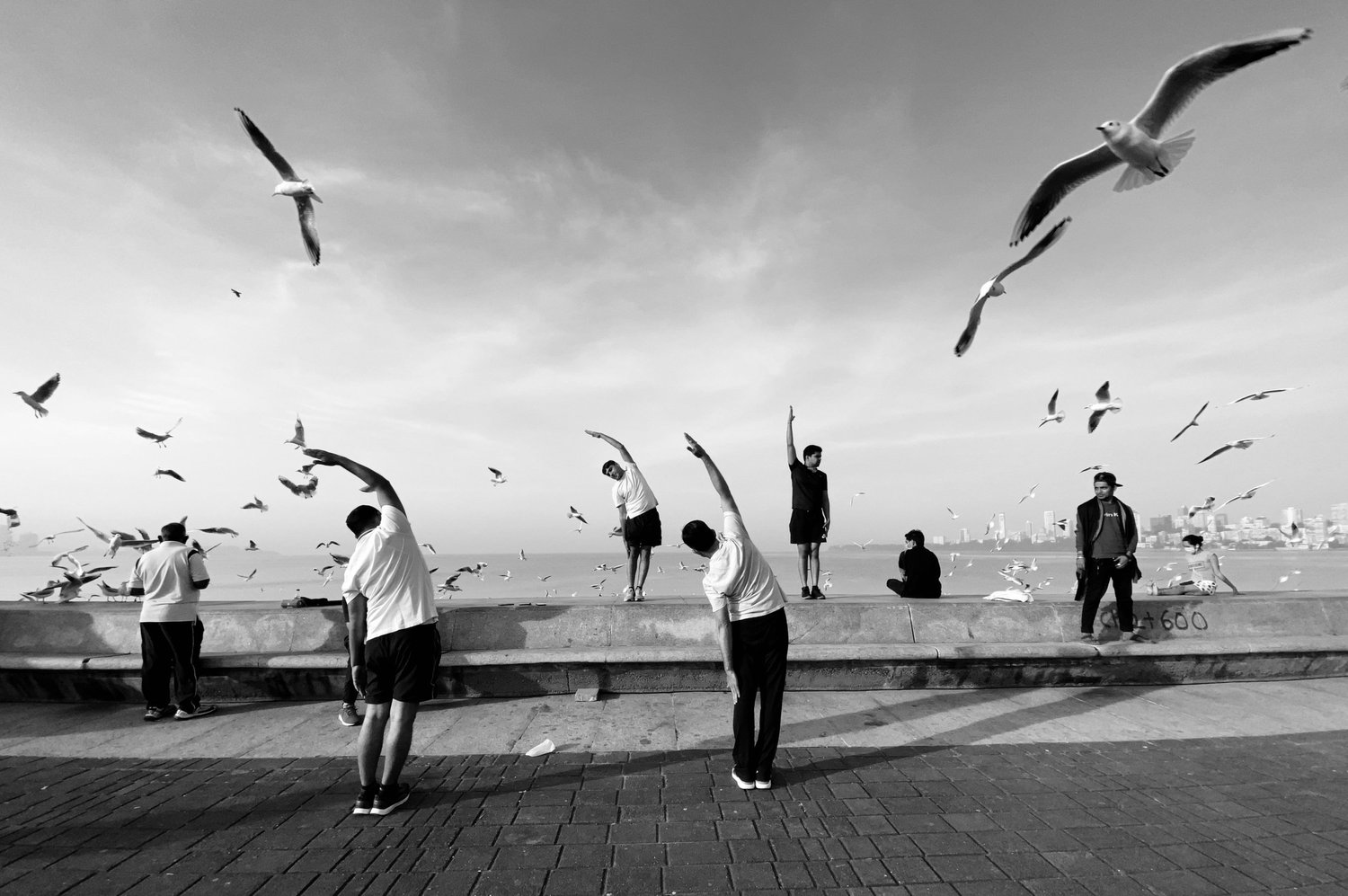
Men doing morning stretches along a seafront promenade, arms arced overhead in near-unison, gulls wheeling low across the frame, a city skyline behind
Chosen, then multiplied Several men, one gesture — arms arced overhead — with gulls crossing at the same angle. Bhalotia shoots entirely on the phone in her pocket and releases only at the apex of a movement, which is why the arms are at full extension rather than halfway. The birds are what you get for waiting past the first acceptable version. Dimpy Bhalotia · Marine Drive, Mumbai · © the photographer, shown here for critical commentary · see more
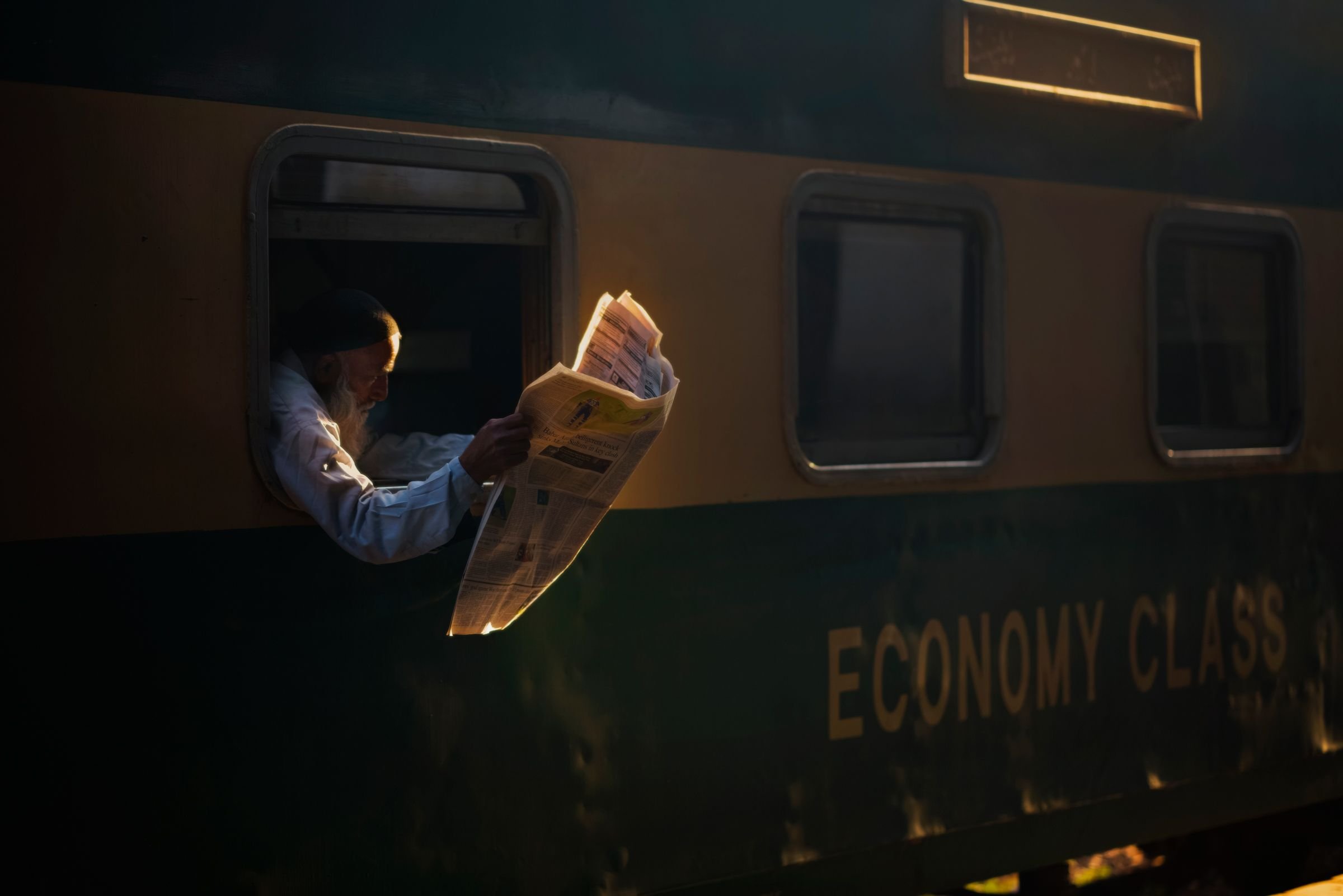
A Pakistan Railways carriage in low golden light with ECONOMY CLASS lettered across its green flank; an elderly bearded man in a white kurta leans out of one window frame holding an open newspaper into the light, while every other window is black
One lit window out of many Every window on the carriage is black except one, and in it a man has leaned out to catch the last usable light on his newspaper. The lettering — ECONOMY CLASS — is doing quiet work beside him. This is subject-first with the environment answering, and the photographer’s only job was to recognise which window was going to matter. Umaima Tanweer · Lahore · Photographer of the Year, Dawn · © the photographer, shown here for critical commentary · see more
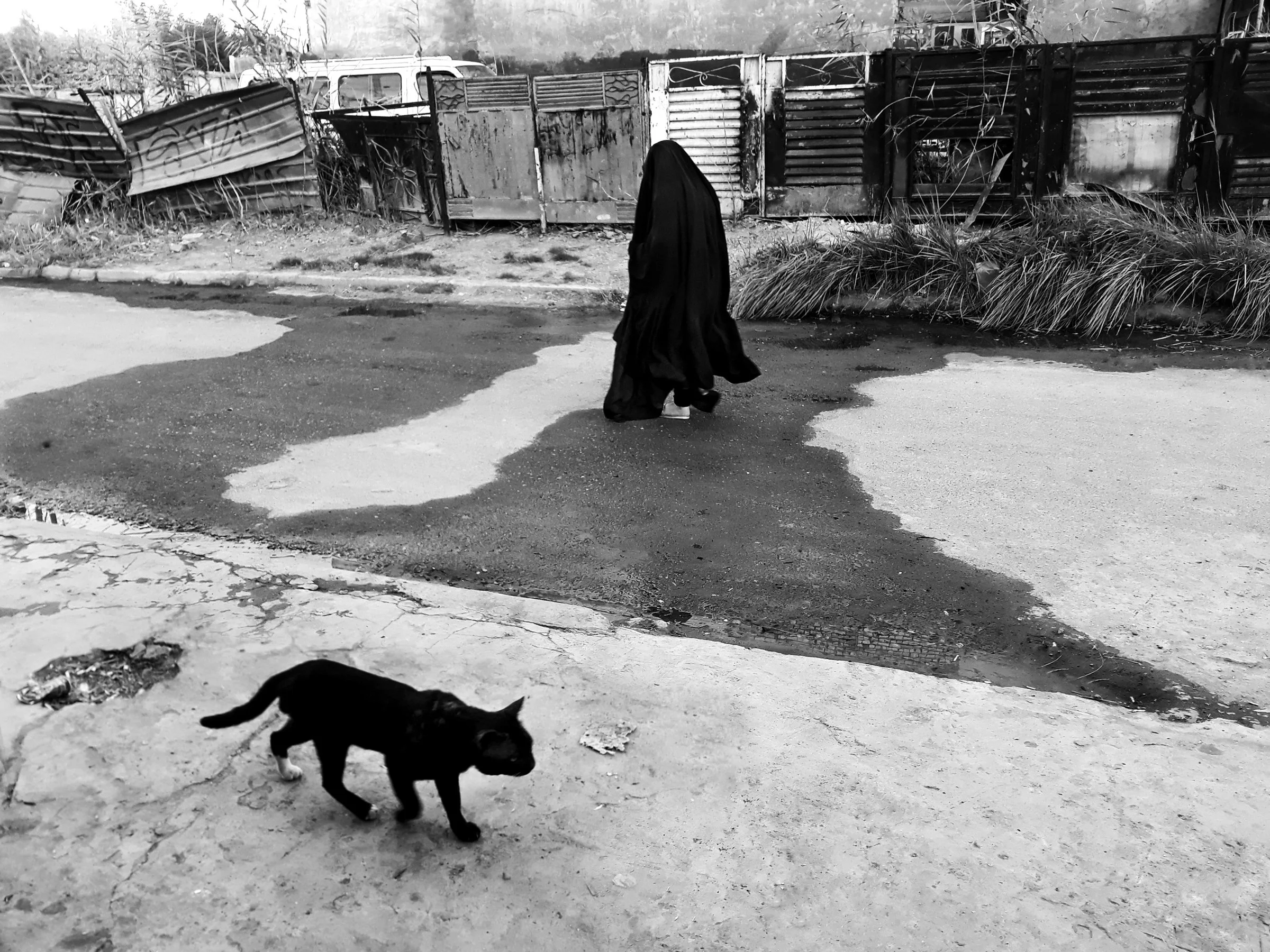
High-contrast black and white: a woman in a full black abaya walks away over wet cracked tarmac while a black street cat crosses the near foreground, rusted corrugated gates and a battered van behind
Two black shapes, one street A woman in black walking away and a black cat crossing toward you — two solid shapes on wet tarmac, moving in opposite directions, with everything else reduced to rust and grain. The rhyme only exists for the second the cat is in the open, and it only reads because the exposure kept both shapes solid rather than trying to save shadow detail. Haneen Kareem · Baghdad · © the photographer, shown here for critical commentary · see more
Women in saris gathered at a riverside ghat, one of them looking straight down the lens
The returned look Someone has noticed, and the photographer kept shooting rather than lowering the camera. That direct look is what separates a frame made among people from one made about them — and it is only available if you are close enough to be seen, which is the whole argument of Lesson 01 restated by a subject. Suhitha Shetty · Pune · Hardcore Street Collective · © the photographer, shown here for critical commentary · see more
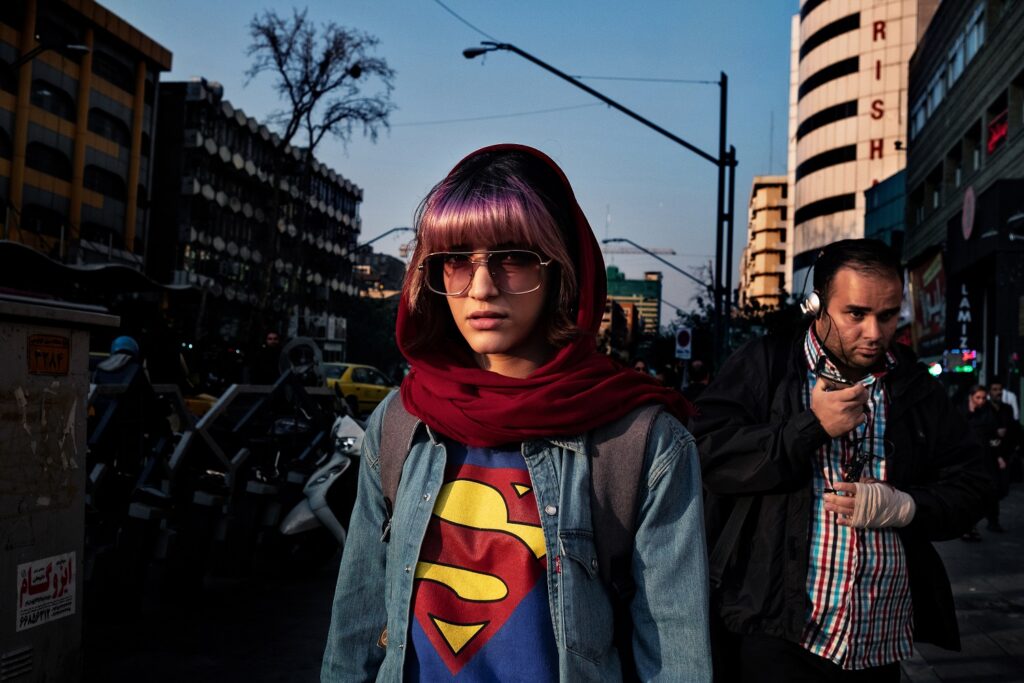
Blue-hour Tehran street: a young woman fills the frame in a dark red headscarf pushed back off a pink-dyed fringe, aviator glasses, denim jacket over a Superman T-shirt, looking flatly into the lens; behind her right shoulder a man with headphones holds a handset to his ear, one hand bandaged
Chosen, in a city where the choice is legible Run the test. The scarf is pushed back off a dyed fringe rather than worn forward, and the shirt under the denim is Superman — in a country where head covering is legally mandated that is not a costume, it is a position, held steadily down the lens. Two other things are doing work: the flash, fired at blue hour so she is lit at portrait quality while the sky keeps its colour; and the man on the handset behind her, who is the only reason this is a street photograph rather than a portrait made outdoors. Masoud Gharaei · Tehran · © the photographer, shown here for critical commentary · see more
Flash-lit frame at a pink-red ice cream van: a woman in grey stands hand on hip staring straight into the lens, while beside her a purple-haired woman kisses the cheek of a third person whose face is hidden inside a dusty-pink hood; the vendor watches from the serving hatch
Seen, and photographed anyway Three people at an ice cream van: one kissing the cheek of a friend entirely hidden inside a hood, one staring flat down the lens with a hand on her hip, and the vendor watching from the hatch. This was made from something like a metre and a half with a wide lens and a flash, so there was never a version where she did not know. Beginners treat being noticed as the failure. Here what she does with the noticing is the photograph. Danielle Houghton · Dublin · Observe Collective · © the photographer, shown here for critical commentary · see more
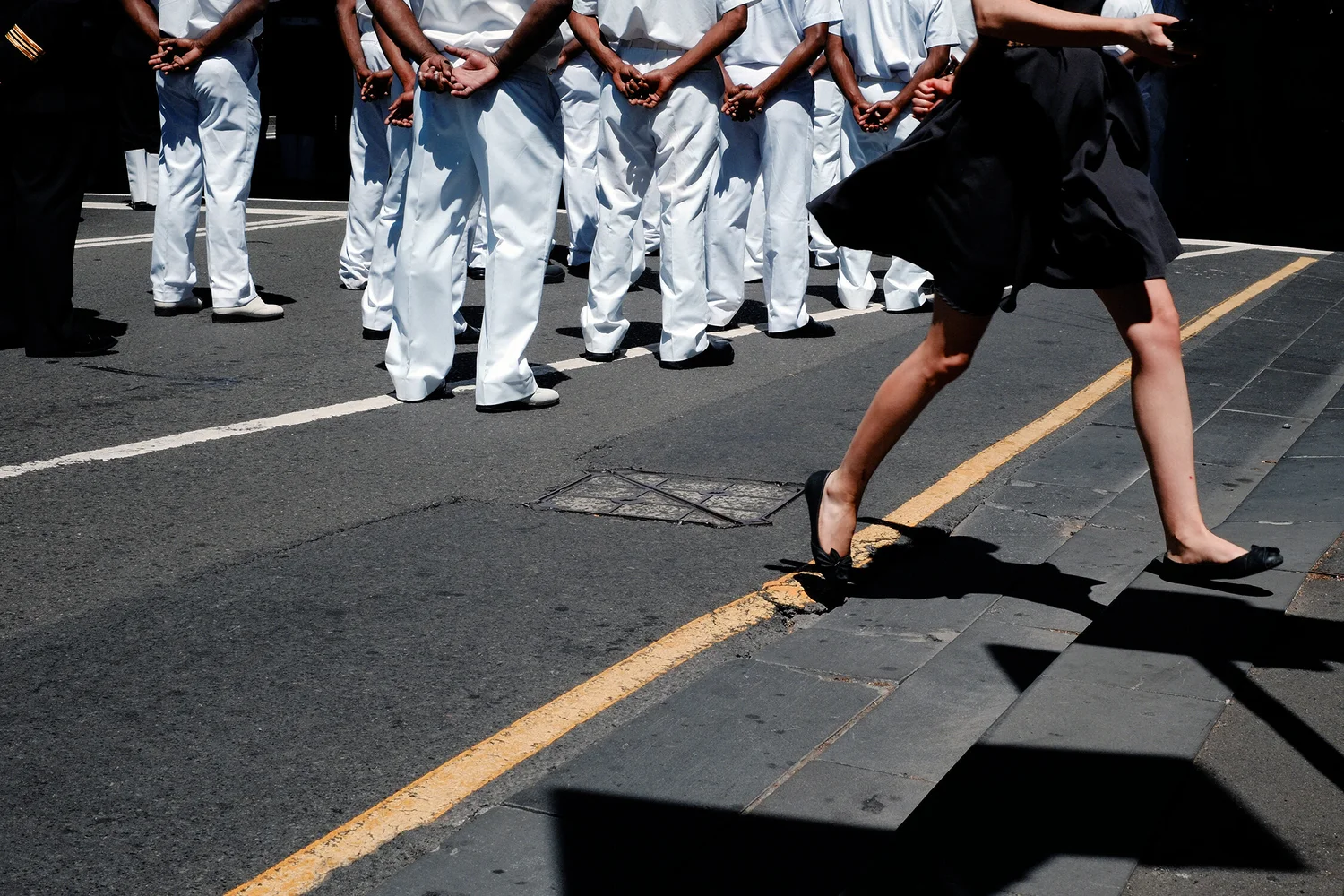
Harsh midday sun: a rank of sailors in white uniforms cropped off at the waist, hands clasped behind their backs, shadows pooled beneath them; at right a woman in a black skirt strides across a yellow kerb line, cropped at the shoulders, her shadow cutting a hard diagonal over the pavement
Where this lesson stops being true The honest counter-case. Ask the question — would the photograph change if she were someone else? — and the answer here is no, because she has been reduced to a black shape, two legs and one arm, cropped at the shoulders exactly like the rank of sailors she is passing. Ferris kept the white uniforms, the yellow kerb line and the midday shadow, and threw every face away. Subject-first is the rule; this is the case where identity is deliberately deleted so tone, line and shape can carry the frame alone. The mistake is not choosing one — it is doing the second by accident while believing you did the first. Sam Ferris · Sydney · © the photographer, shown here for critical commentary · see more
Chosen people, not passing figures
A streetcar motorman leaning out of his cab as the car moves
Carl Mydans · Street car motorman. Washington, D.C. · 1936 · LoC
Two people crossing a wet street past a Coca-Cola sign, seen from behind
Jack Delano · Street in a town in the Virgin Islands, Christiansted, St. Croix? · 1939 · LoC
Carry this

Pick the person first. Not “a person” — this person, because of the hat, the gesture, the load they’re carrying, the way light lands on them. Then let the background resolve second. If anyone could replace the subject, you built a stage again.

A busy sidewalk of shoppers passing storefronts, a woman with a bag walking toward the camera
Russell Lee · Street in the Negro section of Chicago, Illinois · 1941 · LoC
A row of onlookers in caps and hats seen in profile, all watching something out of frame
John Vachon · Spectators at fire, Washington, D.C. · 1937 · LoC
Two boys seen from behind, arms linked, studying a wall of painted cinema posters
Russell Lee · Mexican boys looking at movie poster, San Antonio, Texas · 1939 · LoC
Lesson 03

The peak, and pressing on meaning

A street photograph peaks: there is a half-second when gesture, glance and geometry converge. A frame that would look the same shot three seconds earlier or later is timing-agnostic — the definition of pressing on presence instead of meaning.

In practice §03 — blur has two causes

The “decisive moment” is a phrase Cartier-Bresson never chose — his 1952 book was Images à la sauvette, “images on the run”; the English title was the American publisher’s. What he actually defined is more useful: the simultaneous recognition, in a fraction of a second, of an event’s significance and of the precise organization of forms that expresses it. Moment and geometry converging — not moment alone, not geometry alone. A photographer arriving from landscape brings the second half already trained.

The instructive part of his most famous frame, Behind the Gare Saint-Lazare (1932), is how it was made: a pre-seen stage — puddle, ladder, ripples — shot through a gap in a plank fence so narrow it partially blocked the lens, fired essentially blind as the man leapt, and then cropped (by the no-crop purist himself) to remove the intruding fence. He hadn’t even noticed the leaping-dancer posters echoing the jump until afterwards. No superhuman reflex anywhere in that story: a stage, a bet on an arriving moment, and honesty in the edit. The test it leaves for any frame: does the picture collapse if the moment moves a half-second either way? If nothing collapses, nothing peaked.

Two women talk beside a baby carriage outside a corner tailor shop; one raises a hand mid-sentence
Annotation study — the gesture that peaked A conversation outside a corner tailor’s. The raised hand is the photograph: it marks the sentence’s emphasis, the exact syllable of the exchange. Drop the hand and the frame is two women standing near a pram — present, not peaking. The signage, the marble storefront and the pram were there for minutes; the picture existed for half a second. Russell Lee · Women with baby carriage, L Street, Washington, D.C. · 1938 · LoC

Anticipation is arithmetic, not talent

Measured mean simple visual reaction time in adults is about 230 ms (Woods et al. 2015, n ≈ 1,470), before adding shutter lag. A person at walking pace covers ~35 cm in a quarter second; a cyclist covers a metre and a half. So a peak gesture cannot be reacted to — only anticipated. Every decisive photograph was pressed before its moment, by a photographer who watched the approach and bet on the convergence. This is why the pre-composed stage isn’t the enemy — it is half the method. The missing half is choosing the moment the stage is for, then firing ahead of it.

A man in a long coat and hat strides past two small wooden storefronts, one lettered American Lunch
Pressed at the seam One walker, two frame-worn storefronts. The shutter fired as he crossed the seam between the buildings — a beat earlier he is lost against blank clapboard, a beat later he is out of the frame. Watch feet, not faces: a stride telegraphs its landing point a full step ahead, which is more warning than an expression ever gives. Russell Lee · Buildings, L Street, Washington, D.C. · 1938 · LoC

Practical consequences, all cheap: prefocus the zone (Lesson 01) so shutter lag is the only latency; watch hands and feet, not faces — gesture telegraphs sooner than expression; and when a scene has a repeating rhythm (a crossing light, a doorway, a shaft of sun), the rhythm is the anticipation, free of charge.

Two figures on a stoop: a top-hatted man in an overcoat bent fully double at the waist to speak to a small newsboy, who stands straight with papers under his arm
Boy selling newspapers The whole photograph is one posture. A man folded completely in half to reach a child’s eye level, the boy standing perfectly upright — a beat earlier or later it is two people on a step. Note what makes it readable: they are in profile against a plain wall, so the gesture reads as pure silhouette. Lewis Hine · Boy selling newspapers · c. 1910 · Wikimedia Commons · Public domain
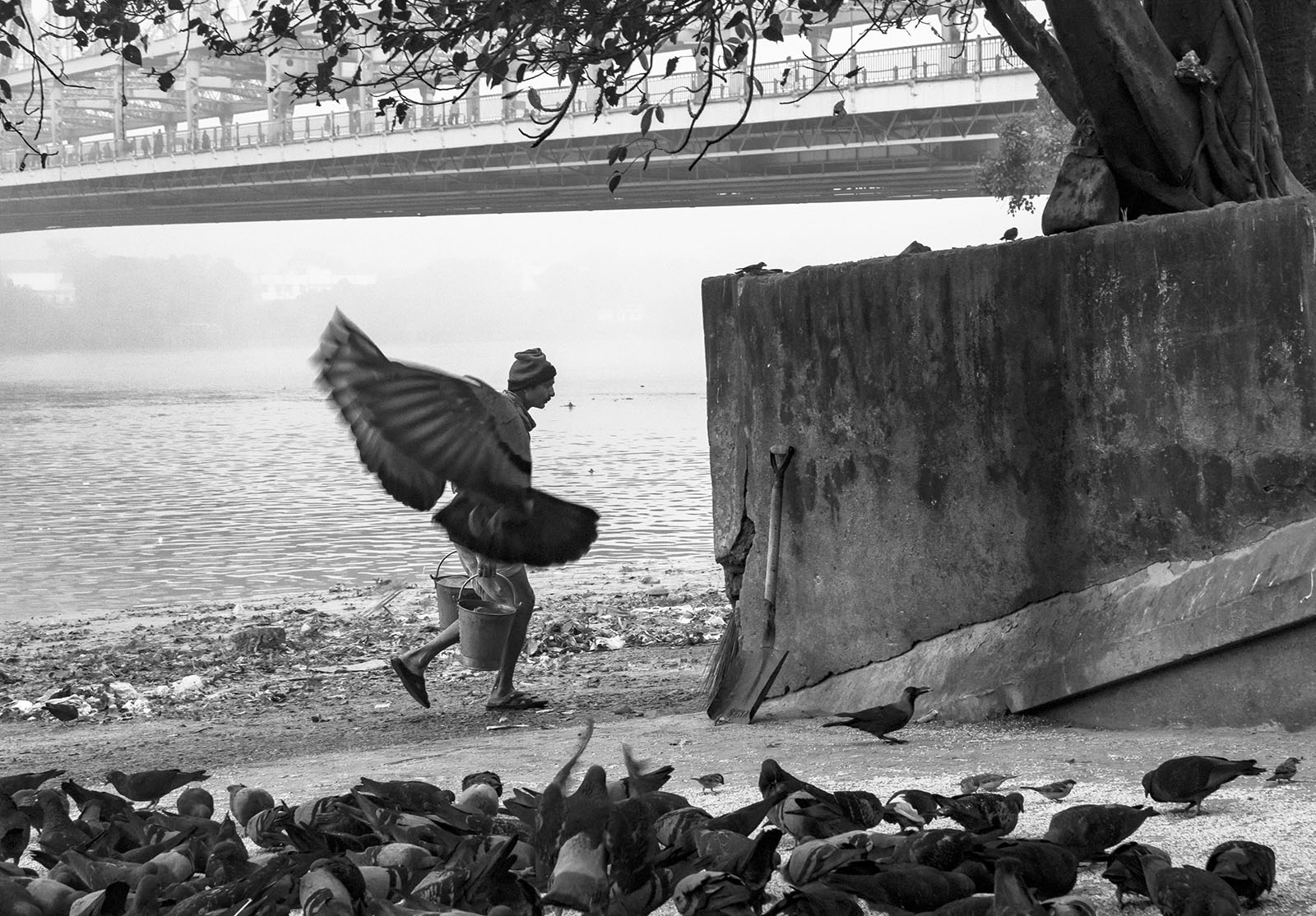
Misty morning under the Howrah Bridge: a man in a knit cap strides past carrying two buckets while a pigeon's outstretched wings, blurred with motion, align exactly over his shoulders so the wings appear to grow from his back; a carpet of feeding pigeons fills the lower third
The wings arrive on time The pigeon’s wingspan lands precisely across the walking man’s shoulders, so for one frame he sprouts wings. That alignment existed for a fraction of the 230 ms a reaction costs — it cannot be reacted to. Das works Kolkata’s crowded ritual spaces daily; this is what accumulated repetitions buy you, not luck. Debrani Das · Howrah Bridge, Kolkata · © the photographer, shown here for critical commentary · see more
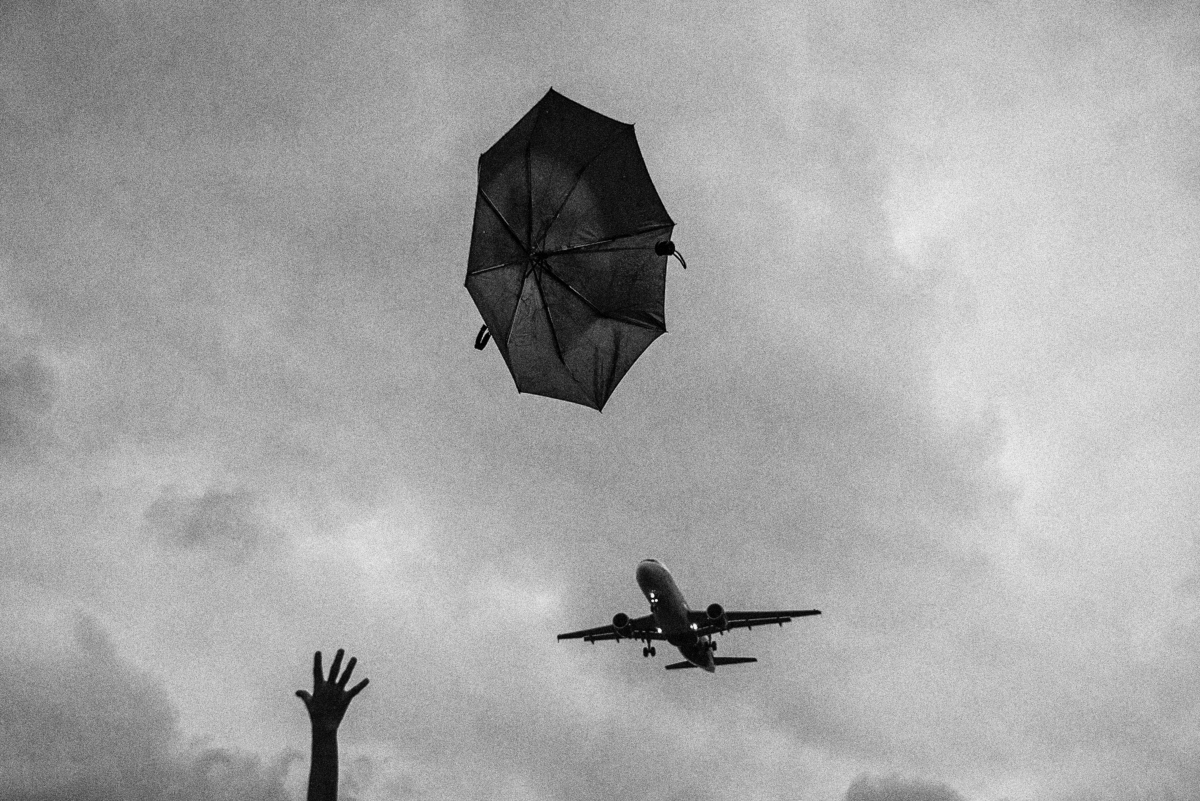
Black-and-white, looking up: a black umbrella tumbling loose and inverted against a grey sky, a bare hand thrust up from the bottom edge reaching for it, and an airliner on final approach below and behind
Three things, one instant A dropped umbrella, a hand reaching, an airliner on approach — three unrelated things locked into one arrangement that lasted perhaps a fifth of a second. The umbrella is already past catching, which is what gives it the tension. Ghosh shoots Hyderabad, deliberately away from the Delhi and Mumbai scenes. Swarat Ghosh · Hyderabad, from Beyond Street · © the photographer, shown here for critical commentary · see more
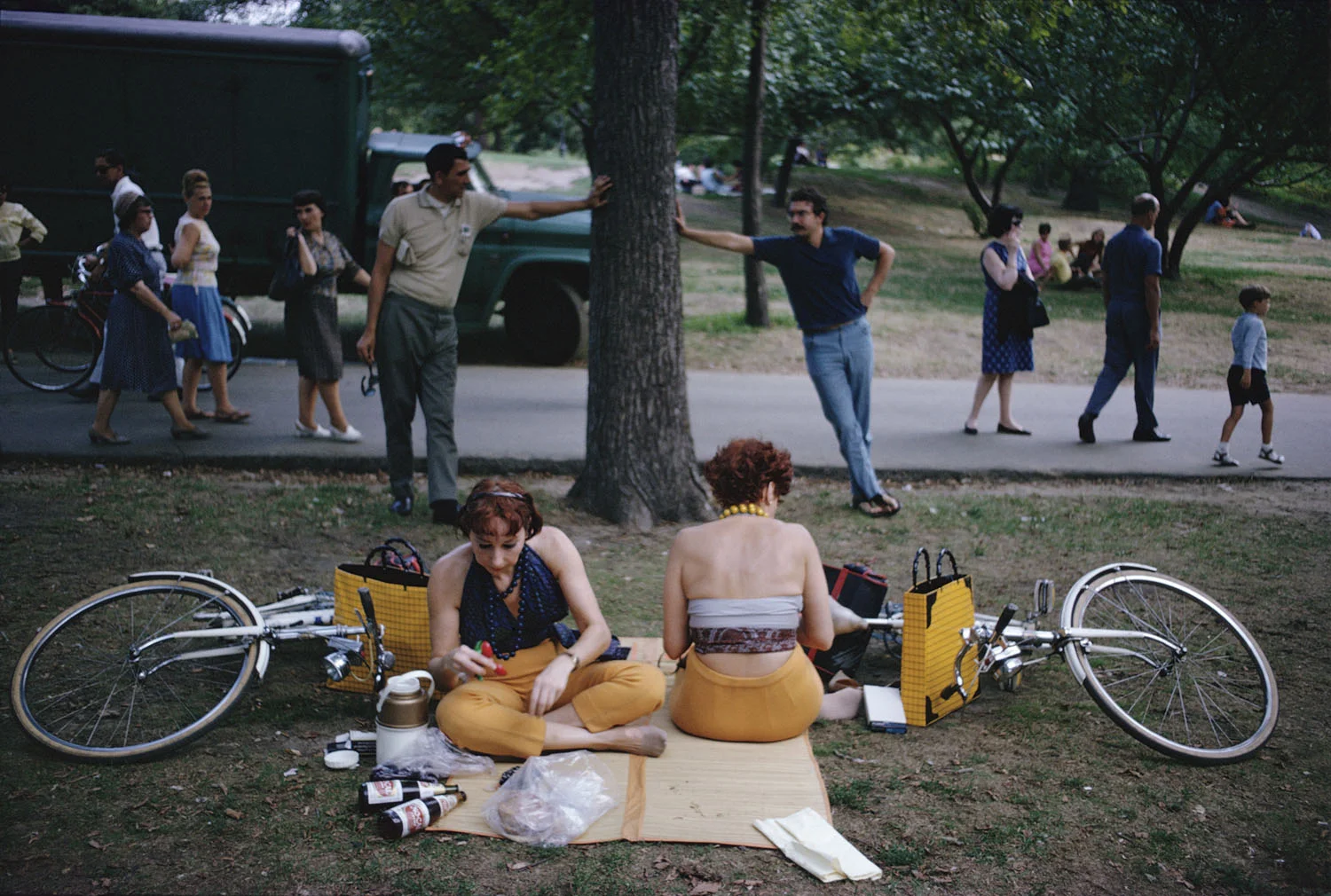
Two women in mustard-yellow trousers sit on a straw mat in a park with bicycles laid flat on the grass either side of them like wings; behind on the path, two men each brace a hand against a tree trunk in near-identical poses, with a truck, a boy and scattered pedestrians beyond
Several things peaking at once Meyerowitz’s method is to accept a busy frame rather than isolate a subject, and fire when the separate pieces of business align. Here: the bicycles laid flat like wings either side of the seated women, and behind them two unconnected men bracing a hand on a tree in the same posture. Neither rhyme survives a second either way. Joel Meyerowitz · New York, 1966 · © the photographer, shown here for critical commentary · see more
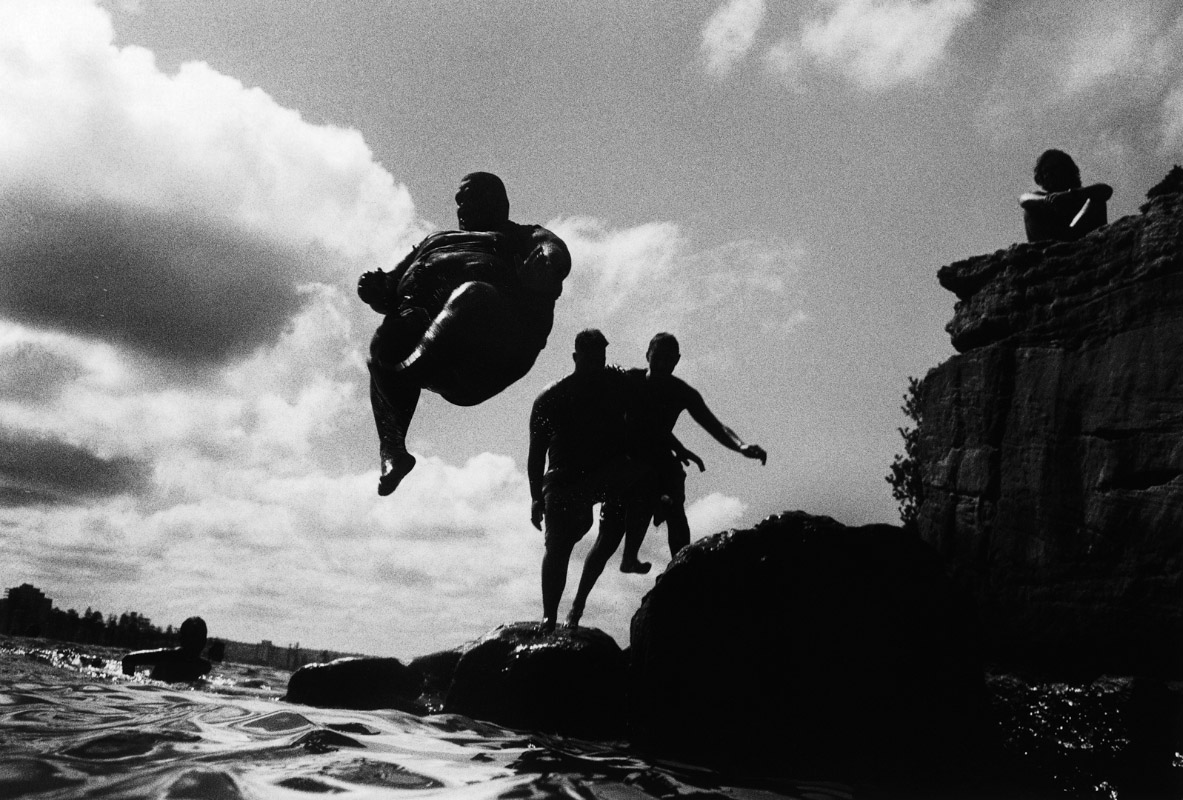
Shot from water level: a heavyset man in board shorts caught mid-air in a tucked bomb-dive off a rock shelf, fully silhouetted against cumulus cloud; two more figures wait to jump, one sits on the headland, and a swimmer's head breaks the foreground water
The apex, from in the water Autio got in the water and shot up from surface level, which is why the diver reads as a silhouette against cloud rather than against rock. The body is at the top of its tuck — the one frame in the sequence where it is neither falling nor pushing off. Everything else in the frame is people waiting to do the same thing. Narelle Autio · from The Seventh Wave, 2004 · © the photographer, shown here for critical commentary · see more
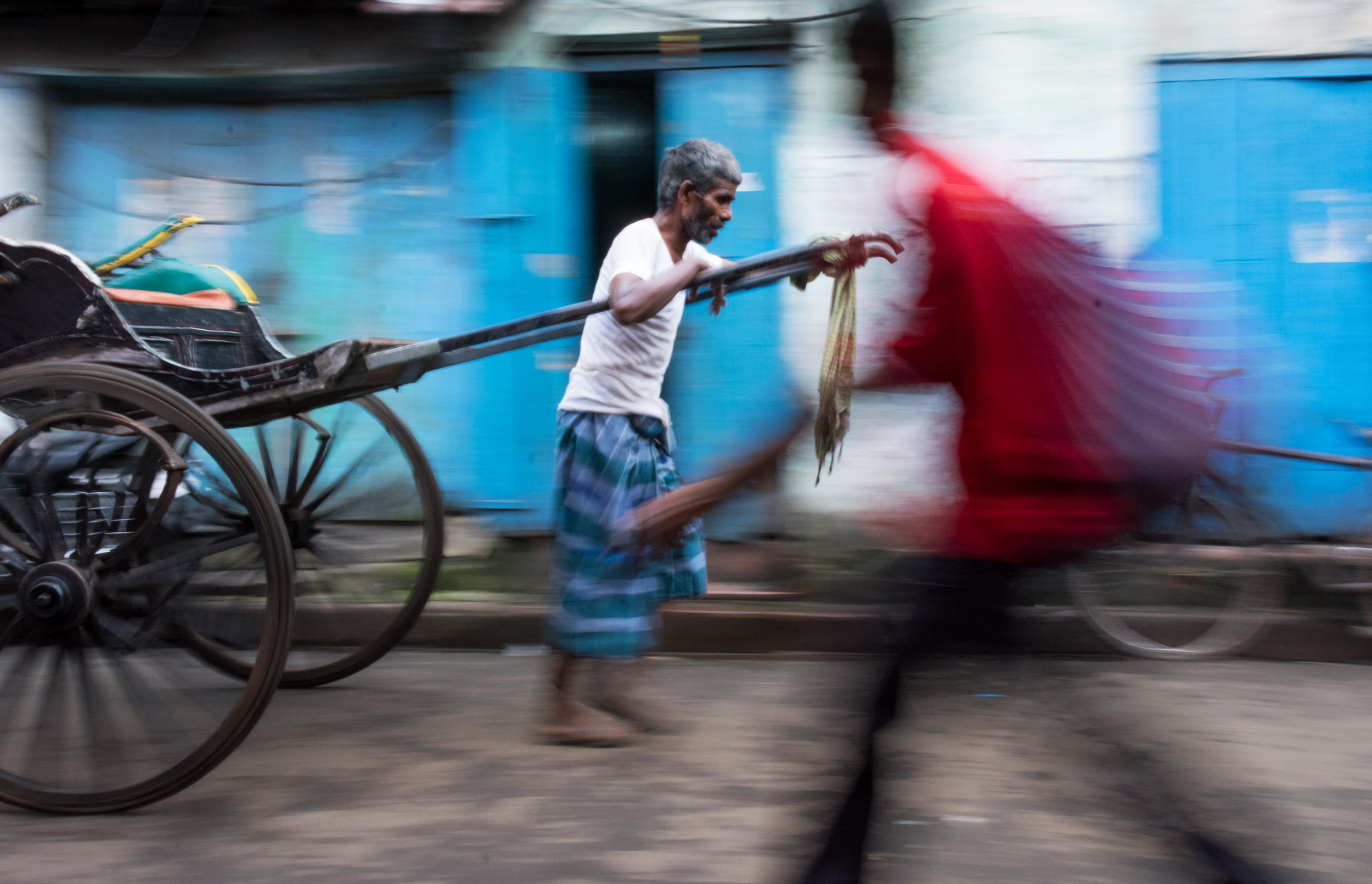
Colour panning shot: a grey-haired rickshaw puller in a vest and check lungi hauls a wooden hand-pulled rickshaw, everything smeared except his face, while a woman in a blazing red sari sweeps through the right of the frame as pure motion blur against a wall of cyan-blue shutters
Blur as a decision, not a substitute Lesson 03 earlier dismissed a dragged shutter that marked only that someone moved. This is the opposite case and worth the comparison. Bera panned with the puller so his face stays sharp while the street, the shutters and the woman in red all tear past — the blur is carrying the labour of the pull, which is the subject. The technique is identical; the intent is not. Sarmistha Bera · Kolkata · winner, Street Photography International Awards 2019 · © the photographer, shown here for critical commentary · see more
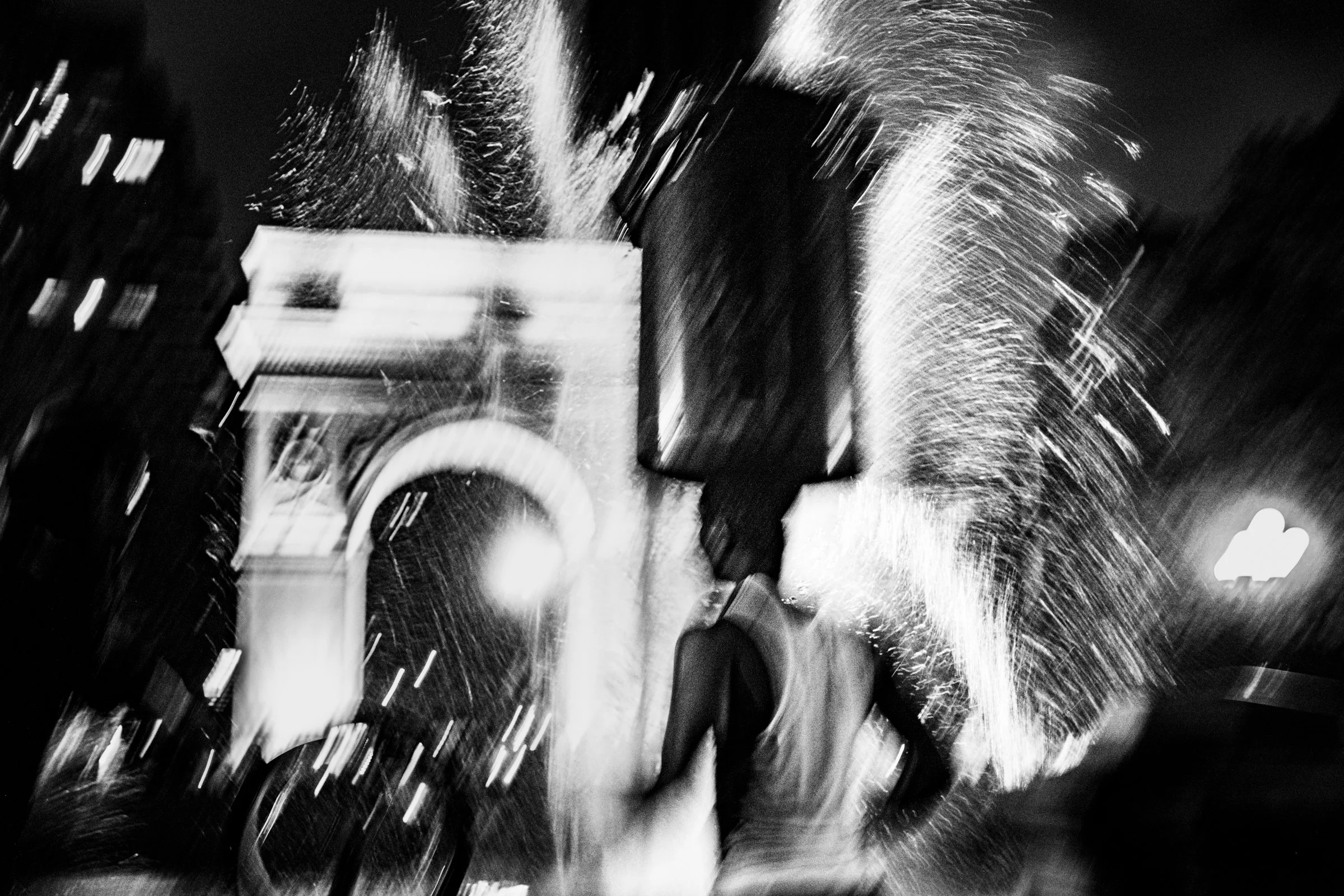
Wild long-exposure night frame in black and white: the Washington Square arch tilted and streaked, fountain spray exploding into white filaments, a dark performer's body swinging through the right half
When the frame is the movement A whip-pan at night: the arch tilts, the fountain becomes filament, a performer swings through as a dark mass. Nothing here is sharp and nothing needs to be, because the subject is the motion itself rather than a person caught inside it. Samanta came to this from twenty years in computer science — worth knowing that the route in does not have to be photographic. Roopsha Samanta · Washington Square Park, New York · Women Street Photographers, Spain 2026 · © the photographer, shown here for critical commentary · see more
The Giza plateau in dust haze: at left a man stands with a camera to his face, centre a man is caught fully airborne with his arms folded, below him another is doubled over with his head to the sand, and at right a boy hauls on a jacket; two saddled black horses stand between them and three pyramids rise behind
Everyone mid-something Four peaks at once. A man with a camera to his face, a man fully airborne with his arms folded, a man doubled over with his head in the sand, a boy hauling on a jacket — and two horses standing patiently through all of it. The fifth marked box holds the most photographed structures on earth, sitting inside the frame doing none of the work. Every event here would have collapsed within a second, and none of them is the pyramids. Laith Majali · Giza, 2018 · from The Arab Street Vol. II · © the photographer, shown here for critical commentary · see more
Three adults in full Spider-Man morphsuits stand backs-to-camera at a McDonald's counter while two customers in shorts and flip-flops order beside them, entirely unbothered
Nobody reacting is the picture Three grown adults in full Spider-Man suits queuing at a McDonald’s, and the two people beside them ordering as though nothing is happening. The peak here is not a gesture, it is an absence of one — and the frame dies the moment somebody turns to look. Kantaya New · Singapore · © the photographer, shown here for critical commentary · see more
Gesture, caught and missed
A boy in a straw hat stands hands-on-hips among tethered horses and men
Marion Post Wolcott · Mountaineers and farmers trading mules and horses on "Jockey St.," ne… · 1939 · LoC
Men and horses on a sloping lot, a boy in blue standing at the centre
Marion Post Wolcott · Mountaineers and farmers trading mules and horses on "Jockey St.," ne… · 1939 · LoC
A street in the Mexican district of San Antonio, figures along the storefronts
Russell Lee · Street scene in Mexican district of San Antonio, Texas · 1939 · LoC
When the moment became photographable
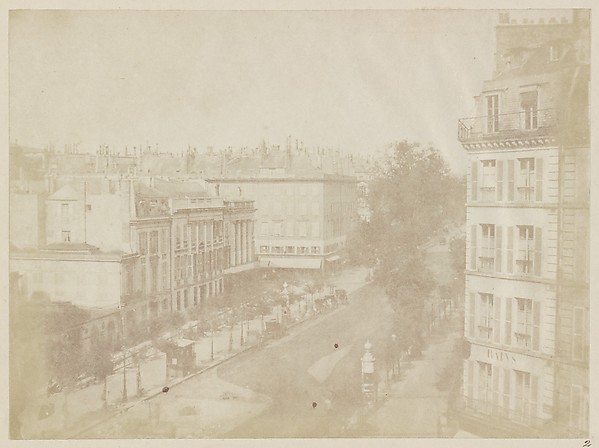
A hazy 1843 view along a Paris boulevard from an upper window — carriages and trees, no legible people
William Henry Fox Talbot · View of the Boulevards at Paris · May 1843 · photogenic drawing · The Met, public domain
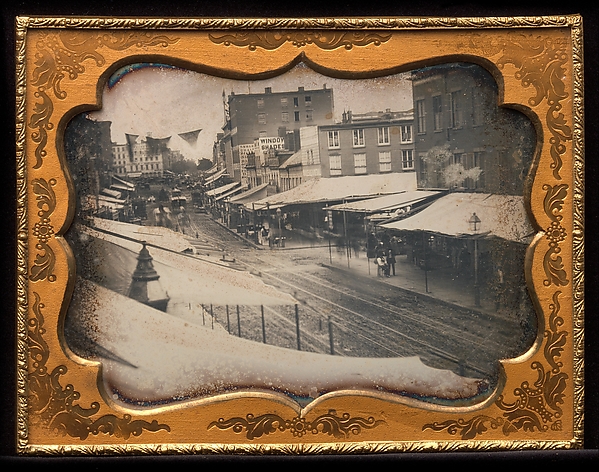
An 1850s daguerreotype of Chatham Square, New York — awnings, banners, the street nearly empty of readable figures
Unknown · Chatham Square, New York · 1853–55 · The Met, public domain
A stereograph of Broadway in the rain around 1860: umbrellas, carriages and pedestrians stopped mid-step
Edward Anthony · Broadway in the Rain, likely taken from 308 or 310 Broadway, Ne… · ca. 1860s · stereograph · The Met, public domain
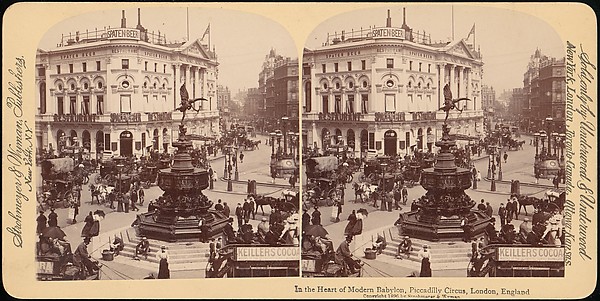
An 1890s stereograph of Piccadilly Circus packed with omnibuses, hansom cabs and walkers, every figure sharp
Strohmeyer & Wyman · In the Heart of Modern Babylon, Piccadilly Circus, London, England · 1850s–1910s · stereograph · The Met, public domain
Carry this

Before pressing, name what is about to happen — “she’ll reach the light,” “he’ll look up,” “the dog will pull.” If you can’t name an about-to, you are photographing presence — and presence is the one thing every flat street frame already has.

Lesson 04

Fishing, not hunting

Working a scene for 2–5 frames and moving on is hunting. Street winners come from standing in one worked spot for 20–40 frames while the scene re-deals itself — fishing. The contact sheets of the masters are the proof: the keeper sits in a thicket of near-misses that paid for it.

In practice §07 — working a scene

The published Magnum Contact Sheets (139 sheets, 69 photographers) put numbers on it. René Burri exposed eight rolls in one Havana interview for the Che portrait everyone knows. Richard Kalvar worked a Rome piazza and got his picture on the last frame of the roll. Bruce Gilden says he can go fifty rolls without a good photograph. Robert Frank shot 767 rolls for The Americans and published 83 frames — a 0.3% keep rate. The name for the method is on record too: Matt Stuart calls it fishing — compose the stage, then wait for the street to deal into it. Alex Webb, who stands in Caribbean heat for hours to stack four elements into one frame, put the whole genre in seven words: “Street photography is 99.9 percent about failure.”

Kodachrome from an upper window: a corner grocery with Coca-Cola signs, snow tracks in the intersection, a blurred pedestrian
The stage, seen as a stage A corner market from an upper window, snow recording every path taken through the intersection like a contact sheet printed on the street. The lone pedestrian is motion-blurred — proof the cast changes by the second while the stage holds still. Stand here for an hour and the corner deals a new hand every crossing cycle. Jack Delano · Street corner, Brockton, Mass. · 1939 · LoC
Kodachrome of a tea room on a wet corner at dusk, two figures waiting under the signs
The fish arrive on their own schedule Wet pavement, lit signage, and two figures who happened to pause under the marquee lines. Every element except the people is permanent — which is exactly why the frame rewards waiting. The photograph improves or dies with whoever stops there next; forty frames from this position are forty different photographs. Jack Delano · [Sylvia Sweets Tea Room, corner of School and Main streets, Brockton… · 1939 · LoC

David Hurn’s On Being a Photographer describes what the best contact sheets look like: the photographer commits to a position, then frames build to a crescendo where a gesture or arrangement signals the picture — or the sequence dies because the event collapsed. His own method for a single beach photograph: fix the angle, find the precise distance, then shift six inches sideways, shooting frames, because only the contact sheet shows which one aligned. The counter-case is real and worth knowing: Martine Franck got four frames of a boy in a hammock before he noticed her and the picture died. Some windows are forty frames wide, some are four — the discipline is staying until the window itself closes, not until boredom arrives.

Why 2–5 frames feels finished (and isn’t)

The landscape instinct says a composition, once found, is done — the mountain will not improve on frame six. That instinct is correct for mountains and wrong for streets: the composition is only the stage, and on a street the cast changes every ten seconds. Two frames sample two casts from a distribution; forty frames sample the distribution.

The discipline has a debrief side too. Reviewing forty frames from one spot teaches more in ten minutes than forty spots teach in a month, because every variable is controlled except the one that matters — the moment. That review is where “what was I waiting for?” gets an answer in your own handwriting.
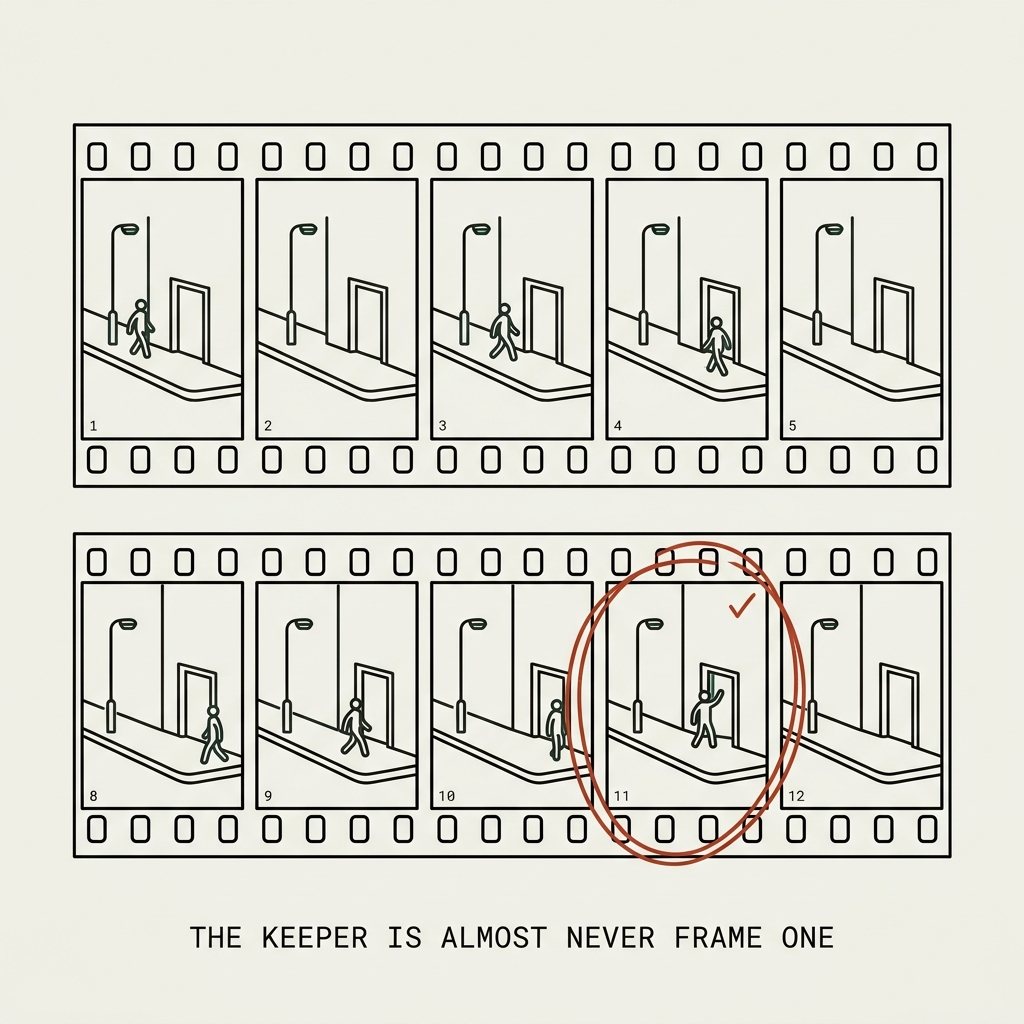
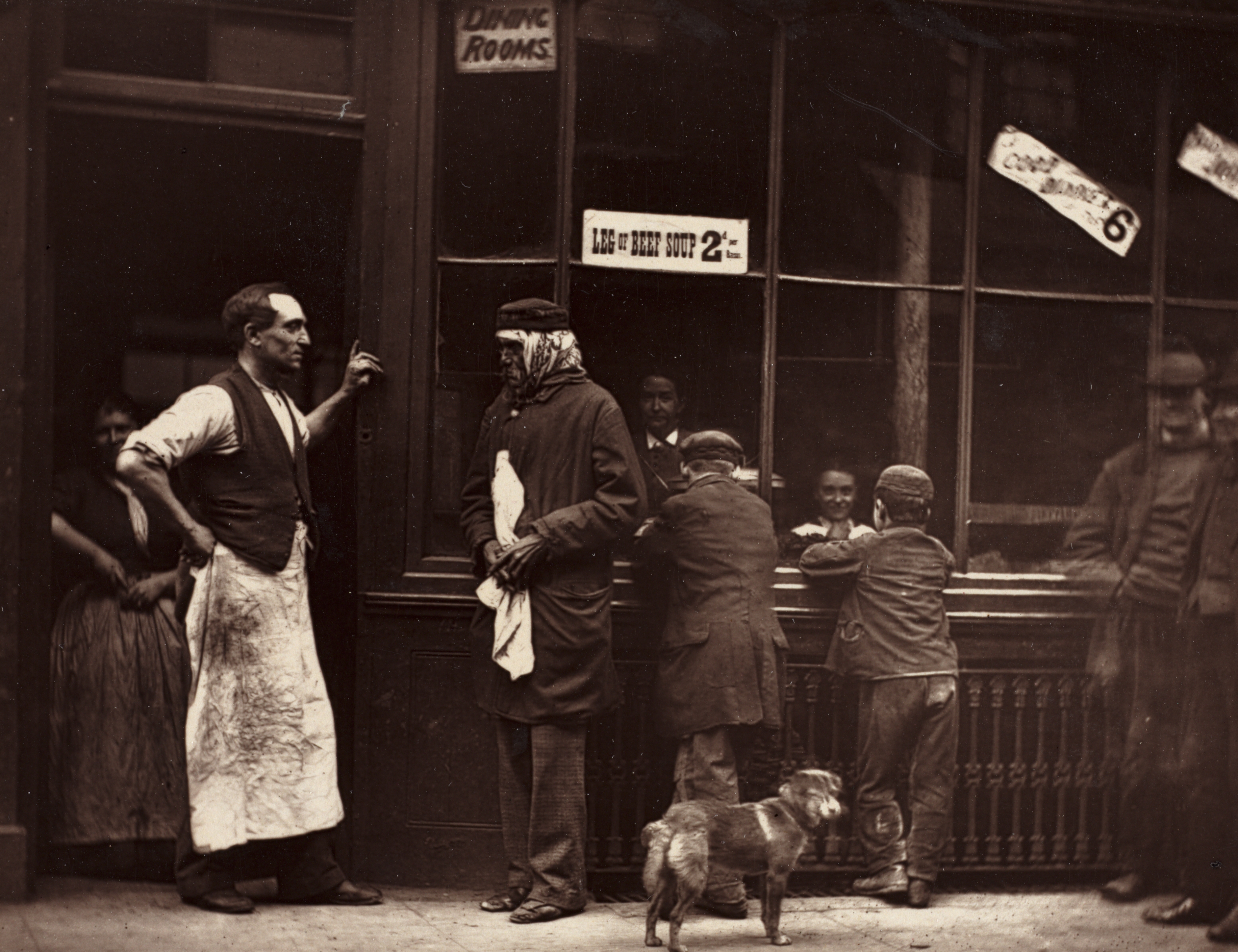
Diagram of two 35mm contact-sheet strips, the same street corner in twelve frames with a walking figure in a different position each time, frame eleven circled in red grease pencil
What a worked scene looks like on the sheet The stage is identical in all twelve frames. Only the cast moves — and only one frame has the picture in it. Diagram drawn for this guide
A butcher in a bloodied apron raises a finger mid-argument outside a dining rooms; a second man in a shawl stands listening, two boys press against the window rail, a dog stands in the foreground
A Convict’s Home, from Street Life in London Thomson was doing this in 1877, which is the point: five separate pieces of business — the raised finger, the listener, the boys at the rail, the faces inside the glass, the dog — in one frame, at a shop he clearly worked for some time. The exposures were long enough that everybody had to hold still, so this is a worked scene in the most literal sense. John Thomson · A Convict’s Home, from Street Life in London · 1877 · Cleveland Museum of Art · CC0
Ground-level frame: a pigeon strutting across paving in sharp profile, behind it the black-trousered legs of walkers mid-stride against a pale stone wall
Trafalgar Square, 2006 The museum caption records the method exactly: he aimed at people’s legs and waited, and a pigeon strutted past at the right moment. Everything except the bird was pre-composed — camera low, backdrop chosen, focus set. The keeper arrived because he was still standing there. Matt Stuart · from All That Life Can Afford · © the photographer, shown here for critical commentary · see more
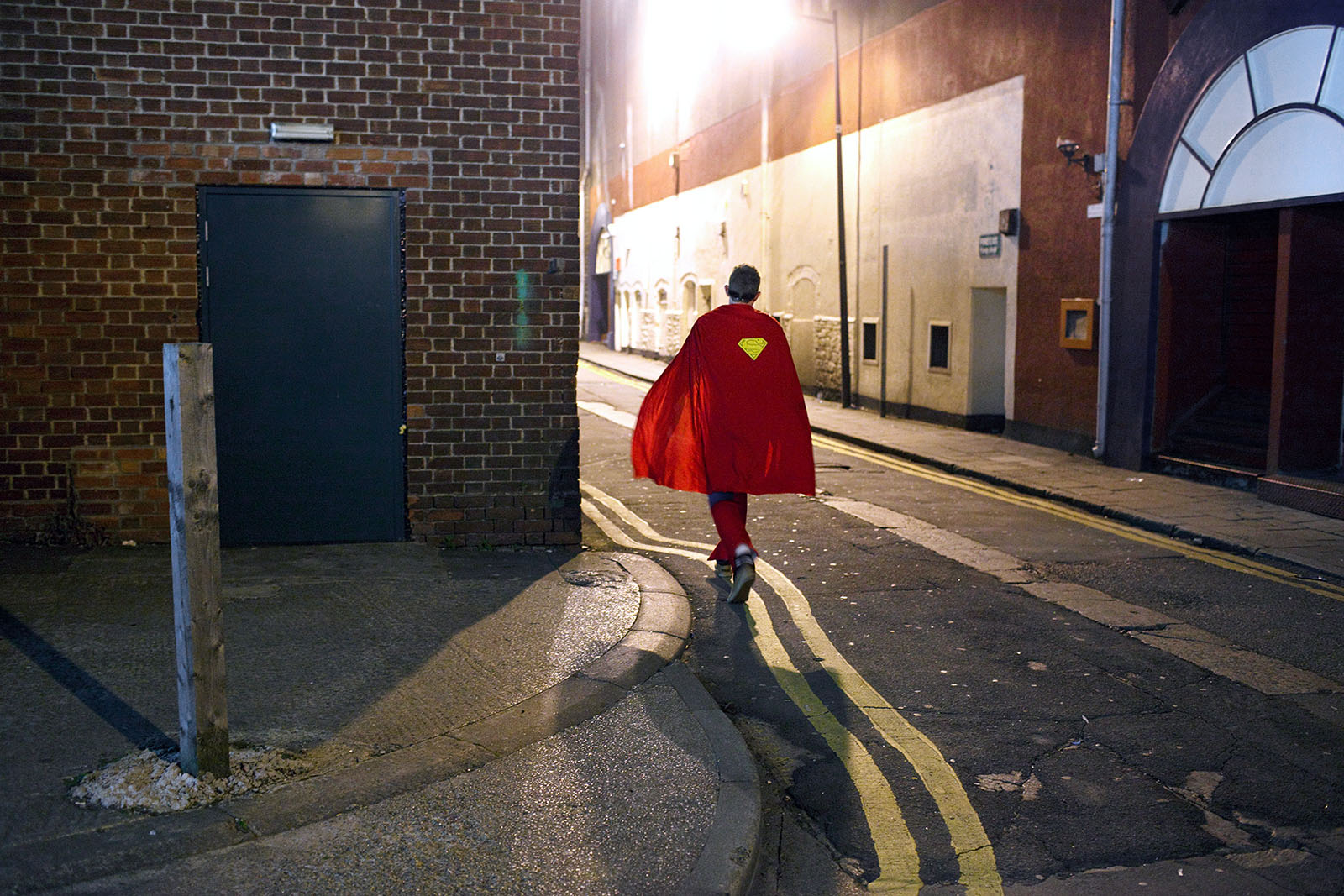
Night street: a man in a Superman cape walking away up an empty road between brick and painted walls, a streetlight flaring behind him, double yellow lines running past
Six years, one street Dakowicz photographed the same few hundred metres of St Mary Street on the same nights of the week for six years. That is why he was standing here when a man in a cape walked away up an empty road under a flaring streetlight — not luck, tenure. The kerb, the double yellow line curving in from the bottom of the frame and the lit wall at the end of it were there every one of those nights; the cape was not. Maciej Dakowicz · from Cardiff After Dark, 2012 · © the photographer, shown here for critical commentary · see more
Straight down onto a faded red pickup truck on a highway; four workers lie in the open bed under a grey plaid blanket, three faces visible and one man shielding his eyes, the driver's arm hanging out of the window
One overpass, hundreds of frames Cartagena stood on a single pedestrian bridge over one Monterrey highway and pointed straight down, over and over, for two years. The method is the fishing lesson taken to its logical end: the stage never changes at all, so every variable except the cast is eliminated, and the series becomes an argument rather than a picture. Same bridge, same lane markings, same overhead angle in all of them; what moves is who is lying in the bed and how. Alejandro Cartagena · from Carpoolers, 2011–12 · © the photographer, shown here for critical commentary · see more
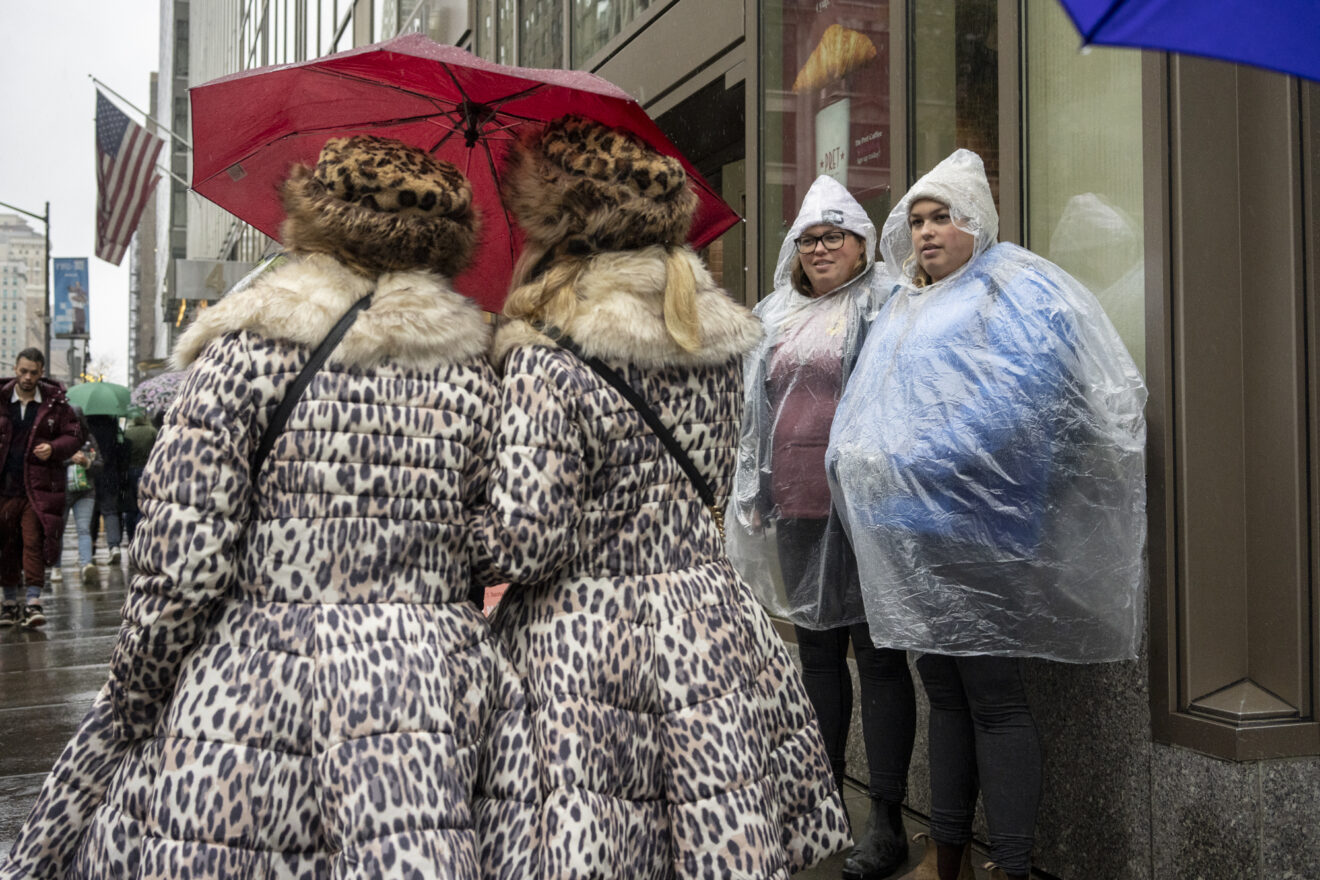
Two women seen from behind in matching leopard-print puffer coats and leopard fur hats under a single red umbrella, facing two more women in transparent plastic rain ponchos against a wet Fifth Avenue storefront
Thirty or forty minutes, one corner Her stated method: plant yourself on a good corner and let the city come to you. This is what that produces — two women dressed identically in leopard meeting two women dressed identically in clear plastic, under one red umbrella in the rain. You cannot look for that. You can only be standing somewhere long enough for it to walk in. Melissa O’Shaughnessy · Fifth Avenue, New York · © the photographer, shown here for critical commentary · see more
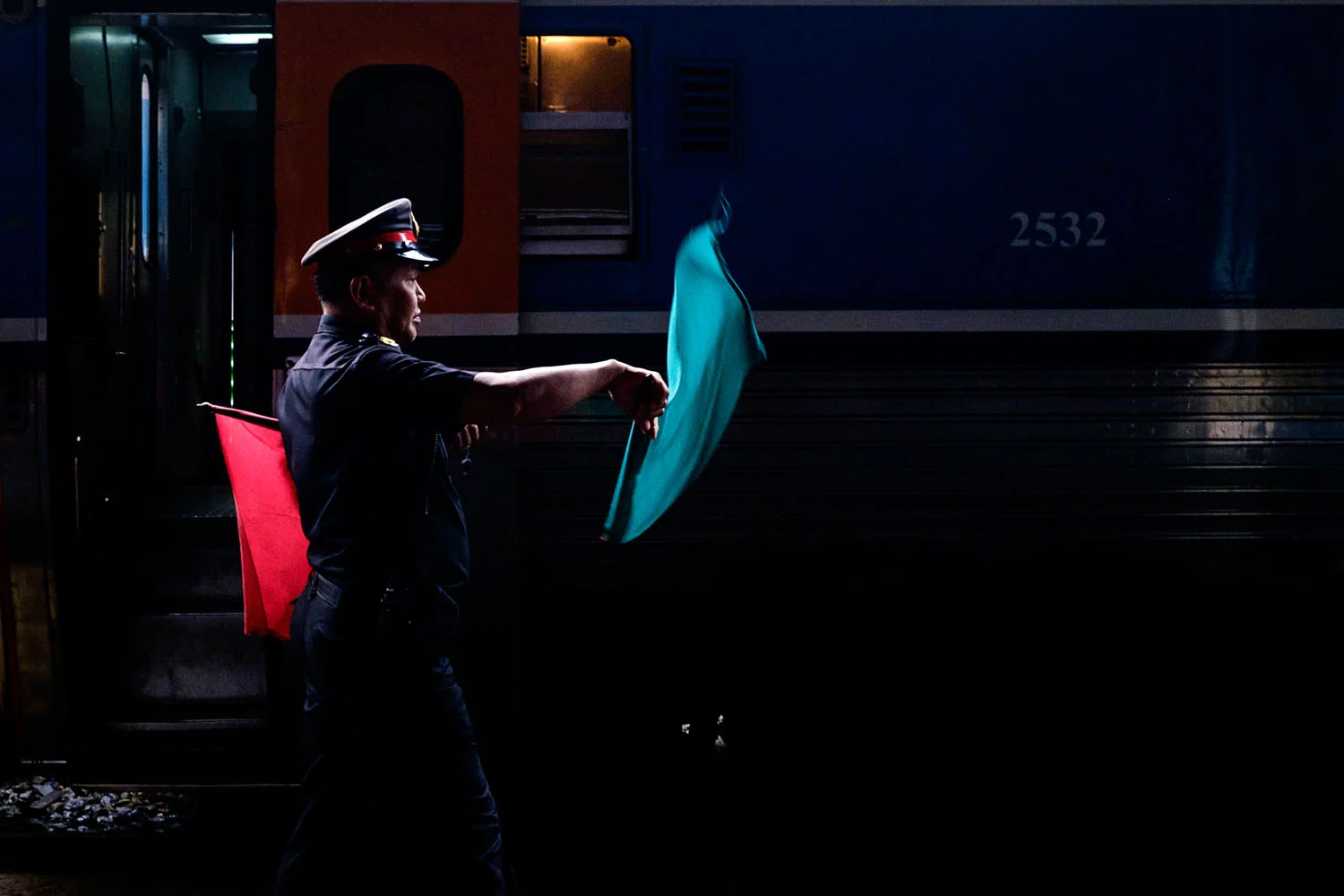
Near-black night frame on a railway platform: a guard in a peaked cap stands in profile inside a narrow band of light, one arm thrust out holding a turquoise flag caught mid-flutter and a red flag tucked under the other arm, against a deep blue carriage stencilled 2532 beside a slab of orange doorway
Six months, one platform, twenty minutes a day Narula made Platform 10 at Bangkok’s Hua Lamphong station over six months, working a single platform during the daily twenty-minute stop of a three-carriage train. That is a fishing spot narrowed to an appointment. What the repetition buys is visible in the exposure: he already knows precisely where the one usable band of light falls and how little else on that platform is lit, so he can give nine tenths of the frame to black and wait for a guard to walk into the remaining tenth. You cannot compose this on arrival — you can only know it. Rammy Narula · Hua Lamphong, Bangkok, from Platform 10 · © the photographer, shown here for critical commentary · see more
One town, one afternoon: an archive contact sheet
A crowd on a brick corner in the sun, one man holding an accordion
Marion Post Wolcott · Farmers and townspeople in center of town on Court Day, Compton [i.e… · 1939 · LoC
Townspeople clustered on a corner, long shadows across the dirt street
Marion Post Wolcott · Farmers and townspeople in the center of town on court day, Campton, Ky. · 1939 · LoC
Men gathered on the sidewalk under a store awning
Marion Post Wolcott · Farmers and townspeople in town on Court day, Campton, Ky. · 1939 · LoC
A wagon in the foreground, a crowd and horses beyond a shed
Marion Post Wolcott · Mountaineers and farmers trading mules and horses on "Jockey St.," ne… · 1939 · LoC
Carry this

One block, one hour, one hundred frames. The urge to move on arrives around frame four — treat it as the signal that the actual work is starting, not ending.

Lesson 05

Layers: the loaded frame

A layered street photograph is several photographs that agree: one event in the foreground, another in the middle distance, a third on the far plane — each readable, none colliding. Layers are what the wide lens’s 13-metre background slice is for.

This is Alex Webb’s territory. His frames stack three and four elements deep — a shoulder entering one edge, a dog mid-frame, children against a far wall — and every plane holds something deliberate. The method behind it is the sum of the last four lessons: wide lens (the deep slice), close position (the planes separate), a worked spot (the elements accumulate), and patience for the half-second when all of them peak at once. Which is why he calls the genre 99.9 percent failure: the more planes you load, the more ways the frame can miss.

The optics make layering a wide-lens monopoly. At 35mm-e from 2.9 m, a face at 1 m renders three times the size of a face at 3 m — the planes separate by size, and the eye reads depth without being told. At 300mm-e from 25 m, a face at 24 m and a face at 27 m render within a few percent of each other: the planes fuse, and layering is geometrically impossible. Compression doesn’t stack layers; it deletes them. And zone focus at f/8 (Lesson 01) keeps two or three planes acceptably sharp at once, so the layers you compose are the layers you get.

An elderly man in a homburg hat stands at a shop window; two women stand behind him at the glass; farther back, pedestrians and cars on the avenue
Annotation study — three planes, one frame Foreground: a face close enough to show the stubble under the hat brim. Middle: two women at the shop glass, one meeting the lens. Far plane: walkers, cars, a full city block. Each plane is a complete event, and the size gradient — huge, half, small — is the depth. Cover any one plane with a thumb and the other two still make a photograph; that is the test of a layer that earns its place. John Vachon · Street scene, Washington, D.C. · 1937 · LoC
Overhead Kodachrome of women and girls in Sunday dresses descending street steps through a lattice of tree shadows
Layered by light From above, the planes are drawn by shadow instead of size: a dark lattice across the foreground, the group in sun mid-frame, the stair wall closing the top. The one red dress does what a foreground does at eye level — it starts the eye’s route through the stack. Jack Delano · Street scene, Christiansted, St. Croix island, Virgin Islands? · 1939 · LoC
View from a brownstone stoop past an ironwork rail and an illuminated cross sign, down a long tenement street
The near edge is a layer too Shot past a stoop rail and a hanging cross sign, so the viewer stands on the steps instead of floating over the street. The near-edge material isn’t clutter — it is the plane that places you. Webb’s frames do this constantly: something at arm’s length, deliberately admitted, so the depth starts at your chest instead of at the curb. Gordon Parks · New York, New York. A Harlem street scene · 1943 · LoC

Edge discipline is the layering skill that does not show in the final frame. With three planes live, every frame edge is cutting through something; the craft is choosing what gets cut and where. Webb’s edges tend to amputate at joints — a shoulder, a hat brim, a door jamb — rather than mid-face. The rule of thumb: an edge may crop a thing, but it shouldn’t decapitate an event.
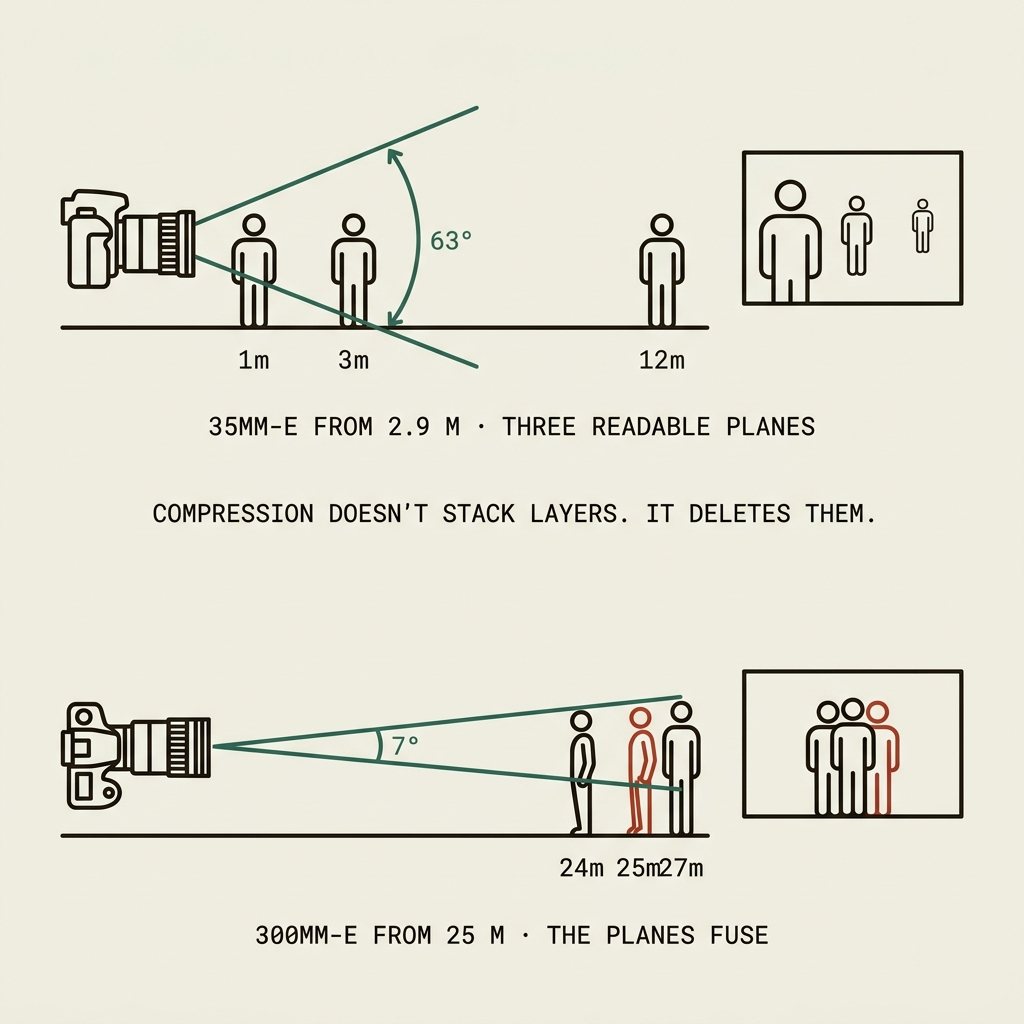
Side-elevation diagram comparing a 35mm lens at 2.9 metres, whose wide cone renders three figures at markedly different sizes, with a 300mm lens at 25 metres, whose narrow cone renders three figures at almost identical size
Why layering is a wide-lens monopoly Top: three planes at 1, 3 and 12 metres render huge, medium and small — depth the eye reads without being told. Bottom: three planes at 24, 25 and 27 metres render within a few percent of each other and fuse into one mass. Diagram drawn for this guide
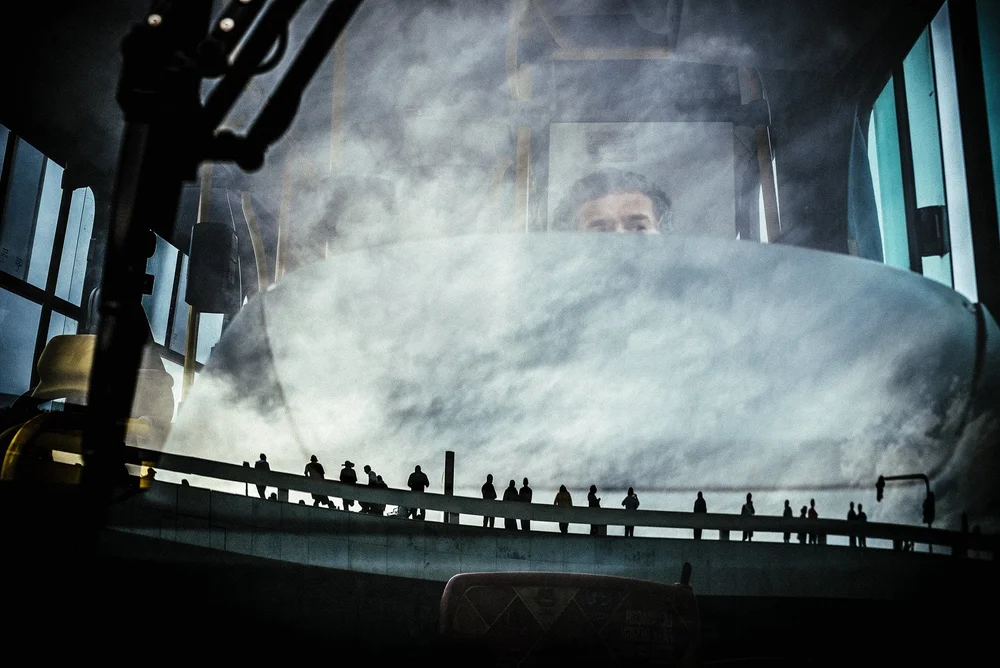
A bus driver's face, lit and half-swallowed by reflection, seen through a windscreen that mirrors an enormous cumulus cloud filling the whole glass; a row of tiny black commuter silhouettes walks a raised rail along the bottom third
Three planes, one sheet of glass The driver is behind the windscreen, the cloud is reflected on its surface, and the commuters are in front of it — three depths stacked into a single pane. Glass is the cheapest layering device on any street: it holds what is behind and what is in front simultaneously, which is the effect Lesson 05 otherwise needs physical distance to build. Gustavo Minas · Brasília bus station, from Rodoviária · © the photographer, shown here for critical commentary · see more
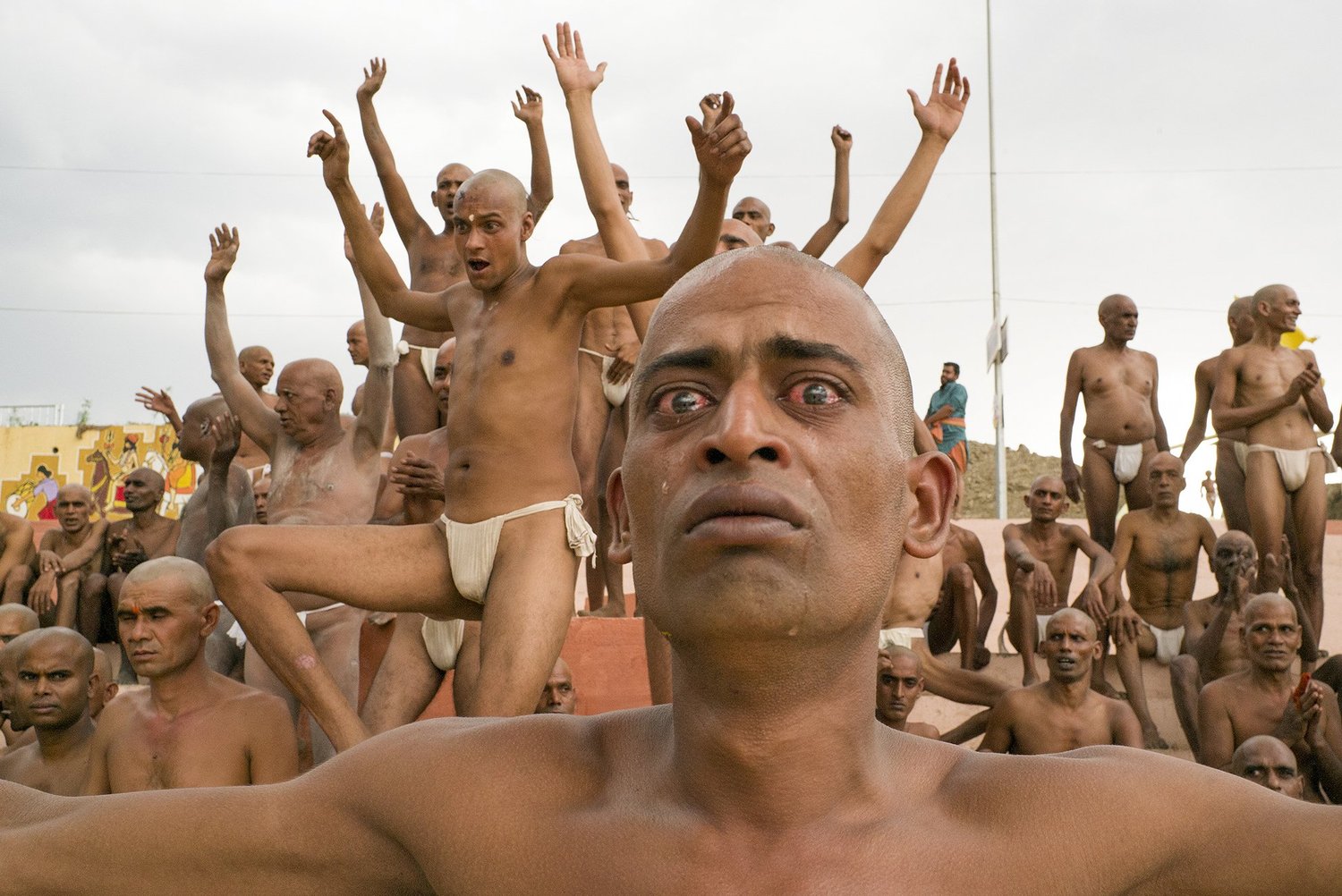
A mass initiation rite: dozens of shaven-headed men in white loincloths with arms flung upward, and in the immediate foreground one man's face fills the frame, eyes bloodshot and streaming, a tear on his cheek
A face at arm’s length, a rite behind it Foreground: one face close enough to show the tear. Middle and far: dozens of raised arms receding. The size gradient does all the work — and the frame only holds together because he was near enough for that first plane to dominate. Back up three metres and it flattens into a crowd shot of a ceremony. Vineet Vohra · New Delhi · © the photographer, shown here for critical commentary · see more
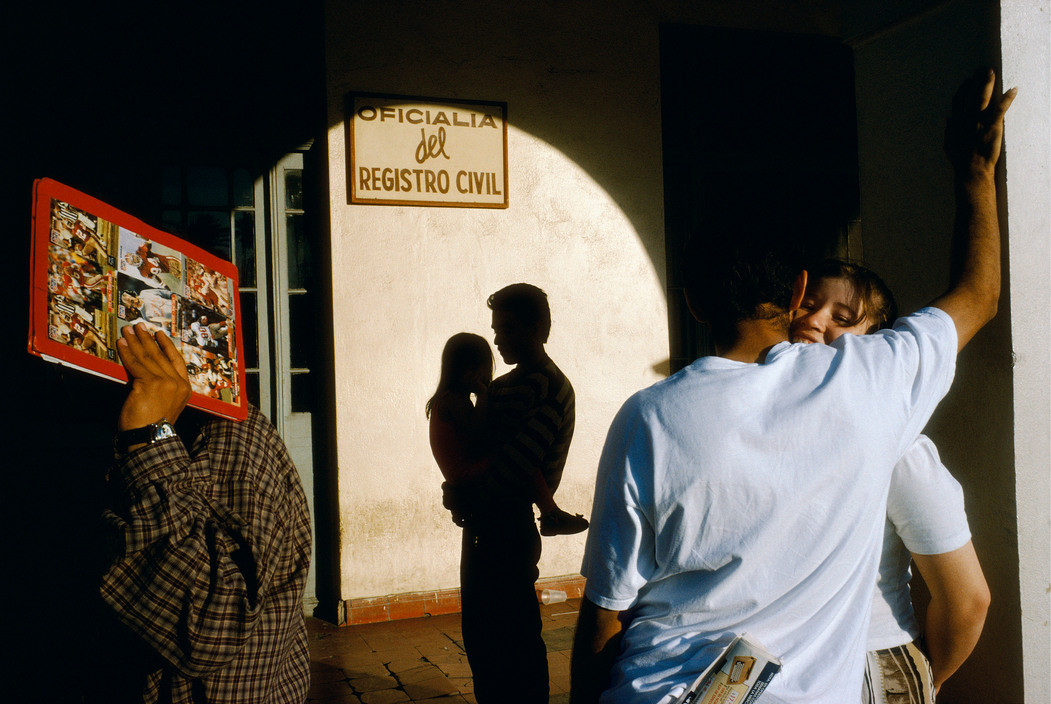
Hard raking sun: at right a couple embrace with the man's arm braced high on a wall; at left a man in shadow holds a red-framed board of pinned photographs across his face; between them a sunlit wall reads OFICIALIA del REGISTRO CIVIL, against which a man carrying a small child is thrown into pure black silhouette
Four things, one frame Four events, stacked. A couple embracing, a man whose face is replaced by a board of photographs, a silhouette crossing a sunlit wall, and the words Registro Civil behind all of it — marriages and births recorded in the building they are standing against. Four elements, each readable, none colliding, held together by one shaft of hard sun. Alex Webb · Magnum ref PAR112765 · © the photographer, shown here for critical commentary · see more
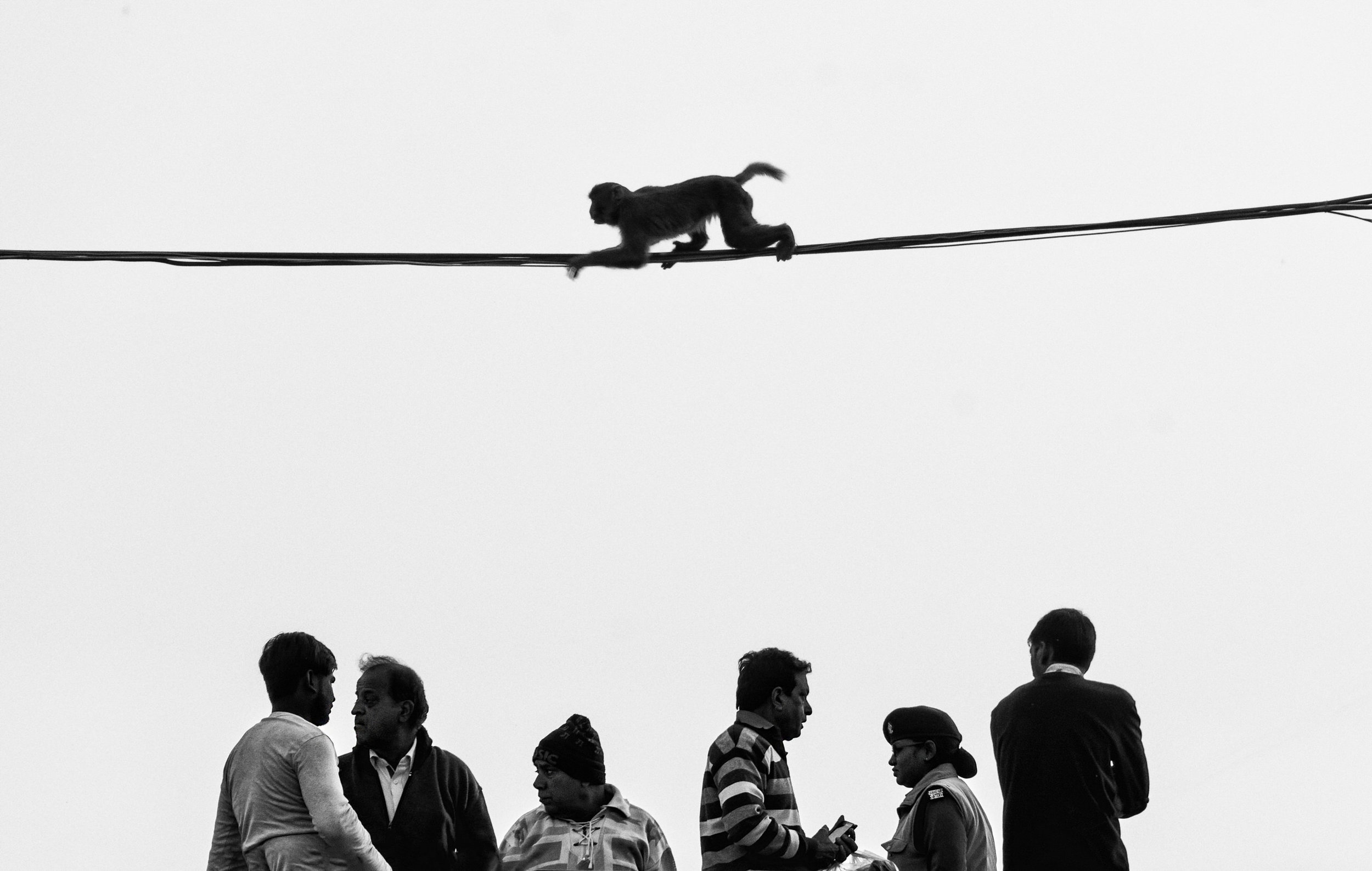
High-key black and white: a monkey crossing a power line, silhouetted mid-stride against blank white sky, while along the bottom edge six adults, one in a police beret, stand in a frieze — none of them looking up
Two registers, one frame Top: a monkey mid-stride on a wire against blown-white sky. Bottom: a row of adults in a frieze, not one of them looking up. The planes are stacked vertically rather than in depth, and the whole photograph is the gap between them — the event nobody in the frame is attending to. Cover either band and there is nothing left. Sarmistha Bera · Kolkata · © the photographer, shown here for critical commentary · see more
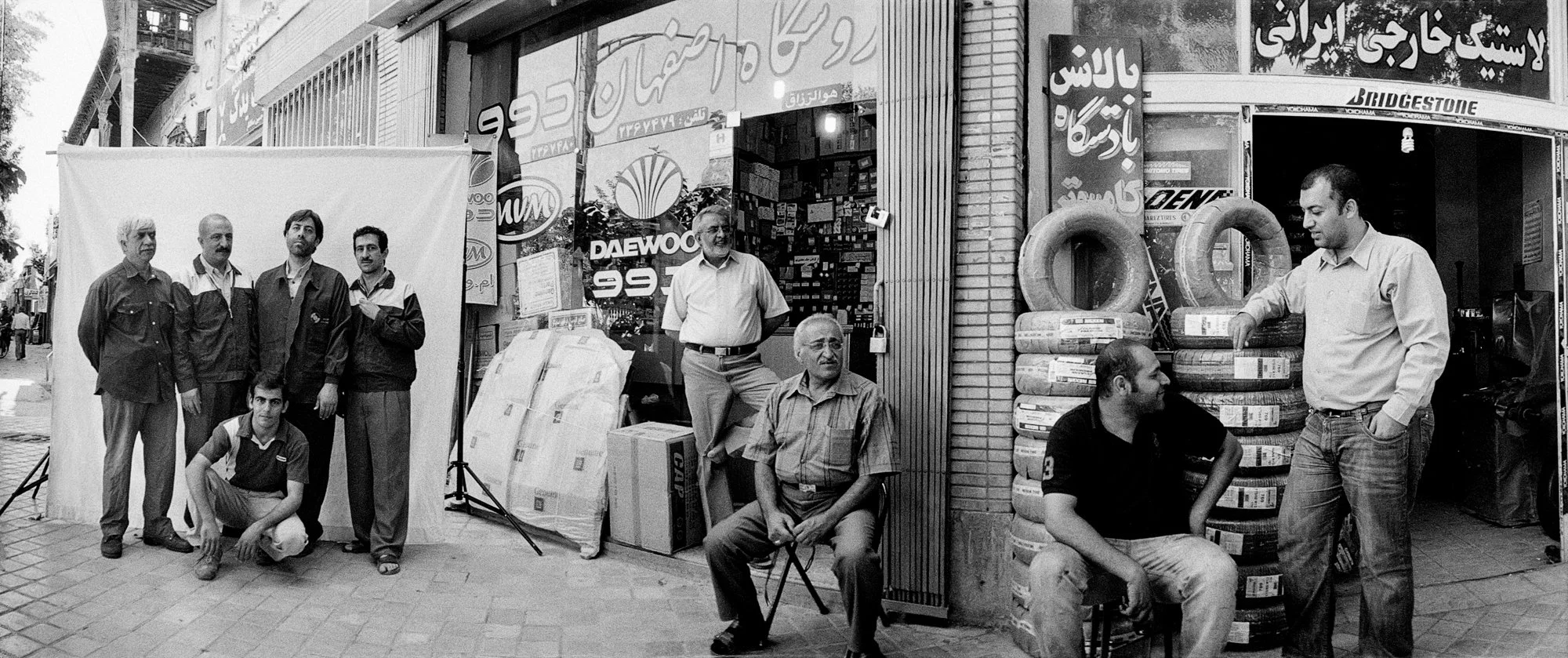
A wide black-and-white panoramic frieze of an Iranian tyre-and-parts street with Persian shop signage and stacked tyres; nine or ten men are strung across the frame — four standing stiffly against a hung white sheet with a fifth crouched at their feet, one standing in a shop mouth, one seated on a stool with a cane, one crouched among stacked tyres, one standing hands-in-pockets at the right edge
Layered sideways Most layering stacks front to back. This stacks left to right, and the read shows how: four vertical seams in the architecture cut one street into five compartments, each holding its own unrelated piece of business, nobody looking at anybody. Everything sits on a single continuous ground line — a frieze, not a stage — so there is no depth doing the work at all. And the hung white sheet is a studio backdrop dropped into a tyre shop, which is what turns four men standing around into a portrait. Elaheh Abdolahabadi · Nishabour, Iran · An Instant of Time and Place · © the photographer, shown here for critical commentary · see more
Black and white looking straight down the throat of a twin escalator in a transit atrium, louvred walls converging toward a skylight, one masked man tiny on the right-hand escalator
Architecture as the other planes The building supplies every layer — two escalator runs, converging louvred walls, a skylight at the vanishing point — and a single small figure supplies the scale that makes them legible. Remove him and this is a diagram. Modern transit interiors are the most reliable free geometry in any city. Toh Ee Siew · Kuala Lumpur · © the photographer, shown here for critical commentary · see more
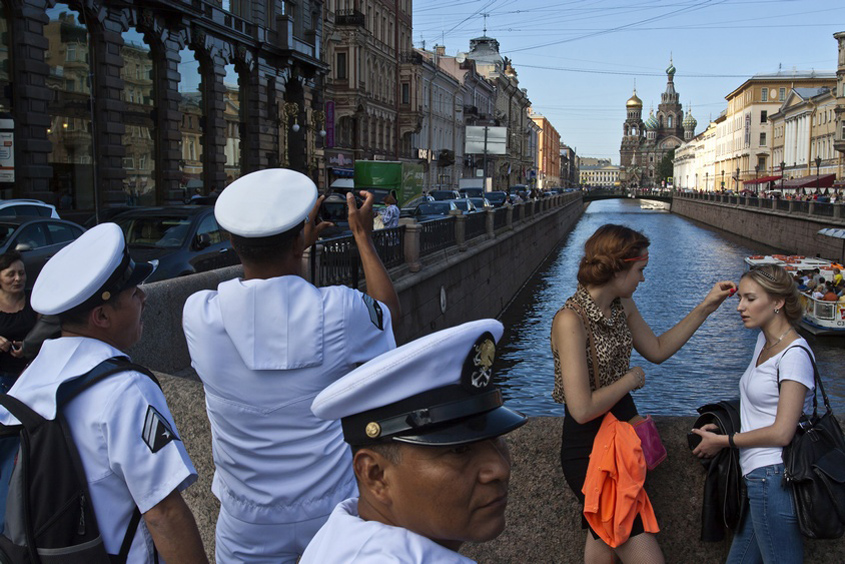
A canal embankment: three naval cadets in white uniforms crowd the left foreground, one raising a phone to photograph the water, one turned back toward the lens; at right two women stand at the parapet, one reaching up to touch the other's face; far behind, the onion domes of the Church of the Saviour on Spilled Blood
Three planes, and the landmark kept small Foreground: cadets in white, one shooting the canal on his phone, one turned back into the lens. Middle: two women at the parapet, one reaching for the other’s face. Far plane: the Church of the Saviour on Spilled Blood, doing the one thing a landmark should do in a layered frame, which is sit at the back and stay small. Cover any plane with a thumb and the other two still make a photograph. Note also that the depth is bought with size, not focus — everything here is sharp. Ilya Shtutsa · Griboyedov Canal, St Petersburg · Observe Collective · © the photographer, shown here for critical commentary · see more
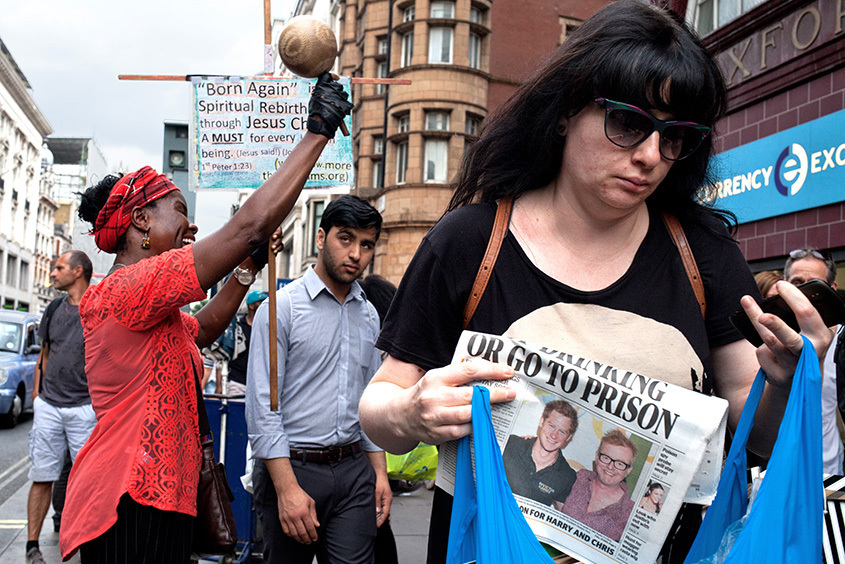
Packed London shopping street: at the bottom right a woman in cat-eye sunglasses holds up a tabloid headlined OR GO TO PRISON; a young South Asian man in a grey shirt is wedged behind her looking into the lens; behind them a woman in a red headwrap laughs head back, raising a wooden cross topped with a coconut and a Born Again placard
Layers inside two metres of crowd Everything else in this lesson builds depth across a street. This builds it inside arm’s reach, and the read gives you the arithmetic: the near head fills 42% of the frame height and both far heads fill about half that. A two-to-one size ratio is all the depth cue a viewer needs, and at 35mm-e you get it from roughly a metre of separation — no distance required, just a crowd. The fourth box is the gift: a tabloid held up at the bottom edge, supplying a caption nobody in the frame chose. Marcelo Argolo · London · Observe Collective · © the photographer, shown here for critical commentary · see more
Depth, built from arcades and shade
An arcaded street with a red truck parked under the colonnade
Jack Delano · Street in Christiansted, St. Croix? Virgin Islands · 1939 · LoC
A shopping street with arcades on both sides and figures in the middle distance
Jack Delano · The main shopping street, Christiansted, Saint Croix, Virgin Islands · 1939 · LoC
A street ending at the harbour, arcades and parked cars along one side
Jack Delano · A street in a town of the Virgin Islands, Christiansted, Saint Croix · 1939 · LoC
Paris before Haussmann: depth without a single figure
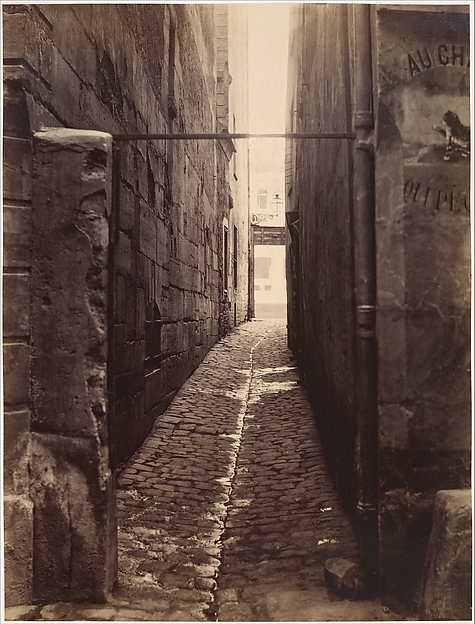
A narrow stone alley, walls filling both edges, a bright sliver of building at the far end
Charles Marville · Rue du Chat-qui-Pêche (from the Rue de la Huchette) · ca. 1868 · The Met, public domain
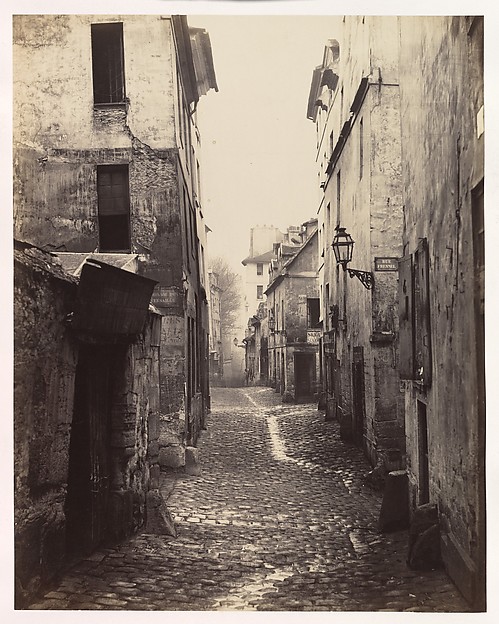
A cobbled street curving between leaning tenements, a lamp on the right, mist at the far end
Charles Marville · Rue Traversine (from the Rue d'Arras) · ca. 1868 · The Met, public domain
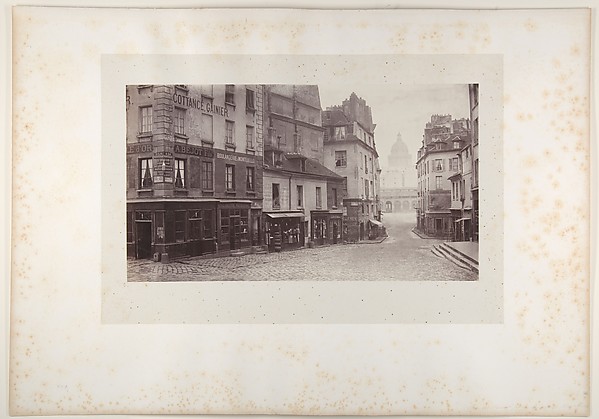
A street of shopfronts opening onto the dome of the Panthéon in the far distance
Charles Marville · Rue du Haut-Pave (Pantheon in Distance) · 1865–69 · The Met, public domain
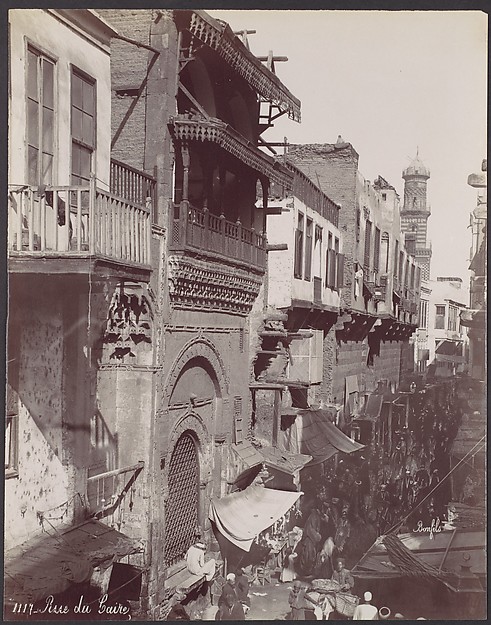
A Cairo street shot from above: carved wooden balconies overhanging a crowded, awning-covered market lane
Félix Bonfils · Rue du Caire · 1870s · The Met, public domain
Carry this

Load one extra plane on purpose. When the single-subject frame is composed, don’t press — take one step closer or sideways until something enters the foreground or resolves in the distance, then wait for both planes to peak. The keeper rate drops and the keepers get better; that trade is the lesson.
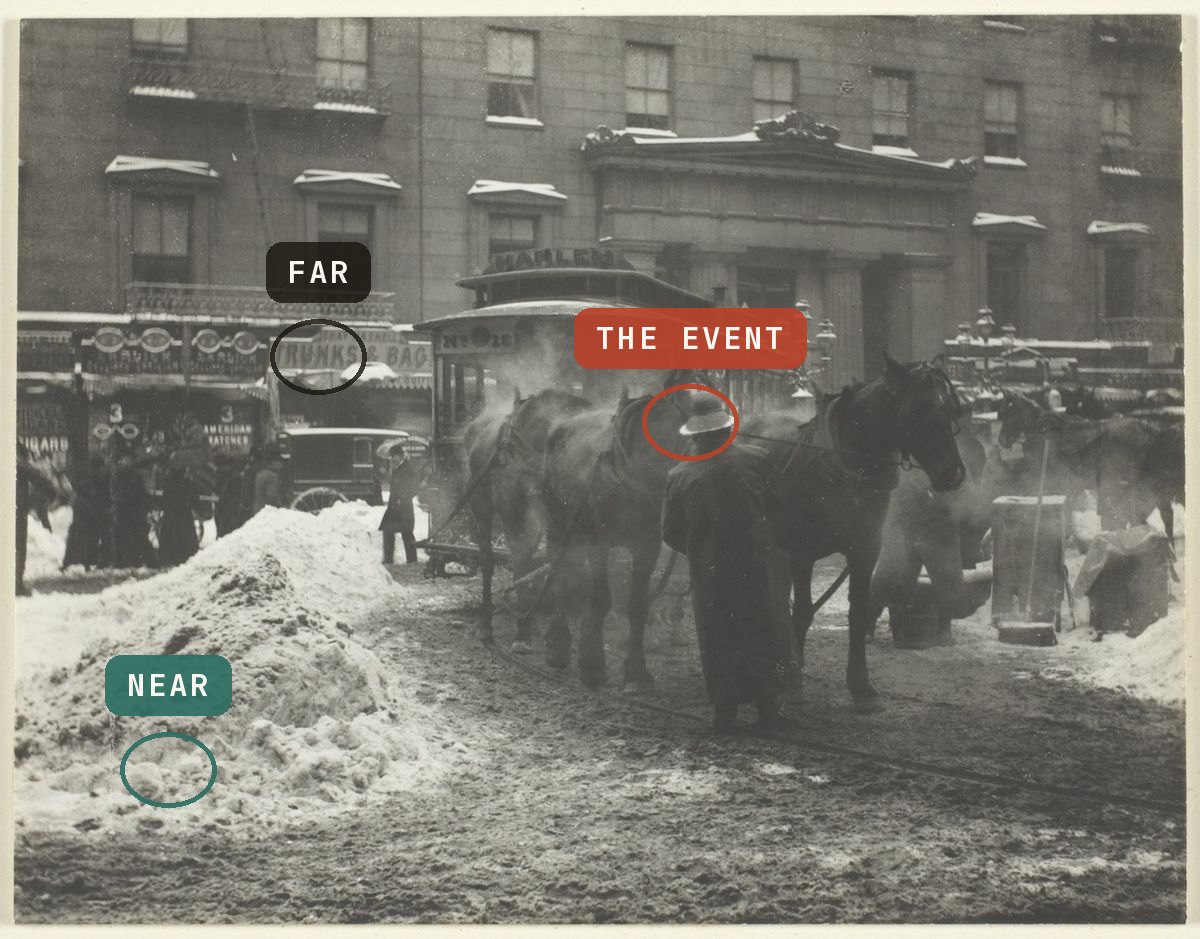
Snowbound street: a driver in a heavy coat waters a team of steaming horses hitched to a Harlem streetcar, snowbanks piled in the foreground, shopfronts and figures behind
Annotation study — three planes, loaded on purpose Stieglitz could have shot the team head-on from the cleared street. He stood behind a snowbank instead, so the frame carries three depths at once: churned snow in the near plane, the driver watering his steaming team in the middle, the shopfronts and waiting figures behind. Cover the snow and it is a competent record of a horsecar terminus. The near plane is what puts you in the cold standing in it. And the steam is the only thing here that existed for a second — the snow, the signs and the building would all have been there an hour later. Alfred Stieglitz · The Terminal · 1893 · Art Institute of Chicago · CC0
Lesson 06

Objects: transform, don’t describe

An object photographed as it is, competently, is an inventory entry — the viewer files it and moves on. Transformation — light, angle, or abstraction changing what the thing reads as — is the way out.

In practice §04 — the four properties of light

The gap between a description and a transformation is not sharpness, color, or crop — those are decided after the fact. It is what the light and the angle were allowed to do before the shutter opened.

A sidewalk lined with overlapping LOANS, JEWELRY and CLOTHING signs receding down the block, one man walking through
Repetition found, not arranged Five loan-shop signs stacked down one block until the word stops meaning and starts drumming. The signs were inventory; the angle — shooting down the sidewalk instead of across at one storefront — turned them into rhythm. One walker gives the pattern scale and a beat. Angle is the cheapest transformation lever: it costs four steps. John Vachon · Loan companies on lower Douglas Street. Omaha, Nebraska · 1938 · LoC
A dry goods store window filled with hanging garments, cards and sunglasses, framed by brick
The found still life A shop window is the street’s pre-composed object frame: somebody already arranged it, the glass already flattens it, and the reflection layer comes free. Shot square-on, the window becomes a picture about arrangement itself. The discipline is the minimalist’s: exclude until the edges hold only what the frame is about. Russell Lee · Shop window. L Street N.W., Washington, D.C. · 1937 · LoC
Long exposure at dusk in a railyard: a swung lantern draws a bright ribbon of light beside the silhouetted tracks
Light as the object A switchman swinging a lit fusee — a railroad flare — held open long enough that the man disappears and only the signal remains, a ribbon of fire standing in the dusk. The archive records it as a demonstration, which is the honest note: this is a made photograph, not a caught one, and it still teaches the lever. This is the far end of the transformation scale, where the object dissolves entirely into what it does. Compare the urge to drag a shutter on a crossing crowd: blur transforms only when the streak itself carries the meaning; otherwise it is an effect standing where a moment should be. Jack Delano · Indiana Harbor Belt RR, switchman demonstrating signalwith a "fusee"-… · 1939 · LoC

The transformation levers

Three, and they compose: light (wait until light is doing something to the object — a lighting event, not an architectural one), angle (move until the object’s function disappears and its geometry remains), and abstraction (exclude every element that names the thing; what survives is shape, rhythm, color). The question at the scene is never “what is this?” — it is “what is this becoming right now, and from where?”

The thumbnail test guards the result. Whatever the object became, it must survive at 200 pixels: one shape, unmistakable, uncontested. A single subject on a busy textured field tends to read as texture at thumbnail size, however clean it looked in the finder — at that scale the texture competes with the subject. Before firing: name the one shape the thumbnail will show. Can’t name it — recompose.

A boy crossing a cobbled street almost entirely hidden behind a towering stack of pale hatboxes strapped together, only his cap, one arm and his boots visible
Boy carrying hats, Bleecker St., New York The object has eaten the person, and that is the photograph. Hine could have shot a boy carrying hats; instead he waited until the stack read as a single pale monolith crossing a dark street, with just a cap and two boots to tell you it is being carried. Description would have been a boy with boxes. Lewis Hine · Boy carrying hats, Bleecker St., New York · 1912 · Wikimedia Commons · CC0
A man stands against a yellow hoarding carrying a large yellow board that completely hides his head and torso; a red STOP sign sits at right against blue sky
Read it twice For half a second this is a headless man. Then it resolves into someone carrying a board, and the yellow-on-yellow tells you why the illusion held. The delay is the picture — an object that reads as something impossible until the viewer does the work. Note also the one red element, doing what Lesson 07 describes. Jesse Marlow · from Don’t Just Tell Them, Show Them · © the photographer, shown here for critical commentary · see more
A live pigeon in flight above a construction hoarding printed with three black silhouetted birds, so the real bird appears to join the printed flock
The coincidence A real pigeon flying into formation with three printed ones. Buscató hunts exactly this — two unrelated things overlapping for a fraction of a second into one impossible object — and is candid that it can take years at the same spot. The hoarding was permanent; the bird was available for perhaps a tenth of a second. Pau Buscató · Barcelona · © the photographer, shown here for critical commentary · see more
An entire street scene inverted in a muddy puddle — utility pole with fanned power lines, a low corrugated-roof building, a standing man — with a real pedestrian's legs and shoes entering upside-down at the lower left
The puddle does the transforming A puddle is the street’s free optical instrument: it inverts, it crops, and it removes the sky. Everything identifying Lagos is present but hanging the wrong way up, so the frame reads as geometry before it reads as a place. The real legs entering at the lower left are what stop it becoming a trick — they tell you where the photographer actually stood. Logo Oluwamuyiwa · Lagos, from Monochrome Lagos, 2013 · © the photographer, shown here for critical commentary · see more
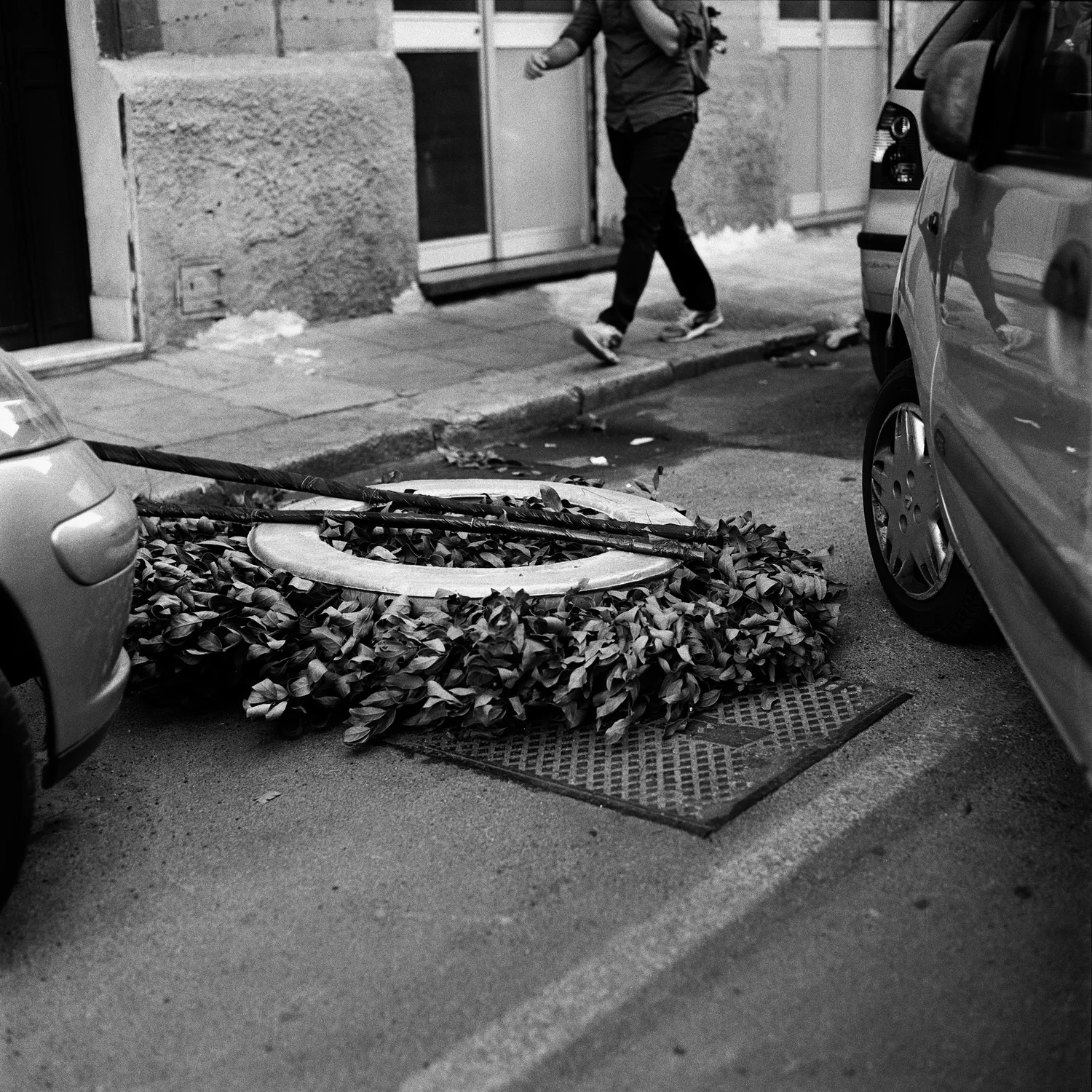
A large funeral wreath lies dumped face-down in the gutter between two parked cars, leaves dried and curling, a broken wooden pole laid across it, half of it resting on a storm drain; in the upper third a pedestrian walks past, cropped so only legs, one arm and a shoulder bag show
An object that is entirely argument This is the memorial wreath for General Carlo Alberto Dalla Chiesa, murdered by Cosa Nostra in 1982, lying face-down in a Palermo gutter with a storm drain under it. Photographed straight, as an object, with a passer-by cropped to legs — no face, no drama, no commentary. Transformation is not always about light. Sometimes it is knowing what a thing is and refusing to arrange it. Mimi Mollica · Palermo · from Terra Nostra · © the photographer, shown here for critical commentary · see more
A woman at a white café table in a Midtown plaza holds up a copy of Memoirs of a Geisha so the cover's painted geisha face lands exactly where her own face would be, her real hair falling either side of the book
Substitution Her face replaced by a painted one, at exactly the right scale and height, with her own hair continuing past the edges of the book so the join reads. Higbee scouts a backdrop and returns to wait — “up to a few hours a day for a week” — which is the only way an alignment this exact ever gets photographed. Jonathan Higbee · New York · from Coincidences · © the photographer, shown here for critical commentary · see more
A black taxi at the kerb with its rear door open, and a vast white wedding dress sheathed in translucent plastic being manoeuvred into the back seat, reading as a headless bride standing on the pavement while the driver bends into the car
A dress becomes a person For a moment the plastic-wrapped dress is a headless bride standing on the pavement, and the bending driver is attending her. Noguchi works candid but in the open — standing where he can be seen, waiting for the unguarded configuration inside a frame he has already composed. Shin Noguchi · Ginza, Tokyo, April 2017 · from Sorry, You’ll Never Walk Alone · © the photographer, shown here for critical commentary · see more
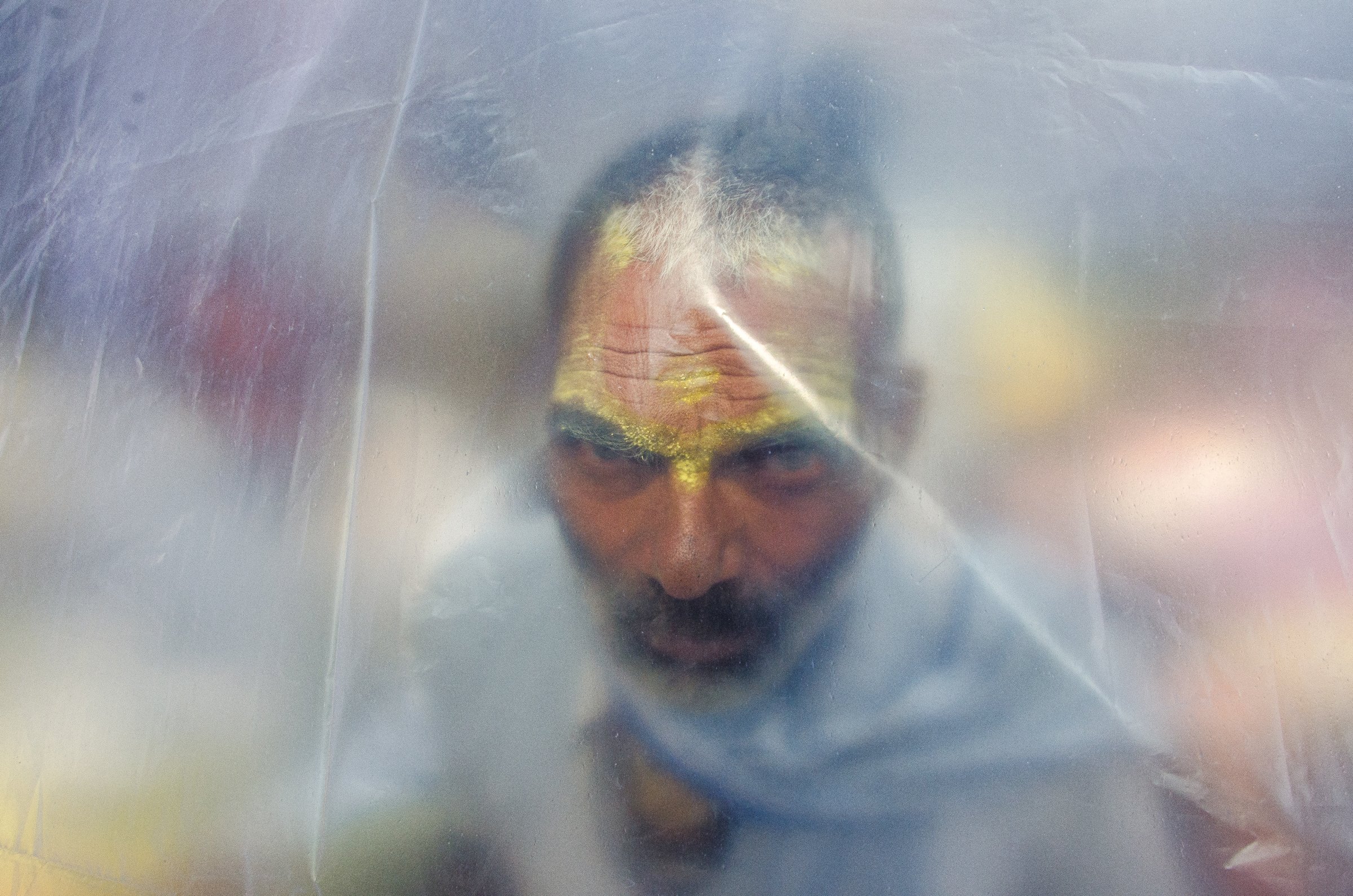
A man's face pressed close behind a translucent rain-wet plastic sheet, a crease running diagonally across his forehead; yellow tilak paste is smeared across his brow, his eyes stare down and out through the milky film, soft red and yellow blobs of unfocused crowd behind
A sheet of plastic, doing everything The transforming object here is a plastic sheet the group was sheltering under against the cold at Sonepur Fair. It softens him, mattes the crowd behind into colour blobs, and lays one hard crease diagonally across his forehead. Without it this is a portrait; with it the material is the photograph. Cheapest lever in the lesson — find the thing already in front of your subject. Rimita Sen · Destiny · Sonepur Fair, Bihar · Indian Photo Festival, Hyderabad 2022 · © the photographer, shown here for critical commentary · see more
A row of urinals against a mottled mosaic wall; at the centre a busker stands facing the wall entirely hidden behind the huge circular bass drum strapped to their back, a guitar case propped above
The object eats the person A bass drum big enough to erase the person carrying it, in a tiled room where the repeated urinals set a rhythm the circle interrupts. Jorgensen spent thirty years as a press photographer and works on reflex — no setup, no waiting, just recognising an absurd alignment before it dissolves. Nils Jorgensen · London · © the photographer, shown here for critical commentary · see more
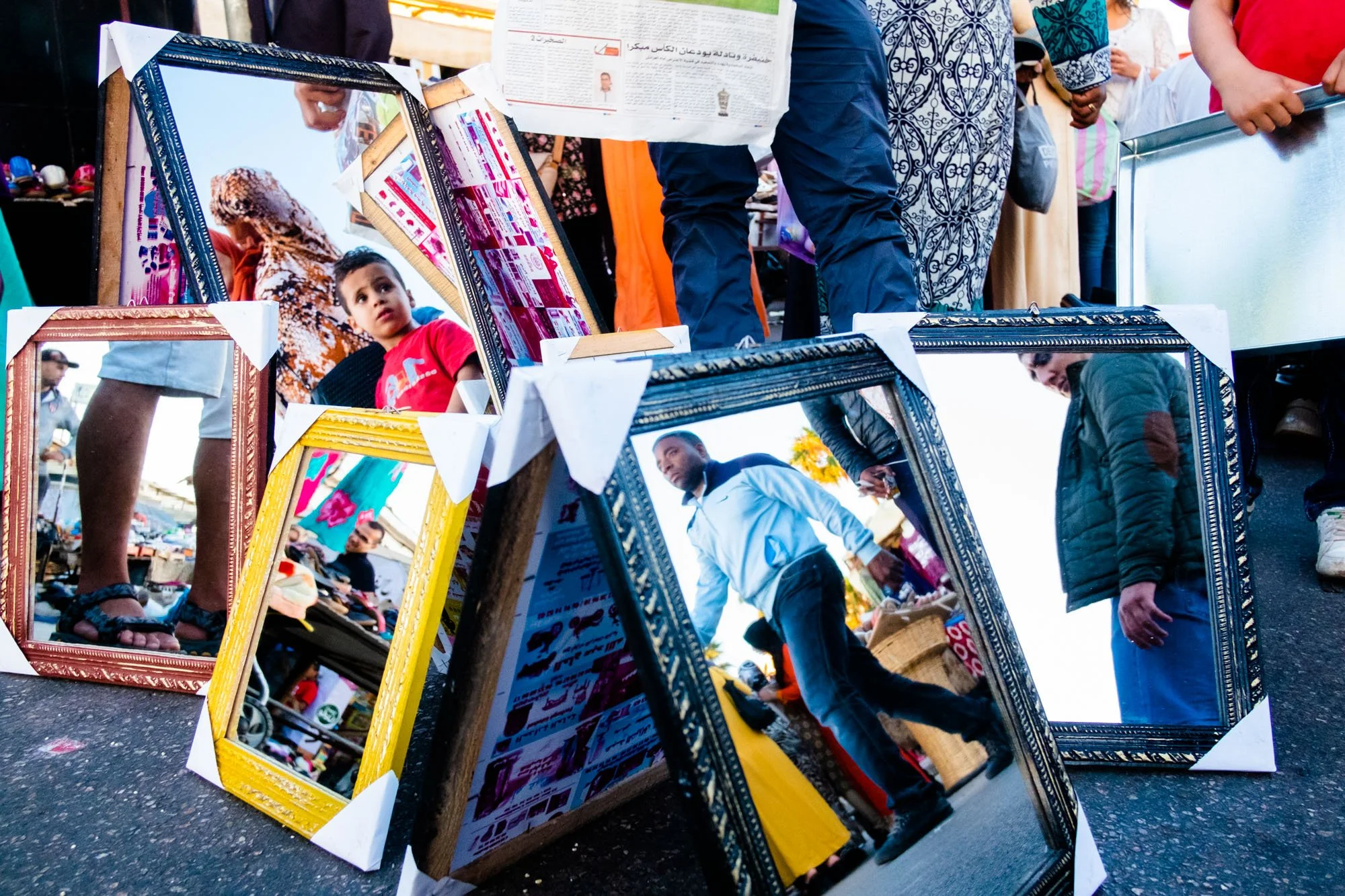
A dozen second-hand mirrors and picture frames propped on flea-market tarmac at odd angles, each catching a different slice of the market above — sandalled feet, a man in a pale blue jacket mid-stride, a woman in a patterned djellaba, an Arabic newspaper; only legs and hands of the real crowd appear above the frames
The market, served in fragments A dozen mirrors for sale on the tarmac, each one holding a different piece of the market standing above them. The real people are cropped to legs; everything you can actually read about them arrives second-hand, at a different angle, in a different frame. An object that photographs the scene for you. Yoriyas (Yassine Alaoui Ismaili) · Casablanca · from Casablanca Not the Movie · 1st prize, World Street Photography 2016 · © the photographer, shown here for critical commentary · see more
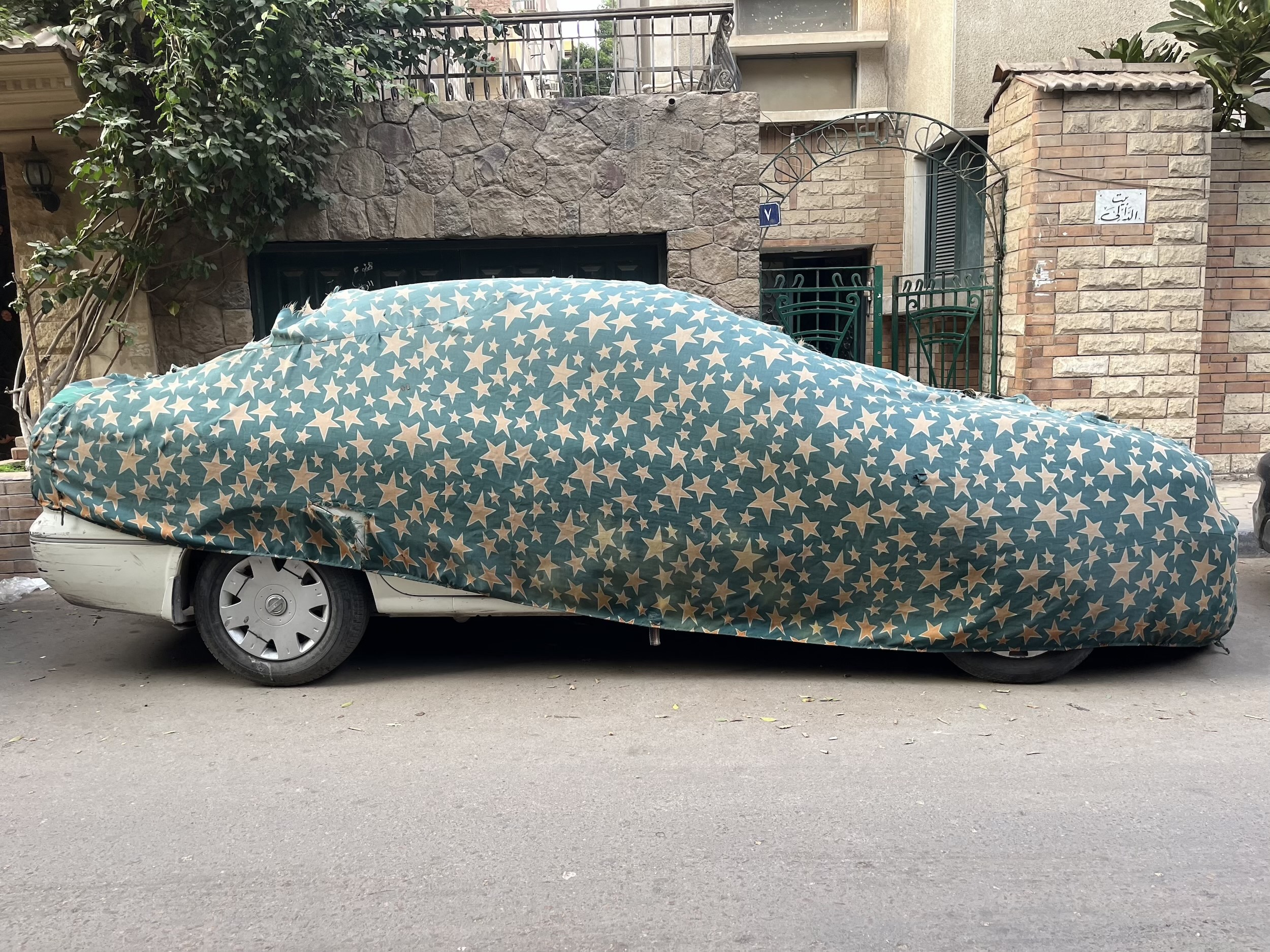
A Cairo side street where a saloon car is completely swallowed by a homemade teal cover printed with hundreds of gold stars, one wheel showing, a stone villa wall and green iron grilles behind
Transformed by its owner, not the photographer Somebody covered their car in a teal sheet printed with gold stars, and in doing so turned a saloon into a soft glittering mass with one wheel escaping at the bottom. The photograph’s only job was to shoot it straight, square-on, and let the absurdity stand. Not every transformation has to be yours; some are already waiting. Yomna El Beyaly · Cairo · © the photographer, shown here for critical commentary · see more
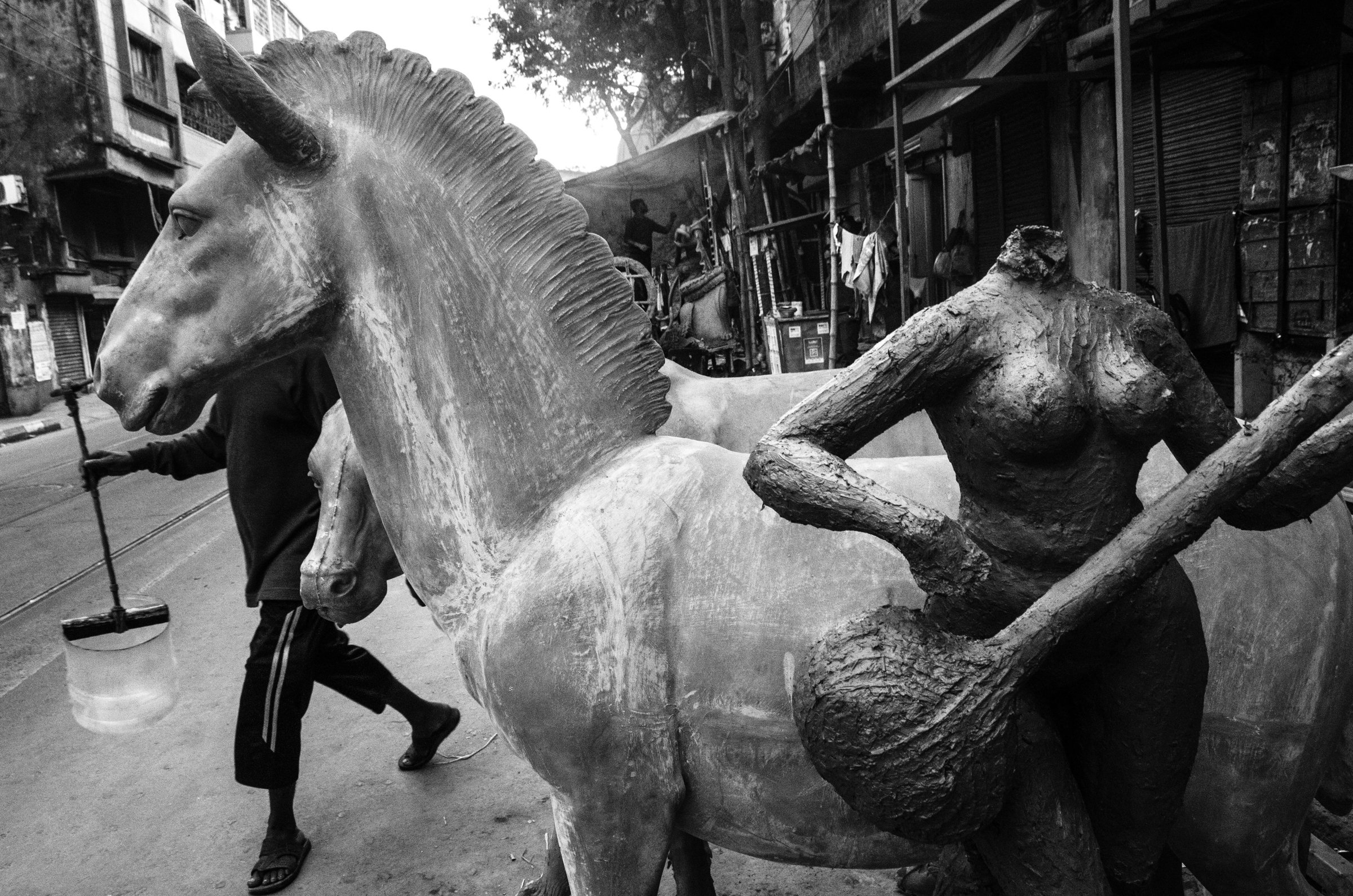
Plaster horse-and-rider sculptures standing unfinished on a street in the idol-makers' quarter, with a man carrying a bucket walking behind them
Objects that outrank the people In Kumartuli the unfinished idols stand in the street while their makers work around them, so the sculptures read as the inhabitants and the man with the bucket as an intruder in his own workshop. The photographer did not arrange that inversion — she recognised it and framed so the horses dominate. Krishna Goswami · Kumartuli, Kolkata · © the photographer, shown here for critical commentary · see more
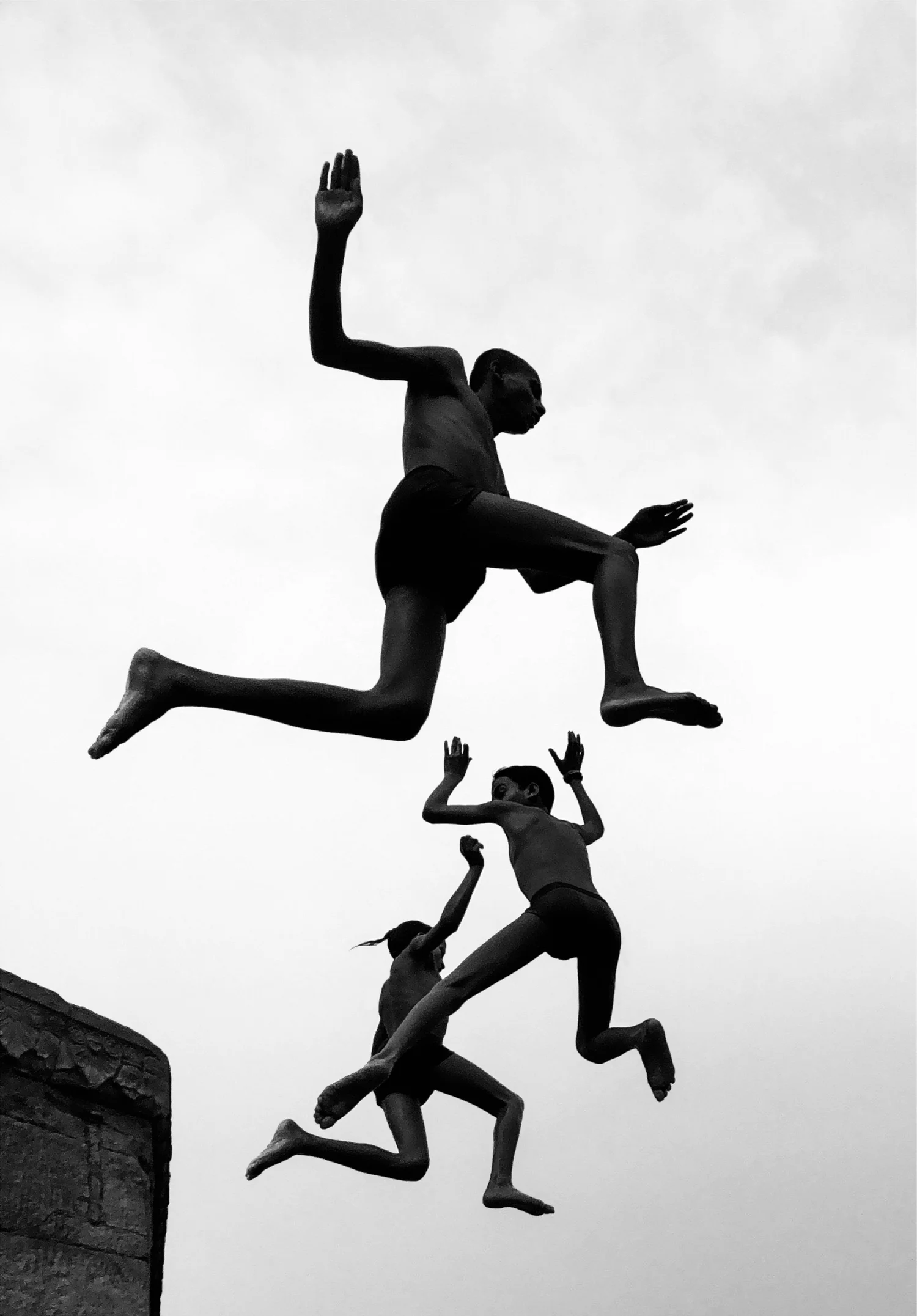
Three boys silhouetted in mid-leap against a blank white sky, bodies fully extended, faces not legible
Flying Boys The frame she is known for, and the clearest lesson in it is subtraction: the sky is given up entirely, the bodies are given up to silhouette, and what is left is three shapes at the top of their arc. Shot on a phone. Everything that would normally be called image quality has been discarded, and the photograph is not weaker for it — which is worth sitting with if you are inclined to solve problems by buying glass. Dimpy Bhalotia · Flying Boys, Varanasi, 2020 · Grand Prize and Photographer of the Year, IPPAWARDS · © the photographer, shown here for critical commentary · see more
An empty street at night in ochre and pale green sodium light: two people stand by a steel bin outside a shuttered shop, and a large white cloud of exhaled vapour completely replaces both of their heads; the pavement recedes empty into the dark at right
The object that arrived and left A quiet street of ochre and pale green, and one white cloud where two heads should be. The vapour is the brightest thing in the frame and the only pure white in it, and it existed for perhaps two seconds — an object in the sense that counts, something with its own shape and tone that the street manufactured unasked. The read also shows what is not happening: two thirds of the frame is empty pavement. No gesture, no glance, no second event. Remove the cloud and this is a photograph of a bin. Julie Hrudova · Amsterdam · © the photographer, shown here for critical commentary · see more
Things the street arranged first
A weathered shoe repair shop front with hand-lettered window and a FOR SALE card
Russell Lee · Shoe shop, L Street, Washington, D.C. · 1938 · LoC
A half-demolished building on a city block, rubble and a lone arched doorway standing
Russell Lee · Wrecking building, I Street, Washington, D.C. · 1938 · LoC
A large ATLANTIC service station sign on a pole against a blue sky
Fenno Jacobs · Street scene, with building of the Southington News, Southington, Con… · 1939 · LoC
A main street running between two enormous rock cliffs, storefronts along it
Andreas Feininger · [Main Street, Creede, Colorado · 1939 · LoC
Carry this

If the caption would start with the object’s name, you described it. If the caption has to start with what it looks like instead — rhythm, ribbon, drumbeat — you transformed it. Only shoot objects the light is actively transforming; the rest are scouting notes.

A pavement magazine rack seen from above, twelve covers laid out in a grid, one passer-by’s legs at the frame edge
Russell Lee · Magazine stand, Washington, D.C. · 1938 · LoC
Lesson 07

Color as structure

Color earns its place in a street frame the same way a person does: by doing structural work. One saturated element anchoring a quiet field is composition; six competing hues are noise. The choice between color and monochrome is a decision about what the frame is made of — and it happens before the shutter, not in the edit.

The colour archive is small and precious: alongside 171,074 black-and-white negatives, the FSA/OWI photographers left only 1,623 colour transparencies — Kodachrome was expensive, slow, and considered unserious for documentary work. The frames that survive show color used exactly the way the later masters would use it: not as a record of what things looked like, but as structure.

Kodachrome of a narrow street: a red Coca-Cola bar sign hangs over the pavement against deep blue sky and a yellow corner wall
One red, doing all the work Deep blue sky, ochre walls, and a single red sign hung exactly where the street bends. Cover the sign with a thumb: the frame goes quiet, the depth flattens, the eye has nowhere to enter. One saturated element, placed on the structural seam, carries the entire composition — color as architecture, not decoration. Jack Delano · Street in San Juan, Puerto Rico · 1939 · LoC
Kodachrome of a shadowed street corner with balconies; one sunlit sidewalk strip where a single figure walks
Color is light first The lesson inverted: everything in shadow drops to near-monochrome, and the only living color rides the one sunlit strip — where the lone figure happens to be walking. Color photography is light photography with the gain turned up: no committed light, no color worth keeping. Golden hour isn’t a beauty preference; it is when color becomes structural. Jack Delano · Street in San Juan, Puerto Rico · 1939 · LoC

Saul Leiter, shooting Kodachrome in New York from 1948 — often expired stock, partly because it was cheap — built exactly this grammar into fine art: one red umbrella against snow, a traffic light bleeding through fogged glass. A painter before he was a photographer, he composed in planes of color the way Bonnard did, and the street obliged. The full study of his method is in Lesson 08; the working rule it yields is simple: find the color first, then wait for the street to use it. The red sign is a stage (Lesson 04); whoever walks under it is the cast.

Monochrome is the same decision made in the other direction — subtraction as structure. Fan Ho’s Hong Kong is geometry and haze precisely because color would have dissolved both into travel photography; gesture and shape carry everything when hue is gone. The honest test before each outing, or each frame: is a color doing compositional work here? If yes, protect it — expose for the saturated plane, exclude competing hues, wait for the anchor. If no, the frame is already monochrome; shooting it in color just adds noise you’ll have to mute later.

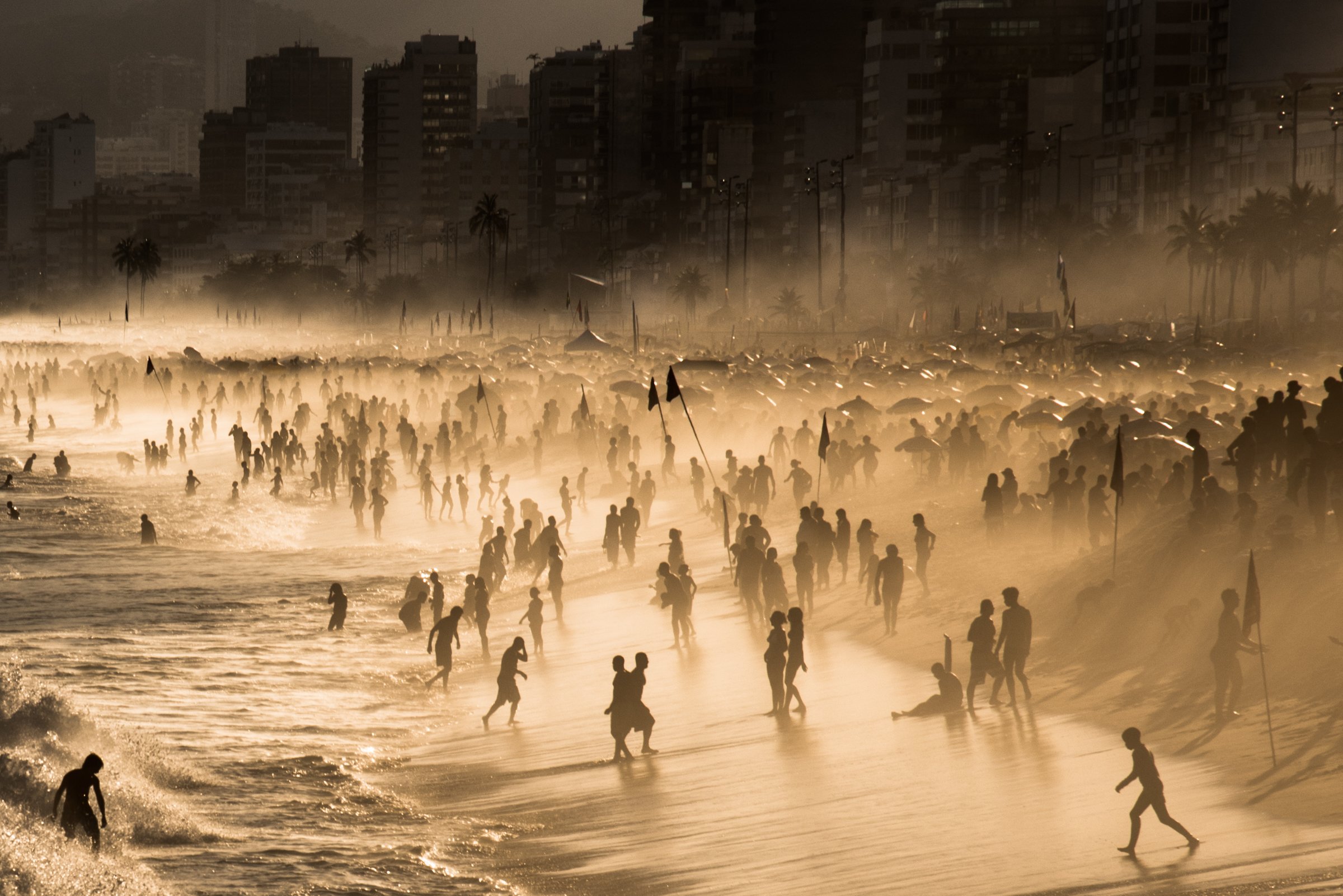
Colour photograph of a fabric seller almost buried in hanging cloth — a wall of saturated orange, blue, green and red bolts, with a red-patterned shawl drawn across the front of the frame
Karachi market Six competing colours would normally be noise. They work here because the reds are organised into one continuous diagonal sweep across the front, and everything else recedes behind it — the composition is built out of hue rather than decorated with it. Cover the red sweep and the frame collapses into a jumble. Steve Evans · Karachi market · 2000s · Wikimedia Commons · CC BY 2.0
Beach at low golden light: hundreds of bathers reduced to dark silhouettes in a haze of gold spray, city towers and palms dissolving behind
When light becomes the colour There is essentially one hue here, and it is doing all the structural work — figures reduce to silhouette, the city dissolves, and depth is carried entirely by how much gold haze sits between you and each plane. Cattaneo Adorno began photographing at sixty; this is what Lesson 07 means by committing to light rather than recording it. Sandra Cattaneo Adorno · from Águas de Ouro, Rio · © the photographer, shown here for critical commentary · see more
A black bollard wrapped in loops of white tape stands against a grey road with white lane markings and a yellow TAXIS legend painted on the tarmac
Monochrome by choice, not by camera Shot in colour, and almost none survives: black post, white tape, grey road, one yellow word. Hansen frames road markings as a Mondrian and lets the geometry carry it. A colour photograph whose working colour is nearly nothing — which is a decision, not an absence. Siegfried Hansen · Hamburg · © the photographer, shown here for critical commentary · see more
Square frame: a man sits alone on a low ledge with his back to the camera against a bright blue wall; a large sunburst of teal thread is hand-embroidered radiating outward from his body across the wall, with magenta stitching on the steps and a mango tree rendered in green thread
Colour added by hand, on purpose Choumali photographed Grand-Bassam quietly after the 2016 attack there, then embroidered into the prints by hand. The argument goes literal here: the teal sunburst is structure, not decoration — it radiates from a solitary figure and organises the whole square. She was the first African winner of the Prix Pictet for this work. Joana Choumali · Grand-Bassam, from Ça va aller · © the photographer, shown here for critical commentary · see more
A pedestrian walking through a shaft of sun is blown out to featureless white — an inverted silhouette — dragging a hard black shadow across brick paving, while surrounding commuters sit in crushed near-black
Exposed for the highlight, and nothing else Parke exposes for the lit slot between buildings and lets everything else go to black, which turns a walker into an inverted silhouette — white where you expect dark. The decision is entirely tonal: no colour survives, and none was wanted. He shot hundreds of frames at single Adelaide corners to get this. Trent Parke · Magnum ref LON38356 · © the photographer, shown here for critical commentary · see more
A woman in a white shirt and black trousers walks across a near-white polished plaza and is mirrored full-length in the wet marble; almost the entire frame is blank white
Almost nothing left Nine-tenths of this frame is empty white. What remains — one figure and her reflection — has to carry everything, and does, because the surface is wet enough to double her. Subtraction taken to its end: a photograph whose working colour is the absence of any. Alan Schaller · London · © the photographer, shown here for critical commentary · see more
Three women walk away into raking amber sunset light as near-black silhouettes with rim-lit hair, long shadows thrown back toward the camera across golden paving, the whole group doubled in a mirrored building panel that splits the frame
One colour, and its reflection Everything is one amber. The figures give up all detail to become silhouettes with rim-lit hair, the shadows run toward the camera rather than away, and a mirrored panel repeats the group so the count doubles. This is the axial-light situation Lesson 10 tells you how to predict from a street’s bearing — arrive on the right evening and the city hands you this. Roopsha Samanta · Golden Streets · Penn Station Plaza, New York · Women Street Photographers NYC 2025 · © the photographer, shown here for critical commentary · see more
Everything drowned in turmeric yellow: a woman bent almost double under a caked sari hands a long marigold garland to another woman, six or seven more figures dissolving into the powder haze behind
When one colour takes the whole frame There is one hue here and it has eaten everything — sari, skin, air, background. The garland passing between two women is the only distinct form left, and it survives because it is a different yellow rather than a different colour. Compare the Coca-Cola sign earlier: that was one colour placed on a quiet field, this is a field with no quiet left in it. Both are structural. Lopamudra Talukdar · Kolkata · 1st prize, Street, Siena International Photo Awards 2021 · © the photographer, shown here for critical commentary · see more
Two men on a plank scaffold painting a ship's hull — a hard diagonal of orange laid over acid yellow, their long shadows thrown flat across the fresh paint, one bending to a paint tin, the other reaching up on tiptoe
Two colours and two workers An orange diagonal over acid yellow, with the men reduced almost to marks on it and their shadows laid flat across the wet paint. The composition is a colour-field painting that happens to be a shipyard, and it only works because he shot when the light was raking enough to put the shadows on the surface rather than off the edge. Md Enamul Kabir · Dhaka · Grand Prize, Lucie Foundation On The Block · © the photographer, shown here for critical commentary · see more
An Ankara metro platform at night: a lone worker in a white hazmat suit and yellow rubber boots walks away spraying disinfectant into a wall of cold blue haze, with an open orange-lit carriage running down the left edge
Two temperatures, one platform Cold blue haze filling three-quarters of the frame and one warm orange rectangle of open carriage down the left edge — the colour contrast is the whole structure, and the figure in white sits exactly on the seam between them. Shot on an empty pandemic platform, which is why the haze had room to become the subject. F. Dilek Uyar · Ankara · Disinfection · Category Winner, Street, Sony World Photography Awards 2021 · © the photographer, shown here for critical commentary · see more
Dusk in a car park under a deep blue sky: a woman sits at the wheel behind a rain-beaded windscreen, her face lit orange from below by a phone; above and behind, a lit star-ball and icicle lights hang over a graffitied concrete block, a wall lamp burns on the corner, and a FOTOTESSERA photo booth glows at the far left
Small warm patches, an enormous blue Blue hour is the twenty-odd minutes when tungsten and sky are within a stop of each other and one exposure can hold both; after that the sky goes black and the lamps blow out. The ratio is the argument: four warm sources — a phone lighting a face from below through a rain-beaded windscreen, a star-ball, a wall lamp, and a FOTOTESSERA booth at the left edge — occupy about 6% of the frame between them. The remaining 94% is a single blue. That ratio is the effect; make the warm patches large and the same scene becomes an evening snapshot. Valeria Tofanelli · Rome · © the photographer, shown here for critical commentary · see more
Two people pressed against a graffitied wall under a single toxic-green light: she turns toward him with a hand raised to her mouth, he grips his own crossed arms and stares past her, mouth open; everything else collapses to flat dark green
One hue, no escape A single green source with nothing to correct against, so the wall, the coats and the graffiti all collapse into the same colour and stop being separate things. Only skin resists — the faces and the gripping hands stay just warm enough to read, and that is the entire separation the frame gets. The instruction hidden in it: when a scene has one strong coloured source, stop fighting the white balance. Let everything except the people go to that colour and the people will come forward on their own. Kristin Van den Eede · Belgium · Observe Collective · © the photographer, shown here for critical commentary · see more
What Kodachrome was for
A bare-tree street in early spring, a brick church on the left under a blue sky
Jack Delano · Street scene, [Mystic, Connecticut · 1939 · LoC
A dirt main street with a general store and a hand-painted PIE TOWN sign
Russell Lee · Main Street, Pie Town, New Mexico · 1939 · LoC
A row of small-town storefronts with beer and cafe signs, cars parked at an angle
Russell Lee · On main street of Cascade, Idaho ... · 1939 · LoC
Carry this

Name the working color before you press — “the red sign,” “the yellow wall,” “nothing.” One nameable color: compose around it. No nameable color: think in monochrome, whatever the sensor records. Two or more fighting: walk until one wins.

Lesson 08

Masters as data

Not inspiration — data. Fifty frames per photographer, one line per frame: single shape at thumbnail / where the moment peaks / camera distance / what got transformed. Three photographers, each of whom solved one of the problems above.

Fan Ho — the bridge from the graphic eye

Hong Kong, 1950s–60s, a Rolleiflex, and the stage-building habit done consciously. In his own words: he would find a location and stake it out — returning across days and seasons — and wait for “the suitable subject matter” to enter at the mark where light, mood and composition hit the climax he had already pictured. He knew Central Market’s light “came in so beautifully around four o’clock,” when cooking smoke and dust made the beams solid. That is the difference between his stage and the tourist’s: his stayed empty until the specific figure — right silhouette, right gait, right mark — completed the sentence, while the stage-first habit accepts whoever wanders through. “I am like a cowboy with one bullet,” he told an interviewer, “and not a machine gun.”

He was also honest about control, which matters here: Approaching Shadow (1954), his most famous frame, was posed — his cousin against a wall — and the diagonal shadow was burned in later in the darkroom. Another frame, Private, was staged with two friends. He cropped freely and called the square negative “suitable for my purpose of cropping.” A pictorialist, not a documentarian: the geometry was the instrument, the print was the truth he cared about. The study: which of his fifty frames survive with the figure removed? Almost none — that is the gap to measure.

The Fan Ho grammar was not his alone. The government photographers arrived at it on assignment, between captioned documents:

Overhead Kodachrome: a woman in a white dress carries a bundle on her head along a sunlit street, past a blooming bougainvillea, tram tracks curving through the pavement
The empty stage, completed High vantage, committed light, tracks curving the eye, a bougainvillea holding the corner — and one figure in white at the point where every line agrees. Remove her and it’s a postcard; she is the sentence the stage was waiting to finish. Fan Ho’s method, a decade early and an ocean away. Jack Delano · Street scene, Christiansted, St. Croix, Virgin Islands? · 1939 · LoC
Overhead Kodachrome of a sidewalk in raking light: a man in white walks toward two children, long shadows crossing the diagonal curb
Geometry, gait, and a bet Raking light draws every figure twice — once in body, once in shadow — while the curb runs the diagonal. The man’s stride and the children’s approach are half a second from meeting. Rubric line for this frame: shape@thumbnail: diagonal + three marks · peak: the closing gap · distance: high and far, honestly · transformed: pavement into stage-flat. Jack Delano · Street scene, Christiansted, St. Croix Island, Virgin Islands? · 1941 · LoC

Saul Leiter — the anti-inventory

Leiter is the counterexample to every rule stated too simply. He shot street on telephotos — 85, 90, on occasion a 150mm — but pointed them at reflections, fogged glass, umbrellas, gaps between boards, using compression to stack the street into planes of color rather than to observe people from afar. The tele rule in Lesson 01 survives him: his long lens compressed layers toward the viewer; a tele pointed at a person across the road holds them away. Objects in Leiter are never described: in Snow (1960) a steamed window’s condensation is the subject and the man beyond it becomes pigment; in Through Boards (1957) construction planks blind us to all but a sliver of street. He shot Kodachrome from 1948 — often expired, partly because it was cheap, and the decayed dyes painted like the Bonnards he loved. He was a painter first, and lived in the same East Village blocks from 1952 until 2013, fishing one neighborhood for six decades. The world only caught up at Early Color (Steidl, 2006), when he was 82. “I don’t have a philosophy,” he said. “I have a camera.”

The Magnum contact sheets — what surrounds a keeper

The published sheets are an honest teaching document: the boring frames around the famous one, the photographer circling, re-approaching, waiting out wrong pedestrians. The keeper is almost never frame one — Kalvar’s was the roll’s last. And the cautionary tale sits in the same tradition: Winogrand died leaving ~2,500 rolls undeveloped and thousands more unedited — volume with the review left undone. The study here is of sequences, not photographs: for a chosen sheet, count the frames, plot where the keeper falls, write one line on what changed between frame one and it. Then hold your own 2–5-frame scenes against that count.

Where the record starts
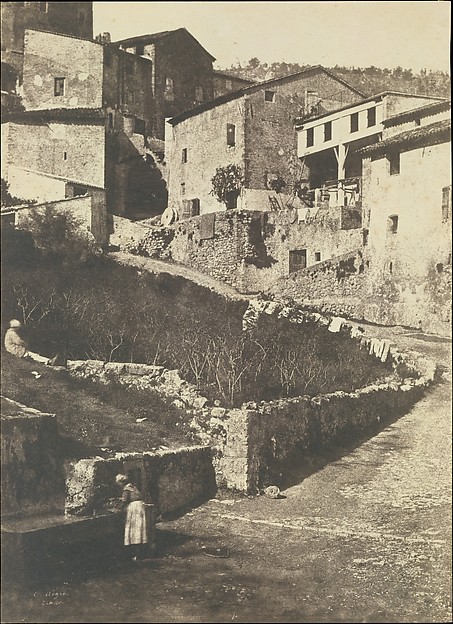
Salted paper print from 1852: a curving street in Grasse, France, buildings stepping down the hill, no people visible
1852 — the street before the moment Charles Nègre’s Grasse: exposures so long that anyone moving vanished, leaving only what a street is when nobody peaks — geometry, light, and recession. People came back into the frame once shutters got fast enough to hold them. Thumbnail truth avant la lettre: one curve, unmistakable at any size. Charles Nègre · A Street in Grasse · 1852 · The Met, public domain
Small 1896 photograph by Edgar Degas: a knot of well-dressed figures seen from behind on a village street, damaged buildings beyond
1896 — a painter presses the button Edgar Degas, on the street with a camera: the group taken from behind, mid-conversation, cropped like one of his pastels — figures cut by the edge, the subject being the crowd rather than any face in it. The painter’s eye arrived at street photography’s grammar the moment the tool allowed. Leiter ran the same route in reverse. Edgar Degas · Street Scene, La-Queue-en-Brie · ca. 1896 · The Met, public domain
Black-and-white: a dabbawala walks through a shaft of hard window light carrying a long tiffin rack on his shoulder; a second rack rests on the floor; grilled arched windows and Bollywood film posters line the wall behind, a man leaning and watching at left
Run the rubric on this one Shape at thumbnail: a horizontal bar of light crossed by a vertical man. Peak: he is fully inside the shaft, one stride either side and he is not. Distance: close, station-floor level, no compression. Transformed: a delivery becomes an annunciation, purely by which second the light was allowed to catch him. Sheth shot only black-and-white film until 2014. Ketaki Sheth · VT station, Bombay, 1991 · from Bombay Mix · © the photographer, shown here for critical commentary · see more
Dense black-and-white crowd at Holi, faces smeared with colour, a young man in a frilled shirt and waistcoat mid-dance holding a camera above his head, laughing women on either side
Forty years, one community Taraporevala has photographed her own Mumbai and her own Parsi community since the 1970s, and the difference shows in what she is close enough to catch — a man dancing with a camera held over his head, which is a joke you only see if you are inside the crowd rather than working it. Raghu Rai’s note on her archive is that the sequence almost becomes a documentary. Sooni Taraporevala · Mumbai, from Home in the City · © the photographer, shown here for critical commentary · see more
Through a gap in dense dark conifer foliage a bespectacled man in a dark suit stands smoking; at upper right, framed by another gap in the same hedge, an enormous billboard face appears to grow out of the foliage, gazing upward
Run the rubric: Tree Man Shape at thumbnail: two pale gaps in a black mass. Peak: the smoker is still, so the timing is the photographer’s position rather than the subject’s. Distance: close to the hedge, which is what makes the gaps frame anything at all. Transformed: a billboard becomes a giant sharing the bush with a commuter. Tavepong changes viewpoint rather than location — put an object between you and the subject and wait for the planes to fuse. Tavepong Pratoomwong · Tree Man, Tokyo, 2014 · 1st place, Miami Street Photography Festival · © the photographer, shown here for critical commentary · see more
Carry this

The rubric, per frame, one line: shape@thumbnail · peak · distance · transformation. Fifty Fan Ho, fifty Leiter, ten Magnum sequences. The output isn’t notes — it’s recalibrated defaults.

Lesson 09

The living bar

Lesson 08 studies the dead for mechanism. This one names the living, because they are the actual standard — people making street photographs now, into the same flood of images you are, where nothing is interesting merely for existing.

Their work is in copyright, so it is linked rather than shown — to the photographer’s own site, their gallery, their publisher or their museum wherever one exists. Study them the way Lesson 08 asks — the rubric, one line per frame — but hold these to the harder question the archive cannot answer: would this stop me if I scrolled past it today?

Working distance → Lesson §distance

Bruce Gilden New York
Steps to arm’s length in front of an oncoming stranger and fires an off-camera flash held out to the side — the face hard-lit, the background gone to black. Facing New York, Coney Island · view · wikipedia
Mikiko Hara Tokyo
The same proximity, the opposite posture: a waist-level 1930s Zeiss Ikonta fired without looking through the viewfinder, close to strangers on trains. Change (Kimura Ihei Award) · view · wikipedia
Akinbode Akinbiyi Lagos · Berlin
Walks for hours with a twin-lens Rolleiflex, composing down into the hood rather than at the subject — unthreatening, and every frame the same square. Sea Never Dry, African Quarter · view · wikipedia
Nick Turpin London
The counter-argument to Gilden: a long lens across a dark street into a lit bus, condensation and reflection becoming the surface. Distance producing more intimacy, not less. On the Night Bus (2017) · view · wikipedia
Julia Coddington Austinmer, NSW
Daylight flash on close subjects; her own series titles are the method. Founded Unexposed Collective for Australian women and non-binary street photographers. Flash It!, Close Enough · view
Daniel Arnold New York
Walks for hours with the simplest camera he owns, shooting from belly level while appearing not to photograph. Volume and endurance; the selection happens in the edit. You Are What You Do (2025) · view · wikipedia

The person is the photo → Lesson §subject

Narelle Autio Adelaide
Gets in the water with the swimmers and shoots from below or inside the breaking wave — a body as weightless silhouette against nothing but bubbles. The Seventh Wave, Coastal Dwellers · view · wikipedia
Ketaki Sheth Mumbai
Black-and-white film in her own city across decades, so one tonal language holds fifteen years of unrelated encounters together. Bombay Mix: Street Photographs · view · wikipedia
Yolanda Andrade Mexico City
One city, one set of recurring civic rituals, returned to for forty years — until the change itself becomes the subject. Pasión Mexicana, Enigma · view · wikipedia
Debrani Das Kolkata
Works her own city’s crowded ritual spaces as street, staying for the unpredictable candid rather than the ceremony. Banaras Chronicles · view

The peak → Lesson §peak

Joel Meyerowitz New York
Moves with the flow of a crowded sidewalk and fires when several separate pieces of street business peak at once — accepting a busy frame over an isolated subject. New York City (1974), Cape Light · view · wikipedia
Dimpy Bhalotia London · Mumbai · Varanasi
Shoots street entirely on the phone in her pocket, in black and white, releasing only at the apex of a body in mid-air. Flying Boys (2020) · view · wikipedia
Nils Jorgensen London
Thirty years of press reflexes turned on the ordinary street incident: no setup, no waiting — recognising an absurd alignment half a second before it dissolves. Nothing Like Something · view

Fishing, not hunting → Lesson §working

Trent Parke Adelaide
The clearest example alive. The Camera is God is hundreds of frames of one Adelaide corner, exposed for the lit slot between buildings so everything else goes black. The Camera is God, Minutes to Midnight · view · wikipedia
Matt Stuart London
Picks a clean graphic backdrop, gets low, pre-focuses, and stays half an hour or more letting passers-by walk into the frame he already built. Trafalgar Square, 2006 — the pigeon frame · view · wikipedia
Maciej Dakowicz Cardiff · Poland
Photographed the same few hundred metres of one street, on the same nights of the week, for six years — until he knew where incidents happened before they happened. Cardiff After Dark (2012) · view · wikipedia
Melissa O’Shaughnessy New York
In her own words: “I’ll often plant myself there for 30 or 40 minutes and let the beautiful chaos of New York City come to me.” She names the corner: 42nd and 5th. Perfect Strangers (2020) · view
Alejandro Cartagena Monterrey
One pedestrian overpass, one highway, camera pointed straight down, the same frame hundreds of times — until the variations are the picture. Carpoolers · view · wikipedia
Rohit Vohra New Delhi
Finds one location where light and texture already work, then stays and keeps failing at it, accepting a very low hit rate. Stolen Moments · view

Layers → Lesson §layering

Alex Webb Brooklyn · the border · the Caribbean
The reference case for the whole lesson: hard tropical light, waited out until unrelated things occupy separate depth planes of one frame. The Suffering of Light, La Calle · view · wikipedia
Vineet Vohra New Delhi
Builds in depth — foreground object, mid-ground gesture, background light — then returns until all three align. First Indian Leica Ambassador. Serendipity · view · wikipedia
Gustavo Minas Brasília · São Paulo
Shoots through reflective surfaces — station glass, puddles, windscreens — so two scenes stack in one frame, camping on the same transit hub until the light works. Maximum Shadow Minimal Light · view

Objects transformed → Lesson §objects

Martin Parr New Brighton · Bristol
1952–2025. Banal leisure shot close with daylight fill-flash and saturated colour, often dropping to macro on the food or the litter until an object carries the whole social observation. The Last Resort (1986) · view · wikipedia
Jesse Marlow Melbourne
Hard Australian light, framed so an ordinary object reads for a second as something impossible — then lets the viewer resolve it. Laser vision; Don’t Just Tell Them, Show Them · view · wikipedia
Pau Buscató Barcelona
Hunts the visual coincidence — two unrelated things overlapping for a fraction of a second into one impossible object — and accepts that it can take years at the same spot. There Is No Plan · view
Tavepong Pratoomwong Bangkok
Changes point of view rather than location: puts an object between himself and the subject and waits for the two planes to fuse. Tree man, Headless Dog, Ant man · view
Jonathan Higbee New York
Scouts a graphically strong billboard, then returns and waits for a passer-by to align with it — “up to a few hours a day for a week.” Coincidences · view

Colour as structure → Lesson §chroma

Shin Noguchi Kamakura · Tokyo
Fully candid but never hidden — stands in the open, directs nothing, and waits for the unguarded gesture inside an already-composed colour frame. In Color In Japan · view · wikipedia
Siegfried Hansen Hamburg
Frames road markings and colour blocks as a flat near-abstract Mondrian, then waits for one figure to enter and supply scale. The human is the smallest element, not the subject. Hold the Line · view · wikipedia
Sandra Cattaneo Adorno Rio de Janeiro
Shoots into low golden light on one beach until bodies reduce to chiaroscuro shapes. Began photographing at sixty. Águas de Ouro · view
Ismail Ferdous Cox’s Bazar · New York
Documentary by training; treats one enormous public beach as his street and shoots it in saturated colour over five years. Sea Beach (Leica Oskar Barnack Award 2023) · view
Alan Schaller London
The negative case: exposes for the highlight so shadow goes fully black, and composes with the resulting shape. Metropolis · view

Where the line is → Lesson §ethics

Vivian Maier Chicago
1926–2009. Rolleiflex at waist level, framing strangers from two feet without raising a camera to her face. Also the hardest ethics case here: ~100,000 negatives, unpublished in her lifetime, discovered at auction and printed and sold by others months after she died. Street Photographer, The Color Work · view · wikipedia
Tatsuo Suzuki Tokyo
Very close, wide, high-contrast, bodies cropping at the edge. In 2020 Fujifilm pulled a launch video of him shooting into strangers’ faces; in 2025 he said the promo “wasn’t even how I photograph people” and that he does not photograph people who object. Contested, which is why it teaches. Friction / Tokyo Street · view · wikipedia
Joana Choumali Abidjan
Photographs a traumatised public place quietly, then embroiders by hand into the print. First African winner of the Prix Pictet. Ça va aller · view · wikipedia
Sooni Taraporevala Mumbai
Photographs her own community from inside it across forty years — which, as Raghu Rai noted, cuts out the exoticism an outsider brings. Home in the City, PARSIS · view · wikipedia
Gulnara Samoilova New York
Photographs openly rather than covertly: makes no secret of the camera, blends in, waits. Founded Women Street Photographers. Women Street Photographers (ed., 2021) · view · wikipedia

Where the genre actually lives now

One thing the standard reading lists get wrong. The canon of street photography is taught as a Franco-American line — Cartier-Bresson to Frank to Winogrand to Webb — and the diversity conversation grafted onto it in the United States runs almost entirely between Black and white, which leaves photographers from South Asia, the Arab world and Southeast Asia out of the discussion altogether. That is a poor description of the present. The most active street scenes, competitions and collectives right now are substantially Asian: APF Magazine out of Delhi, founded by the Vohra brothers in 2011; Street Photo Thailand, whose 365-day project produced Tavepong Pratoomwong; the Kolkata and Mumbai scenes behind Debrani Das and Ketaki Sheth; the Japanese lineage running from Moriyama through Shin Noguchi and Mikiko Hara.

Read that as a statement about craft rather than representation. Those scenes are productive for the reason Lesson 10 gives — the cities are dense, commerce is on the pavement, and public life happens outdoors — so the photographers working them get more repetitions per year than anyone in a car-first Western city possibly can. If you want to know what the current standard looks like, that is where to look, and the names above are in this list on the same footing as the Magnum ones, not appended to them.

Where to keep finding them

Women Street Photographers platform, founded 2017
Grew out of an Instagram feed into thirty travelling exhibitions, an artist residency and an annual New York festival. The best single source of current work outside the usual canon — recent residency winners include Hiroko Hirota, Sehin Tewabe and Debrani Das. view
in-public collective, founded 2000, relaunched 2020
The collective that gave the genre much of its modern vocabulary. Eleven current members; Matt Stuart, Maciej Dakowicz, Siegfried Hansen and Jesse Marlow are historic members now at UP Photographers. view · wikipedia
Unexposed Collective Australia, founded 2018
Founded by Julia Coddington and Rebecca Wiltshire explicitly to counter the domination of the male voice in street photography. view

Start here

Five things, deliberately mixed, mostly free or cheap. Where something is out of print, that is said.

Contacts, Vol. 1 film · free
Thirty-three short films, about thirteen minutes each, in which photographers narrate their own contact sheets — conceived by William Klein for ARTE. Probably the single most instructive free thing in this list, because it is the only place you routinely watch a photographer explain the frames they threw away. Internet Archive, free download · view
Everybody Street film · free with ads
Cheryl Dunn, 2013. Thirteen New York practitioners on method — the closest thing to standing next to them. Tubi, free · view
David Hurn & Bill Jay · On Being a Photographer book · used, £5–10
LensWork, 96 pages. The one that teaches subject choice and self-assignment — the step beginners skip. Lesson 04’s six-inches-sideways method comes from here. ISBN 9781888803068
Making the Image: Richard Kalvar’s Woman in the Window essay · free
An actual frame-by-frame contact-sheet walkthrough with the photographer naming which frames failed and why. Magnum publishes a shelf of these for nothing. Magnum Theory & Practice · view
Robert Frank · The Americans book · out of print at Steidl
The origin point of the postwar idiom, and the 767-rolls-to-83-frames number from Lesson 04 in its finished form. Later printings and secondhand copies are easy to find. Steidl 50th-anniversary ed., ISBN 9783865215840

Go deeper

Magnum Contact Sheets book · in print, ~$65
139 sheets, 69 photographers, 524 pages. The source for every keep-rate figure in Lesson 04, and the only honest teaching document about what surrounds a keeper. Thames & Hudson pb 2017, ISBN 9780500292914
Colin Westerbeck & Joel Meyerowitz · Bystander book · sold out at publisher
The genre’s full lineage, Atget to digital. Note the authorship: Westerbeck is first author, not Meyerowitz alone, however it is usually cited. Laurence King rev. ed. 2017, ISBN 9781786270665
Alex Webb & Rebecca Norris Webb · On Street Photography and the Poetic Image book · in stock, $30
The layering lesson from the photographer who defined it, plus how to build a body of work that is poetic rather than narrative. Aperture, ISBN 9781597112574 · view
David Gibson · The Street Photographer’s Manual book · borrowable free
Twenty hands-on projects. If the six drills in Lesson 11 run dry, this is where the next twenty come from. Thames & Hudson 2014 · borrow
John Szarkowski · The Photographer’s Eye book · in print; 1964 source free
The five formal properties — the thing itself, the detail, the frame, time, vantage point. MoMA’s original 1964 press release states them in Szarkowski’s own words and is a complete free lesson plan. MoMA · 1964 PDF
Monographs to read as data books
Webb The Suffering of Light (in stock, $65) · Leiter Early Color (out of print at Steidl) · Fan Ho A Hong Kong Memoir (sold out at publisher) · Winogrand, ed. Rubinfien (Yale/SFMOMA, 460 images) · Davidson Subway · Levitt A Way of Seeing (out of print) · Raghubir Singh River of Colour · Ming Smith (Aperture, 2020). Run the Lesson 08 rubric across fifty frames of any one of them.
The Art of Street Photography course · $99
Magnum’s own, ten lessons, about three hours: Gilden, Parr, Meiselas, Kalvar. The best-value paid thing found for street specifically. Magnum Learn · view
Films worth the rental film
In No Great Hurry: 13 Lessons in Life with Saul Leiter (rent $3.99, official) · Finding Vivian Maier (free via Kanopy with a library card) · Bill Cunningham New York and Don’t Blink – Robert Frank (both free with ads on Tubi) · Jamel Shabazz Street Photographer (Tubi; no longer on Criterion, whatever older lists say).
Garry Winogrand, interviewed by Bill Moyers transcript · free
1982, not 1981 as usually cited. The source of “I don’t have pictures in my head” and of the line about failure that Lesson 04 is built on.

Archives you can study, and the licence trap

Three tiers, and the distinction between them is the thing to learn. Public domain means reusable: the Library of Congress FSA/OWI collections — 171,074 black-and-white negatives and 1,623 colour transparencies — plus Getty Open Content (160,000+, CC0) and Smithsonian Open Access (5.1M+, CC0). “No known copyright restrictions” is not the same thing: Flickr Commons and NYPL use it to mean the institution is not exercising control, while explicitly declining to guarantee the work is free. Free to view but copyrighted covers the richest teaching material of all — MoMA’s online collection holds 27,812 photographs with images, including 5,032 Atget and 360 Winogrand; study them, never reuse them.

Photogrammar free · University of Richmond
All 170,000 FSA/OWI photographs browsable by photographer, theme and map — so you can pull every frame Delano made in one place. view
Vivian Maier · Contact Sheets free to view · copyrighted
The official archive publishes her contact sheets. Pair it with Lesson 04: this is a hundred thousand negatives by someone who never edited them for an audience. view
Two caveats worth carrying licence
The canon is not free: Berenice Abbott has fourteen files on Wikimedia Commons, and the Met’s photography department — despite the museum’s huge open-access programme — is only around a tenth public domain, mostly nineteenth-century. And searching Commons by keyword rather than category will happily return thousands of hits for photographers who have essentially nothing free there.

Provenance

Some of the vocabulary on this page is this guide’s own rather than the field’s, and saying which is which seemed more useful than letting it pass as received terminology. The terms below are defined here; the marked phrase in each lesson links back to this list. Readings of individual photographs are this guide’s own unless a curator or the photographer is named.

The peak
The half-second in which gesture, glance and geometry converge, tested by whether the picture collapses when the moment moves half a second either way. Coined here to do the work “the decisive moment” is usually asked to do, after Cartier-Bresson’s own 1952 definition — the simultaneous recognition of an event’s significance and of the form that expresses it. Defined in Lesson 03 · this guide’s term
Thumbnail truth
Whether a frame still reads as one unmistakable shape at roughly 200 pixels — the size at which most photographs are actually first seen. A working test, not a measured threshold. Used in Lesson 06 · this guide’s term
Fishing, not hunting
Committing to one productive position and working it for dozens of frames, rather than walking further in search of a better scene. The contact sheets in Lesson 04 are the evidence; the phrase is this guide’s shorthand for what they show. Used in Lesson 04 · this guide’s term
Spectator geometry
The look a frame acquires when it is made from far outside conversational distance: background compressed onto the subject, no near plane, nothing the photographer could have been standing inside. The optics behind it are ordinary perspective arithmetic — see the table in Lesson 01. The name is this guide’s. Used in Lesson 01 · this guide’s term
Timing-agnostic
Of a frame that would look substantially the same shot several seconds earlier or later. The opposite of a frame that peaks. Used in Lesson 03 · this guide’s term
Stage-first, subject-first
Two orders of composing. Stage-first builds the frame and waits for a figure to enter it; subject-first picks the person and lets the background resolve second. Both appear in the canon — Fan Ho worked stage-first deliberately — so this is a description of order, not a ranking. Used in Lesson 02 · this guide’s term
Background slice
How wide a band of the world behind the subject a given focal length admits, at the distance that holds the subject a fixed size. Computed, not asserted; the numbers are in Lesson 01. Used in Lesson 01 · this guide’s term
Transformation, description
A described object is recorded as what it is; a transformed one reads as something else first and resolves into the object second. The levers are light, angle and abstraction. Defined in Lesson 06 · this guide’s term
Carry this

Pick three from this list whose problem is your problem — not whose pictures you like most — and study fifty frames of each against the rubric. Then find the one thing they do that you have never once tried, and spend an outing doing only that.

Lesson 10

Reading a city you don’t know

Street photography has a raw material, and it is pedestrian density. A photographer in a car-first city is not worse than one in Dhaka or Naples — they are working a thinner seam, and the fix is a method for finding the dense hours at home and spending travel days deliberately rather than hopefully.

Every previous lesson assumes people are walking past you. That assumption is doing more work than it looks. Lesson 04 asks for a hundred frames from one block in an hour; on a block where twelve people pass in that hour, the drill cannot run. Photographers in low-density cities routinely read an environmental constraint as a personal failure, conclude they are bad at street, and stop. The honest diagnosis is that the same eye that produces nothing on a Tuesday in a car-first downtown will produce keepers on a Saturday market street in the same city, and produce them steadily in Mexico City.

Measure the seam before you judge the work. Stand at a corner, start a timer, and count the people who cross a fixed line for two minutes. Multiply by thirty for an hourly rate. That number tells you what a spot can give you. The thresholds this guide works to, chosen by feel rather than measured: below roughly a hundred an hour you are waiting for individuals, so shoot subject-first portraits and objects; over a thousand an hour the crossing re-deals fast enough that the fishing drill works as written. Rank three or four candidate spots this way before committing a golden hour to one.

Where a city concentrates itself

Density is not evenly spread, and the places it gathers are the same in almost every city. Look for pinch points, where a wide flow is forced narrow and slow: transit exits, market rows, stair heads, arcades, bridge approaches, ticket barriers. Slow crowds are photographable crowds — people at walking speed give you the 230 ms problem from Lesson 03, people queuing give you time to compose. Then look for reasons to linger: food stalls, buskers, fountains, bus stops, anything that converts a passer-by into a person doing something. A corner with a pinch point and a reason to linger is a fishing spot; a plaza with neither is scenery.

In a low-density city the same rule finds you the exceptions, and they are usually temporal rather than spatial: a weekend market, a stadium letting out, a festival, a transit plaza at shift change, the one commercial street that stays walkable after dark. Those hours are the city’s dense hours, and they are what a home city owes you. The rest of the week belongs to Lessons 06 and 07 — objects and colour — which need light, not crowds, and which a quiet city supplies generously.

Light is geometry, and you can look it up

The other half of scouting is knowing when light will run down a street rather than across it. Axial light — sun low and end-on, throwing long shadows straight toward you — is what makes a contre-jour or silhouette frame possible at all, and it only happens where a street’s bearing matches the sun’s rising or setting azimuth. That azimuth is not fixed: it swings through the year, by an amount set entirely by your latitude.

Sunrise azimuth through the year, by latitude (degrees from true north)
LatitudeJune solsticeEquinoxDecember solsticeArc
Seattle 47.6°N54°90°126°72°
New York 40.7°N58°90°122°63°
San José 37.3°N60°90°120°60°
Tokyo 35.7°N61°90°119°59°
Dhaka 23.8°N64°90°116°52°
Singapore 1.4°N67°90°113°47°

Read it like this. At 37°N the sun rises anywhere from 60° to 120° depending on the date, and sets on the mirrored bearings, 240° to 300°. So a street running roughly east–west gets end-on sun twice a year around the equinoxes; a street angled thirty degrees off it gets its turn near a solstice; and a street running north–south never gets axial light at all, only cross-light on one façade. Take your city’s grid bearing off any map, compare it to that arc, and you know which streets are worth walking in which month — before you leave the house. Closer to the equator the arc narrows, so the good streets are more predictable but the window is tighter; further north it widens, and the low sun lasts far longer into the day.

Two consequences worth carrying. In a grid rotated off the cardinal directions — which describes a great many American downtowns — the axial mornings and evenings fall on dates you would not guess, and finding them once is worth more than a year of showing up hopefully. And in the tropics the sun is overhead for most of the day, which is why the FSA Kodachromes from the Virgin Islands in Lessons 05 and 08 are shot either early, late, or from above into shadow: midday there is not scouting time, it is nothing time.

Where the street still happens

Density is not spread evenly across a city, and in most of the anglophone West it now concentrates in one predictable kind of place: the immigrant high street. Whitechapel, Southall and Green Street in London; Jackson Heights, Flushing, Sunset Park and Bay Ridge in New York. The reason is structural rather than sentimental. Those streets have commerce at ground level, run by people who live nearby, with goods spilling onto the pavement, cash transactions that take time, food eaten standing up, and religious and festival calendars that put crowds outdoors on known dates. That is the exact recipe from the paragraphs above — pinch points plus reasons to linger — and it is why an hour on Green Street will out-produce a day in a glass-and-plaza financial district.

It also explains the ranking photographers working these cities tend to arrive at independently. New York beats San Francisco for street work not because New Yorkers are more photogenic but because the built environment puts them on the pavement: subway instead of cars, twenty-four-hour ground-floor commerce, and weather that forces constant traffic between inside and out. London in 2026 is a better street city than London in 1986 for the same reason — more people, more outdoor commerce, more of the year’s calendar happening in the open.

Which reframes the home-city problem stated at the top of this lesson. The Bay Area is thin not culturally but physically: downtowns empty at six, commerce sits back behind parking, and almost everyone is in a car. The exceptions fall exactly where the pattern predicts — Story Road and Alum Rock in San José, Fremont Boulevard’s Afghan and Indian commercial stretch, the Mission around 24th Street, Clement Street in the Richmond, Oakland Chinatown. Those are the blocks worth running the two-minute pedestrian count on, and their festival and market dates are worth putting in a calendar a year ahead, because on those days the city briefly behaves like a dense one.

The other half of the city

The genre carries an inherited bias worth naming. Street photography descends from documentary — from the FSA frames above — and it has kept documentary’s instinct that the poor street is the real one and affluence is not a subject. So the market, the stall and the worker get photographed endlessly while the expensive street gets left to fashion magazines.

That is a mistake on its own terms, and it is most obviously a mistake now, because the affluent street is where the cast has changed fastest. The people occupying high-status public space in London, and increasingly in New York, look less like the cast of the 1980s street canon than that canon suggests. Knightsbridge in August, Bond Street, Mayfair, Canary Wharf at shift change — a contemporary subject, and not much worked. The default frame of a rich street is either an advertisement or a sneer; there is a lot of room between those.

Martin Parr is the model here rather than the exception — he spent a career on the middle classes and the wealthy at leisure, and The Cost of Living (1989) is a whole book of it, made with the same fill-flash and the same closeness he used at New Brighton. The method transfers; only the postcode changes.

The craft differs in one useful way. Affluent streets run at lower pedestrian density but higher signal: fewer people, but far more deliberate self-presentation, wider pavements, less visual clutter and better light. So the counting drill from earlier will rate them poorly while the keeper rate can be higher. Work them subject-first (Lesson 02) rather than by fishing — pick the person, then wait — and expect fewer frames per hour rather than more.

What to do at the landmark

The monument is the one thing in a strange city that has already been photographed better than you will photograph it — from a tripod, in better light, by someone who lives there and went back eleven times. What is not exhausted is the traffic around it. A landmark concentrates the two things street work needs and a thin city withholds: density, and people deliberately presenting themselves. Treat the view as a backdrop that establishes place in one glance, then stand with your back to it.

Flat daylight at Giza: three French naval conscripts in white uniforms with red-pommed caps photograph the Sphinx on their phones, two with arms raised holding handsets, one bearded man in the foreground seen from behind; the Sphinx's head sits centred in the gap between them
Turn around at the monument Three French naval conscripts photographing the Sphinx on their phones — cap tallies reading Lann-Bihoué, red pompoms, whites against sandstone. The Sphinx is centred, sharp and entirely secondary: it tells you where you are in one glance and then gets out of the way, which frees the frame to be about the sailors. The photograph was standing behind the people taking the photograph. Jonathan Jasberg · Giza · © the photographer, shown here for critical commentary · see more

Forty-eight hours in a city you have never walked

Travel is when a photographer from a thin city gets a dense one, and the failure mode is to spend it wandering. A plan that survives contact:

  1. Before you fly, pick three anchors and one grid bearing. From a map, find three candidate pinch points — a market, a transit mouth, a narrow commercial street. Check the street bearings against the azimuth arc for that latitude and note which will run axial at dawn or dusk on your dates. Fifteen minutes at a desk buys you both mornings
  2. Day one, walk them at the wrong hours. Midday is for counting: pedestrians per minute, where the light will land later, where you can stand without blocking anyone. Shoot little and badly on purpose. You are building the stage, not working it
  3. Day one evening, fish the best anchor. One spot, the full golden hour, a hundred frames, no relocating. The spot you picked at noon will be wrong about a third of the time — that is a normal result, not a failed day. Trains Lesson 04 under time pressure
  4. Overnight, review as a contact sheet. Mark the three best and note which frame numbers they were, exactly as in the drills. Late frames mean the spot has more to give; early frames mean you read it fast and should move. The review is what makes day two different from day one
  5. Day two, return to the best spot first. Not somewhere new. A known stage worked twice beats two stages worked once, and the second visit is where the frame you actually keep tends to happen. Fan Ho staked out single locations across seasons
  6. Keep one wildcard block. A last unplanned hour for whatever you noticed and could not photograph yet — the thing that made you say “I should come back here.” That sentence is the whole method in six words. Scouting notes are only worth what you return for
Carry this

Count before you shoot, and shoot where the count is. A quiet home city is a scheduling problem, not a verdict on your eye: find its dense hours, give the rest of the week to objects and light, and arrive in dense cities with three anchors and a bearing already chosen.

Lesson 11

Kit and settings

Lesson 01 settles most of what gear can settle: stand closer, use a wide-normal. Past that there are perhaps five settings that decide whether a frame you have already seen is available to you, and most of them are about not focusing.

X100VI §Focus · §Viewfinder · OM-1 §Speed · In practice §02 — depth of field

Zone focus, and why f/8

Autofocus is a request the camera answers when it is ready. Zone focus is a decision made before you arrive, so that focus is simply not in the loop. That matters because of the arithmetic in Lesson 03: 230 ms of human reaction, plus shutter lag, plus however long the camera hunts. Remove the third term and the frame is roughly twice as reachable.

Set the lens to manual, pick a distance, and everything inside a band around that distance renders acceptably sharp. The band comes from one expression:

H = f² / (N × c)  hyperfocal distance
f = focal length (mm, actual, not equivalent) · N = f-number · c = circle of confusion
c = 0.02 mm APS-C · 0.015 mm Micro Four Thirds

c is the honest part of this. It is the diameter of a blur circle small enough to read as a point — a convention about print size and viewing distance, not a fact about optics. So “acceptably sharp” means acceptable in a print held at arm’s length, or a web image around 2000 px. Pixel-peep a 40 MP file at 100% and the edges of the zone are visibly soft. That is not a failure of the method; it is the method being quoted correctly.

Focus at H and the far limit runs to infinity while the near limit sits at about H/2. On the X100VI’s 23mm:

f/2  → H 13.3 m  · sharp 6.6 m → ∞
f/4  → H 6.6 m  · sharp 3.3 m → ∞
f/5.6 → H 4.8 m  · sharp 2.4 m → ∞
f/8  → H 3.3 m  · sharp 1.7 m → ∞
f/11 → H 2.4 m  · sharp 1.2 m → ∞

f/8 is the first aperture where the near limit falls under two metres. That is the practical reason to prefer it here. Below f/8 the zone starts beyond conversational distance, which is exactly where Lesson 01 wants you standing — a person at 2 m would be outside the zone at f/5.6 and you would be back to focusing. f/11 buys another half-metre at the front and costs a stop; on a 40 MP APS-C sensor it is also where diffraction starts showing. f/8 is the compromise, not the optimum.

ONE FOCUS DISTANCE (2.5 m), FOUR APERTURES · 23mm, APS-C focus 2.5 m f/2 2.11 – 3.07 m · 0.97 m deep f/4 1.82 – 3.99 m · 2.2 m f/5.6 1.64 – 5.23 m · 3.6 m f/8 1.43 – 9.77 m · 8.3 m deep 1 m 2 3 5 10 Nothing moves but the aperture ring. Stopping down 2 → 8 turns a 1 m slab into an 8 m one.
Why the aperture is the focus control Same lens, same focus distance, four apertures. At f/2 the sharp band is under a metre, so a subject who steps toward you leaves it; at f/8 it runs from 1.4 m to nearly 10 m and almost the whole street is inside it. This is why zone focus is an aperture decision rather than a focus decision — you are not choosing where to focus, you are choosing how much of the street to stop caring about. Diagram drawn for this guide · computed with c = 0.02 mm

What it costs is light, and this is where the method has an honest edge. f/8 is four stops down from f/2. In sun that is free — 1/400 s at ISO 100. Overcast still works at 1/250 s and ISO 400. But at blue hour, f/8 wants something like a half-second at base ISO, and no amount of stabilisation fixes a walking subject. So you open up, the zone collapses to the metre-wide slab in the diagram, and you are back on autofocus. Zone focus is a daylight technique. The frames in Lesson 07 that depend on last light were not made this way.

X100VI

The 23mm f/2 is fixed, so the argument of Lesson 01 is settled by the hardware: there is nothing to zoom to from across the road. Set the focus ring to manual, put the zone at f/8 and 3.3 m, and the camera is ready before you are.

Two things about the shutter. It is a leaf shutter, so it fires the whole frame at once and is close to silent — which is what makes conversational distance workable, because the press is not the thing that gets noticed. And it is aperture-limited: at f/2 the blades cannot clear faster than 1/2000 s, which in daylight is not enough. That is what the built-in 4-stop ND is for, and it is why the ND matters more on this camera than on any other you own.

Below a metre, use the electronic finder. The optical finder’s framelines are offset from the lens and the parallax error at close range is larger than the thing you are trying to frame.

Making the steamed-window frame

A fogged pane with somebody’s finger-drawing still on it, one clear patch, a face behind it. Every decision in that frame is which plane gets the sharp slab, and wide open the slab is very thin:

Focus on the glass, ~30 cm, f/2 — sharp from 29.4 to 30.6 cm. About a centimetre deep. The condensation and the drawing render; a face 40 cm behind is gone entirely. The photograph is about the surface.

Focus through the patch, ~1 m, f/2 — sharp from 93 to 108 cm. About fifteen centimetres. The face resolves and the glass drops to texture around it. The photograph is about the person, framed by the surface.

Stop down to f/8 and you get both, which is the one outcome that kills it — the effect is the separation. This is the exact inverse of the zone-focus problem above: there you stop down to stop caring about distance, here you open up because the distance is the subject. Two working notes: use the EVF, and stand at the glass rather than across the street, because at f/2 the separation is bought with proximity and not with distance.

OM-1 with the 12–40

Restrict the zoom to 14–25 mm (28–50mm-e) and treat the rest of the barrel as absent. Micro Four Thirds runs about two stops deeper at the same f-number, so the zone is cheaper here: at 17mm and f/8 the hyperfocal is only 2.4 m, and focusing at 2.5 m holds 1.2 m to infinity. The same setting on the Fuji stops at 9.8 m. Put differently, the format hands you roughly one extra stop of zone for free — f/5.6 here behaves about like f/8 there.

The reason to carry it for street is one feature. ProCapture is the only thing in the bag that actually defeats the 230 ms: half-press and the camera rolls a silent buffer; full-press keeps up to 70 frames from before your reflexes fired. The peak you registered too late is already on the card.

It is a buffer, not a licence to stop watching — you still have to be half-pressed before the thing happens, which still means having read the scene. What it removes is the specific tax on being right but slow. Beyond that: the sealing and the stabiliser make rain and the end of blue hour ordinary shooting conditions rather than a reason to go home, and the 12–40’s 0.3× close focus covers the object work in Lesson 06.

Which camera, when

The X100VI is the street camera, for the reason that sounds like a limitation: it removes the decision. You cannot back off and zoom, so the only way to fill a frame is to walk. Carry the OM-1 when the weather is against you, when the light has gone, or when the frame depends on a peak too fast to anticipate — the three cases where the Fuji is the weaker tool.

As for a better alternative: there is nothing worth buying. Both bodies out-resolve, out-focus and out-shoot the photographers who made most of the frames in these lessons, several of whom worked a fixed lens on film with no meter and no second chance. The measured gap in the street work was distance and timing, and no purchase closes either.

Lesson 12

The drills

Assignments, not intentions. Each one isolates a single reflex. Light discipline runs through all of them: golden and blue hour are shooting hours; midday is scouting.

  1. The fixed-35 month. Street only with a fixed 35mm-e for one month — here, the X100VI; any wide-normal prime works. The telezoom stays home no matter what. Zone focus f/8 at 3.3 m, and the working position is one step closer than comfortable. Trains: Lesson 01 — distance as a chosen medium
  2. One block, one hour, one hundred frames. A single city block, one hour, minimum a hundred frames, no leaving early. Then a contact-sheet review: mark the three best, note what frame number they were. Trains: Lesson 04 — fishing; the review trains Lesson 03
  3. Gesture-only shutter week. For one week the shutter may only fire on a nameable about-to: a reach, a glance, a step off a curb, a hand leaving a pocket. No frames of people merely present. Trains: Lesson 03 — pressing on meaning, not presence
  4. The second plane. For one outing, no frame may hold a single event. Every press needs a foreground and a background that each do something — and one edge decision you can defend out loud. Trains: Lesson 05 — the loaded frame
  5. Light-first object walk. An object walk with the rule inverted: find light doing something first, then find the object it is doing it to. Anything not being transformed by light right now is a scouting note, not a frame. Name the working color, or name the walk monochrome. Trains: Lessons 06 + 07 — transformation, color as structure
  6. The fifty-frame study, then remake ten. Fifty Fan Ho frames, fifty Leiter frames, ten Magnum sequences, one rubric line each — evenings, not shooting time. Then remake ten of them in your own city: same geometry, same light logic, your subjects. Load-bearing imitation, the way painters copy to learn where the decisions were. Trains: Lesson 08 — defaults, replaced with better ones
Lesson 13

Where the line is

The legal line and this site’s line are different lines, and the site’s is stricter. Neither should be negotiated in the field.

The legal baseline, US: photographing people in public places is lawful — there is no reasonable expectation of privacy in what is visible from public space, and artistic publication of candid frames is protected (the settled case is Nussenzweig v. diCorcia: candid Times Square portraits sold as art prints, privacy claim dismissed — art is not “advertising or trade”). The line moves with use (commercial use of a recognizable likeness needs a release) and with conduct (following, blocking, or harassing someone is its own offense regardless of the camera). California adds Civil Code §1708.8 — the anti-paparazzi statute — whose “constructive invasion” clause covers exactly one street-photography temptation: using a long lens to capture what would otherwise require trespass. None of it touches a person walking a public street; all of it touches a lens aimed at a window.

House rules, above the law’s floor — these bind every frame this site publishes:

  1. Homeless people are people, not props. No frames that trade on someone’s bad day; a person’s low point is nobody’s texture. If the photograph’s interest is their misfortune, there is no photograph. One school states this as an absolute: Nick Turpin and the London in-Public collective bar photographing homeless people or people in mental-health crisis outright. Worth knowing whose rule that is, though — it is one British collective’s position, not a universal.
  2. No faces in vulnerable moments. Grief, medical distress, arrest, intoxication — the camera stays down. A moment being public does not make it yours.
  3. Lit windows are off limits. The tele pointed at domestic glass is exactly the intrusion the paparazzi statutes name. Silhouettes on a public rooftop at dusk, fine; a person in their kitchen, never.
  4. Children are photographed as parents would want or not at all. In practice: never the subject of a candid close frame; incidental and anonymous in a wide scene is the ceiling.
  5. Delete on request, gracefully. The legal right to keep the frame exists; exercising it against a person’s direct wish costs more than any photograph is worth. The exchange Lesson 02 asks for cannot start with a refusal.

Whose ethics, decided by whom

The rules above are this site’s, and they are stricter than the law. They are also worth holding at arm’s length, because the mainstream discourse on street-photography ethics is more culturally specific than it admits. The reflex that a stranger in public must not be photographed is strongest in Britain, Northern Europe and North America; across much of South Asia, Latin America, West Africa and the Middle East, public life is straightforwardly public and a camera in a market is unremarkable. A guide that exports one region’s discomfort as universal morality is not being careful, it is being provincial.

There is a sharper version of the objection. “Protect the vulnerable” can slide into deciding, on someone’s behalf and without asking, that their life should not be seen — which is its own kind of erasure, and it has usually been imposed on photographers from the places being photographed rather than on visitors. Shahidul Alam has spent a career on exactly this argument: that Bangladeshi photographers were long told by Western picture editors how their own country might be depicted. Compare Sooni Taraporevala photographing her own Parsi community across forty years, or Ismail Ferdous shooting five years on one Bangladeshi beach — the same frames made by an outsider on a two-week trip would carry a different charge, and it is proximity and stake, not subject matter, that does most of the moral work.

So the operative question is not “is this subject allowed?” It is: whose is this to photograph, what do I know that a visitor doesn’t, and could the person have said no? A rule that answers those honestly will look different in San José than in Dhaka, and it should.

The FSA archive is itself a lesson in the difference. Those photographers worked among people at their lowest, on a government paycheck, and the frames that survive with honor are the ones that granted their subjects standing — the man wiping his hatband is dressed in his dignity, not stripped of it. One working note that is craft as much as ethics: proximity with a small quiet camera reads as participation; a long lens from cover reads as surveillance — to the subject and to the viewer. The 35mm-e position is not only better geometry. It is the honest one: visible, answerable, part of the street being photographed.

The uncomfortable end of the canon

Two things get left out of street photography guides because they are awkward.

The first is that public nudity is an ordinary street situation, not an exotic one — Pride, the Folsom Street Fair, a naked bike ride, a nude beach. All are public places, so the legal baseline above applies unchanged. The practical ethics do not: someone who is undressed at an event consented to being seen there, by the people there. That is not the same as consenting to be indexed, and many participants are not out to an employer or a family. Event organisers frequently publish a photo policy; read it, and when in doubt ask, because here the cost of asking is low and the cost of guessing wrong is somebody’s job.

The second is that the genre’s canon contains work that would not survive its own ethics, and studying it is more useful than pretending otherwise. Garry Winogrand’s Women are Beautiful (1975) is the standing example — a book of street photographs of women that forced the field to argue about the male gaze, and which reads very differently now. Miroslav Tichý, who built cameras out of cardboard and photographed women in his Moravian town without their knowledge, was celebrated by galleries decades later; his case is the cleanest test of whether aesthetic merit launders consent, and the answer is no. Nobuyoshi Araki, enormously influential on Japanese street photography, was the subject of a detailed 2018 open letter by his long-time model KaoRi about consent and credit.

The point is not to strike those names off a reading list. It is that “this is a great photograph” and “this was an acceptable way to make a photograph” are two separate judgements, and a guide that only teaches the first is training half a photographer. When you run the Lesson 08 rubric across a body of work, add a fifth column: could the subject have said no?

The caveat that governs the page

Every drill above fails if it produces frames you wouldn’t show the person in them. The measure of a street photograph, before any score: the subject could see it and feel seen, not taken.