Half the sensor, twice the reach. How a stacked 20MP Micro Four Thirds heart, Spot HI/SH metering, a computational darkroom and IP53 sealing add up to the camera that goes where the weather is bad and the subjects are far.
Scroll to explore
01 — The Format
Half the Frame, Twice the Reach
Micro Four Thirds is a 17.3 × 13 mm sensor — half the diagonal of full frame, a 2× crop, native 4:3. Equivalence cuts both ways, and the OM-1 chose its side deliberately: every millimeter of glass frames like twice its length, depth of field runs about two stops deeper at the same f-number, and the whole system shrinks to something you actually carry up the mountain. Tap a lens and read the trade.
Equivalence, honestly: framing and depth scale by 2× · exposure math (f-stop, shutter, ISO) stays exactly what the dials say
The bargain, stated plainly
You traded shallow focus and two stops of high-ISO ceiling for reach, depth, speed and weather. The OM-1 wins where subjects are far, light is workable, and conditions are hostile — birds, trails, storms, travel. Fight that identity and the camera feels small; lean into it and nothing else comes close per gram.
The honest version of the argument: full frame wins on paper at equal ISO — but to make this exact photograph it must climb two stops anyway, and the advantage cancels
And the frame is squarer. Native 4:3 is closer to classic print ratios than 3:2, and it rewires imported instincts: verticals lose the gangly headroom that makes 3:2 portraits feel stretched, central subjects and symmetry sit comfortably instead of fighting a rule-of-thirds reflex, and stacked horizontal bands — compressed ridgelines, layered haze at 600mm-e — hold without widescreen dead space. Crop to 3:2 later if a screen demands it; compose to the frame you actually have.
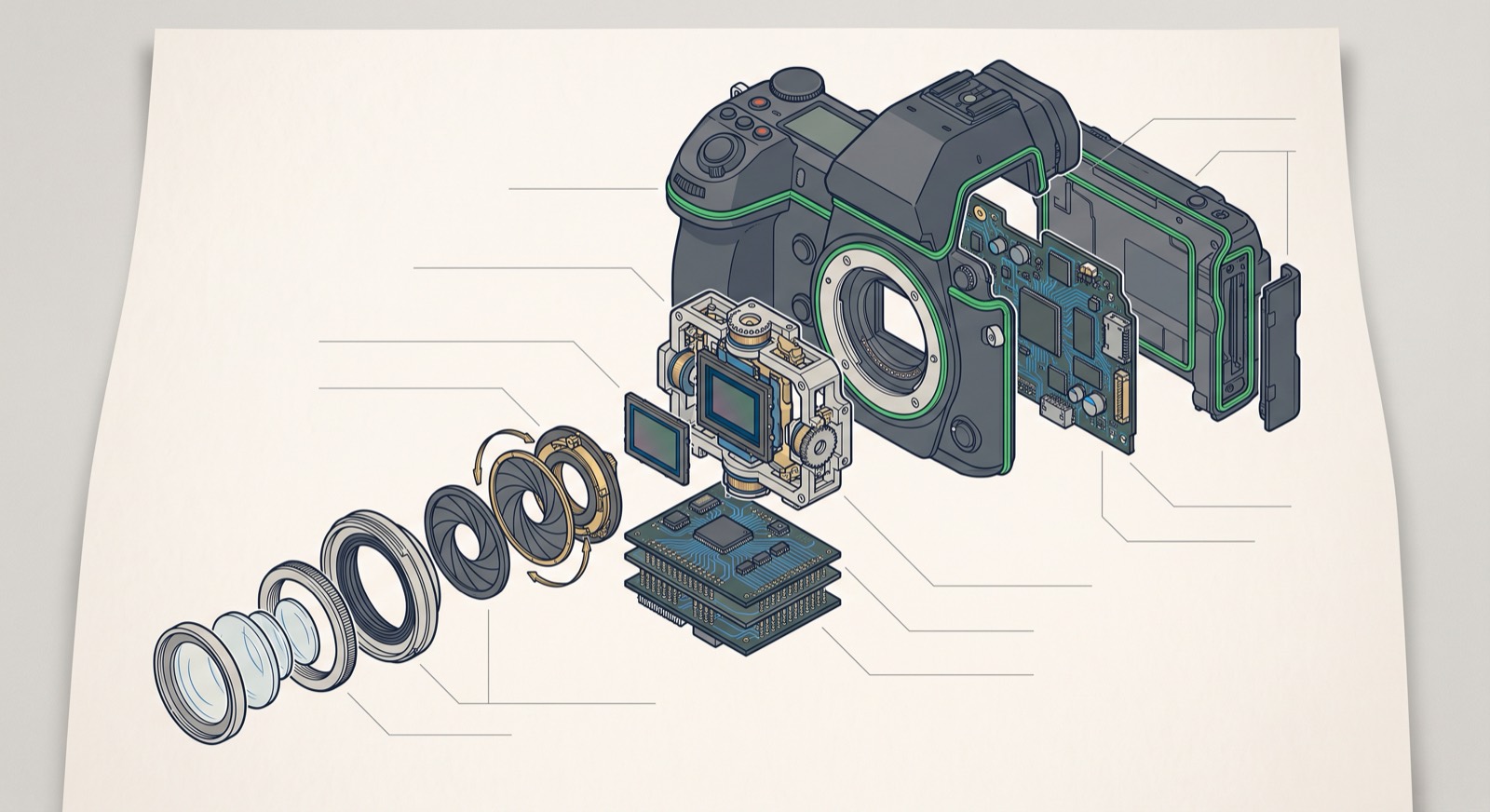
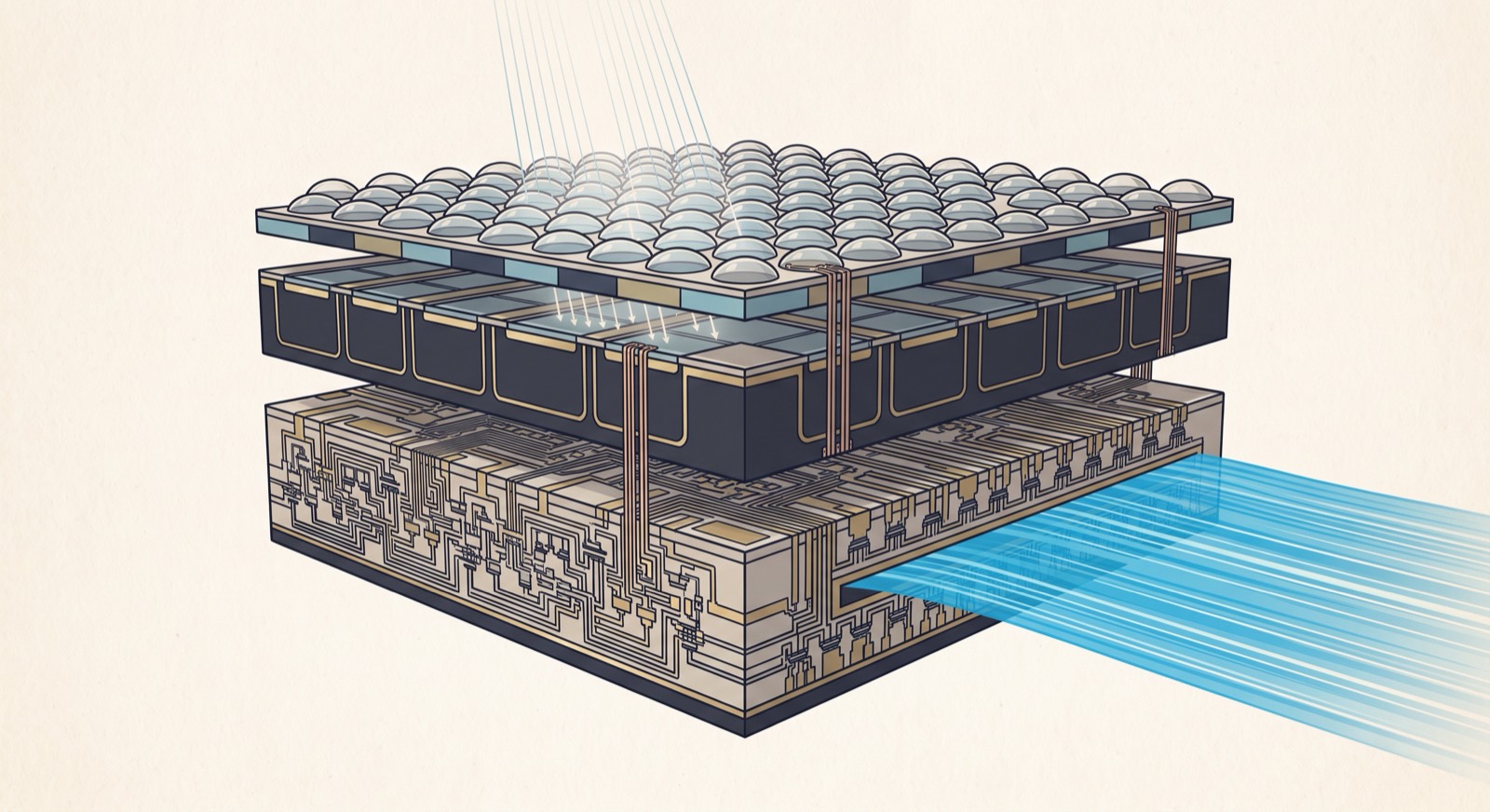
The stacked heart. The 20MP sensor is stacked BSI — readout electronics layered behind the photosites — and it reads out fast enough to change the camera's manners: an electronic shutter to 1/32000 with minimal rolling distortion, a blackout-free 120fps finder, silent 50fps bursts with continuous AF, and the pre-press time machine of §06. Speed, not resolution, is this sensor's argument.
The OM-1, unstacked — glass, iris, the sensor riding its five-axis cage, twin processing boards, and green gasket lines at every seam · rendered cutaway (Gemini), component order stylized
Why it is fast, not big — microlenses, photodiodes, and a whole floor of readout circuitry bonded beneath, dumping data sideways at speed · rendered cutaway (Gemini)
02 — Controls
A Cockpit, Banked by Mission
Where the X100VI hides its modes in dials, the OM-1 is a working cockpit: PASM dial, two command dials, an Fn lever that re-arms what those dials do, and more buttons than you should use. The grammar that matters: front dial exposure-adjust, rear dial the priority you're driving, lever position 2 for the alternates — then stop touching things.
C1–C4: The Real Mode Dial
Custom modes store the whole camera — drive, AF, subject detect, IS, button maps. Bank missions, not settings: C1 birds (S 1/2500 · SH2 · bird detect), C2 landscape (A f/5.6 · ISO 200 · tripod HHHR), C3 macro (stacking armed), C4 night (Starry Sky AF). Recall beats remembering — every time.
The Fn Lever Doubles Everything
Position 1: dials run exposure. Position 2: the same dials run ISO and white balance (or whatever you assign). One thumb-flick, four controls, zero menus. Some shooters instead bind it to AF-mode swap — S-AF hiking, C-AF+detect the instant something moves.
Three Buttons Worth Remapping
AF-ON for back-button focus (half-press freed for metering), ISO where your thumb rests, and one button for subject-detect toggle. The OM menu is deep — the cockpit exists so you never revisit it in the field (§12).
Honest Dial Advice
You will live in A (static subjects), S (anything that moves), M + Auto-ISO (locked look, drifting light — EC still works, §03), and the C banks. The art-filter positions are for other people. B mode hides the computational gems: Live Composite and Live Time (§05).
Save from a fully configured camera: drive mode, AF behaviour, detection, IS, even button maps travel with the bank
03 — Metering
Declare the Tone: Spot HI & Spot SH
Every meter assumes the world averages to 18% gray — and drags whatever it reads toward that gray. The OM-1 carries the standard trio (324-area Digital ESP, center-weighted, 2% spot) plus two modes almost nobody else ships: Spot HI and Spot SH. They let you meter a tone and declare what it is — "this is white," "this is black" — killing the exposure-compensation arithmetic in one gesture. Tap the modes on the egret.
Set SPOT METERING to track the AF target in the custom menu — HI/SH then measure exactly what you’re focused on · needle = the meter’s opinion, histogram = the outcome
How do you know which situation you’re standing in? You don’t judge the scene — you read the camera. The finder shows the photograph you’re about to take; the histogram names the problem before the shutter fires.
EVF vs Your Eyes
Two eyes open — one on the finder, one on the world. When the white bird reads grey in the EVF, that gap is the meter failing, visible before capture. The caveat: LIVE VIEW BOOST → OFF for stills — boost brightens the finder for framing in the dark and quietly breaks the what-you-see-is-what-you-get contract.
The Histogram, Not the Needle
Cycle it in with INFO and read the shape: a middle hump on an even scene, trust it. A hump in the middle while you look at snow, dial + or declare it with Spot HI. Two masses, choose a side. Piled left at night is correct — lifted means mud.
Red & Blue Patches
Highlight&Shadow warning paints blown areas red and crushed areas blue, live in the finder. Set the thresholds near 250 / 5 so the warning fires just before the wall, not after. Blown is forever; crushed usually lifts.
Skip the Arithmetic
The manual method: spot the brightest thing that must hold detail, spot the darkest, count the swing — beyond ~5 stops one frame won’t hold both. The OM-1 method: one press. Spot HI declares the white, Spot SH declares the black, exactly as the simulator above shows.
Setting names as printed in the OM SYSTEM OM-1 instruction manual.
Why this matters
Spot HI replaces "+1⅔ and hope." On the X100VI you spot-meter a white and dial compensation from memory (its §03); here you press one button and the camera places the tone. Egrets, snowfields, black bears, stage light — the two hardest metering days become the two easiest. EVF shows the result live; the histogram settles arguments.
04 — Autofocus
A Thousand Crosses and a Bird Brain
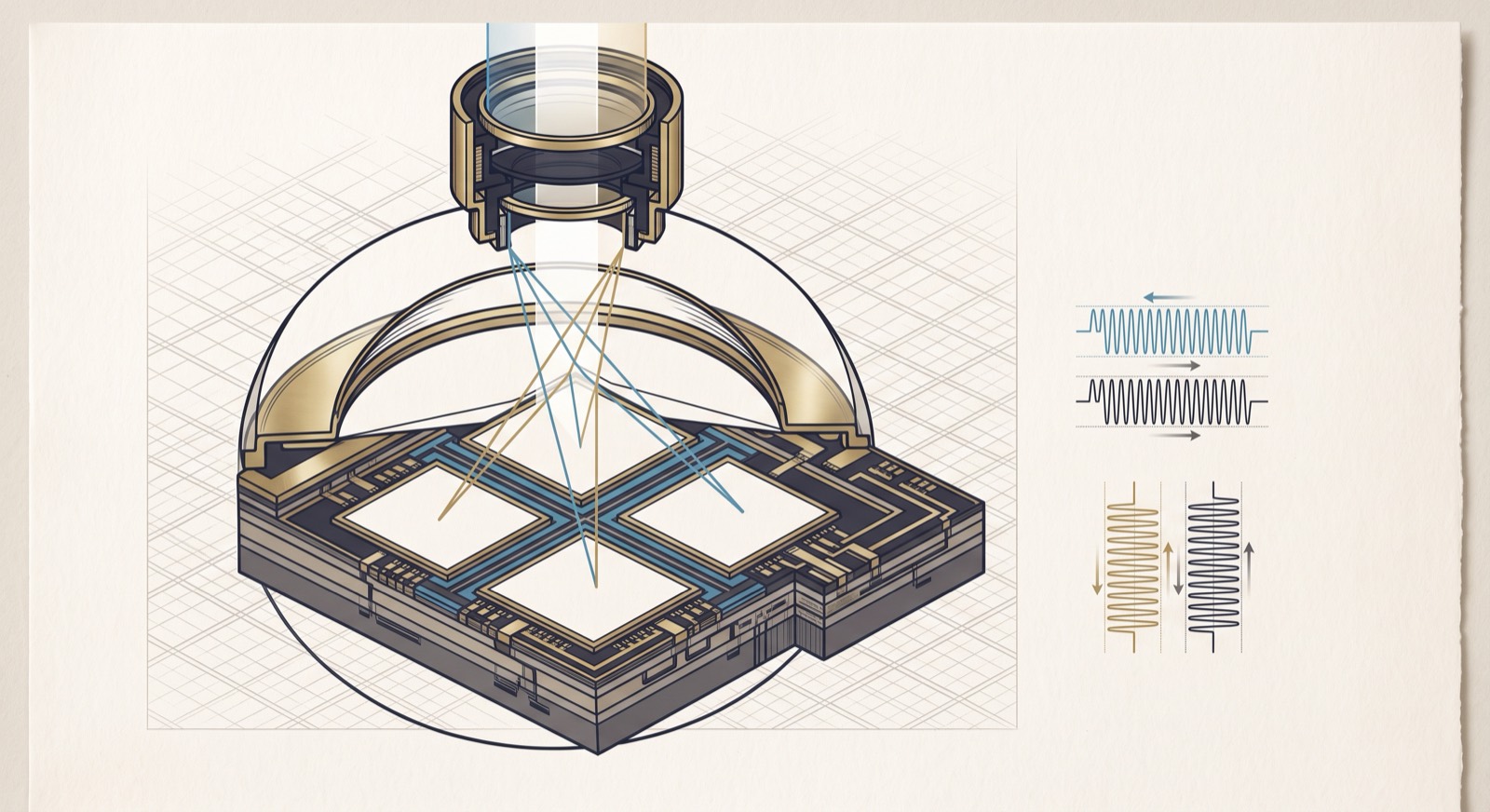
Every one of the OM-1’s 1,053 phase points is cross-type — each pixel split four ways (quad-pixel AF), reading focus on horizontal and vertical detail across the whole frame. On top sits TruePic X subject detection: birds, mammals, motorsport, aircraft, trains, plus human face and eye. The practical consequence: you stop steering AF points and start composing while the camera holds the eye.
The Working Combo
C-AF + subject detect + a mid-size target zone. Let detection find the eye inside your zone rather than using full-auto area (which loves the wrong bird). Old-style C-AF+TR tracking is superseded — leave it off. Detection survives brief occlusion: hold the zone, keep panning.
Back-Button, Two Speeds
AF-ON for C-AF, shutter half-press disabled for focus (§12): thumb drives focus, finger drives timing. Add the AF limiter for long glass — fencing off the near range kills 90% of hunting on busy backgrounds.
C-AF Temperament
Sensitivity −1 or −2 for birds against branches (stick with the subject through clutter), +1/+2 for erratic motorsport lines. Center-start ON for takeoffs. These two menus are the AF system — everything else is inherited defaults.
Low Light & Stars
Cross-type points hold to about −8 EV with fast glass — dusk wildlife stays sticky. And when the sky itself is the subject, Starry Sky AF (§05) focuses on actual stars — no more infinity-mark guessing on a cold tripod.
Negative sensitivity = stubborn (holds your subject through obstructions) · positive = eager (jumps to whatever enters the target)
Quad-pixel AF — one microlens, four quadrants: horizontal and vertical detail read at once, which is what “all 1,053 points are cross-type” actually means · rendered cutaway (Gemini)
05 — The Computational Darkroom
Filters You Can’t Screw On
This is the OM-1’s leaf-shutter moment — the section its rivals can’t follow. The stacked sensor and TruePic X turn tripod-and-filter rituals into menu items that preview live in the finder. Six of them earn permanent space in your muscle memory:
Live ND · ND2–ND64
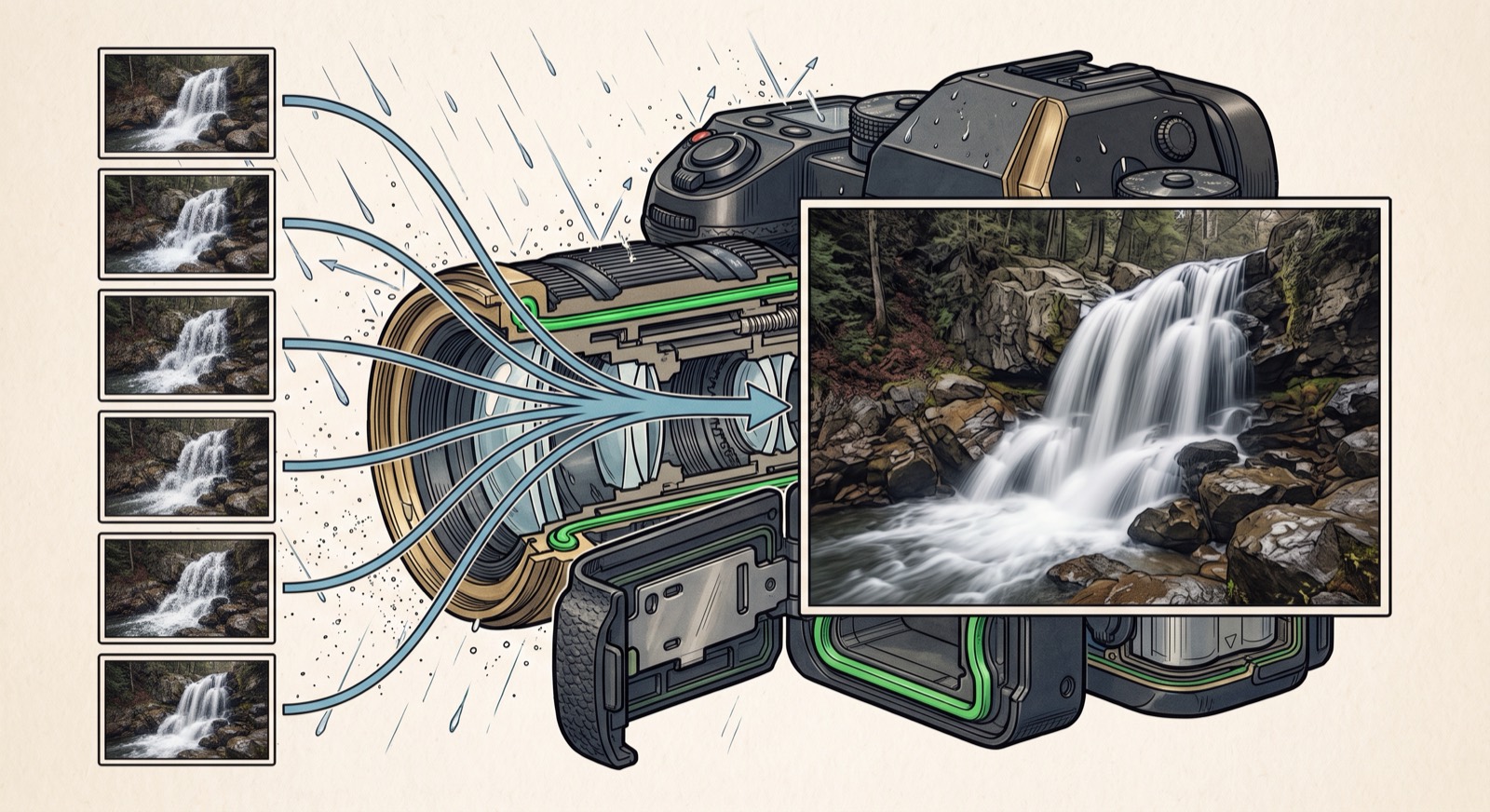
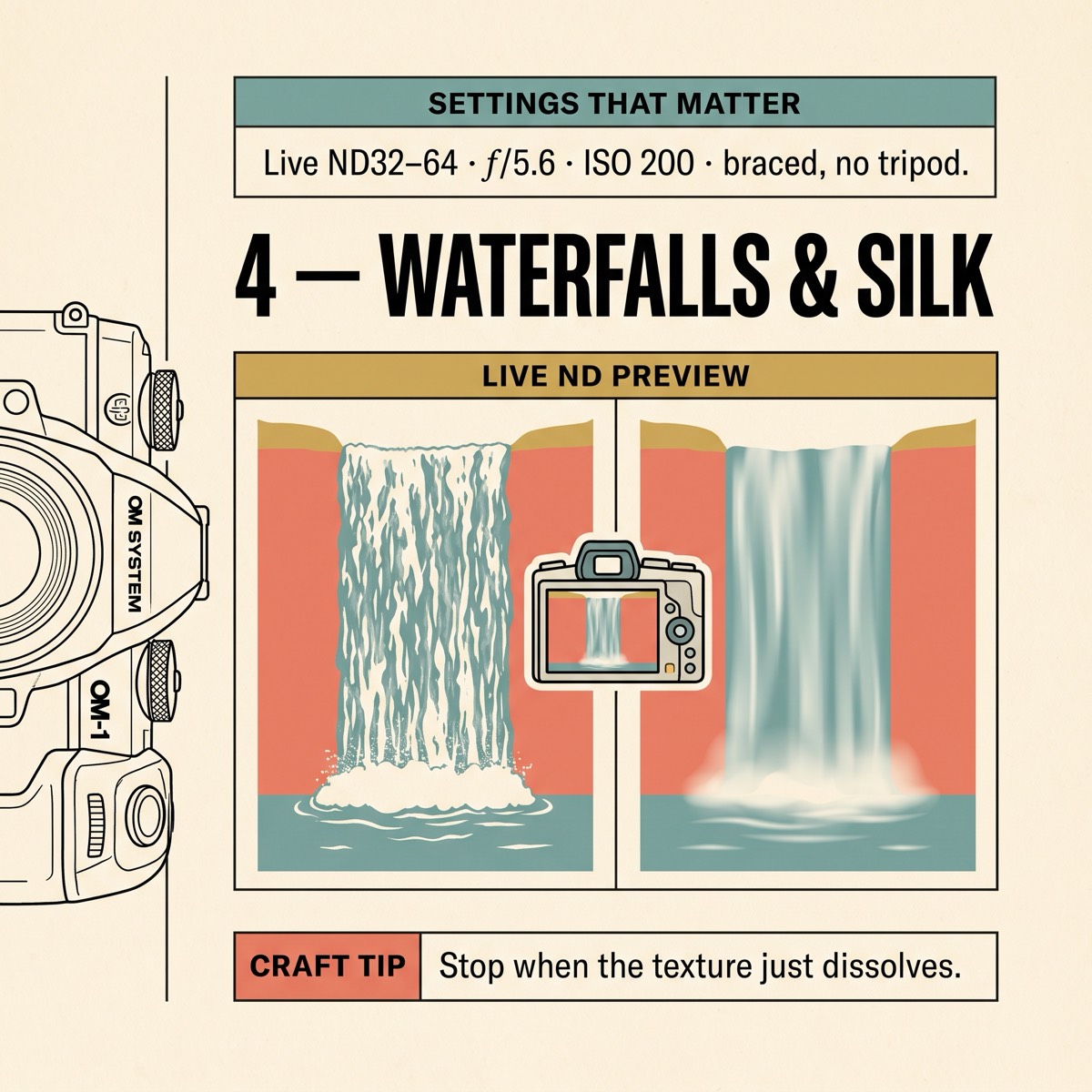
Frame-averaging that synthesizes up to 6 stops of neutral density — silky water at noon, no glass on the lens, the blur previewed live before you commit. Ceiling: it extends shutter time, it can’t freeze; and specular suns still prefer real glass. Waterfall recipe in §11.
Live Composite
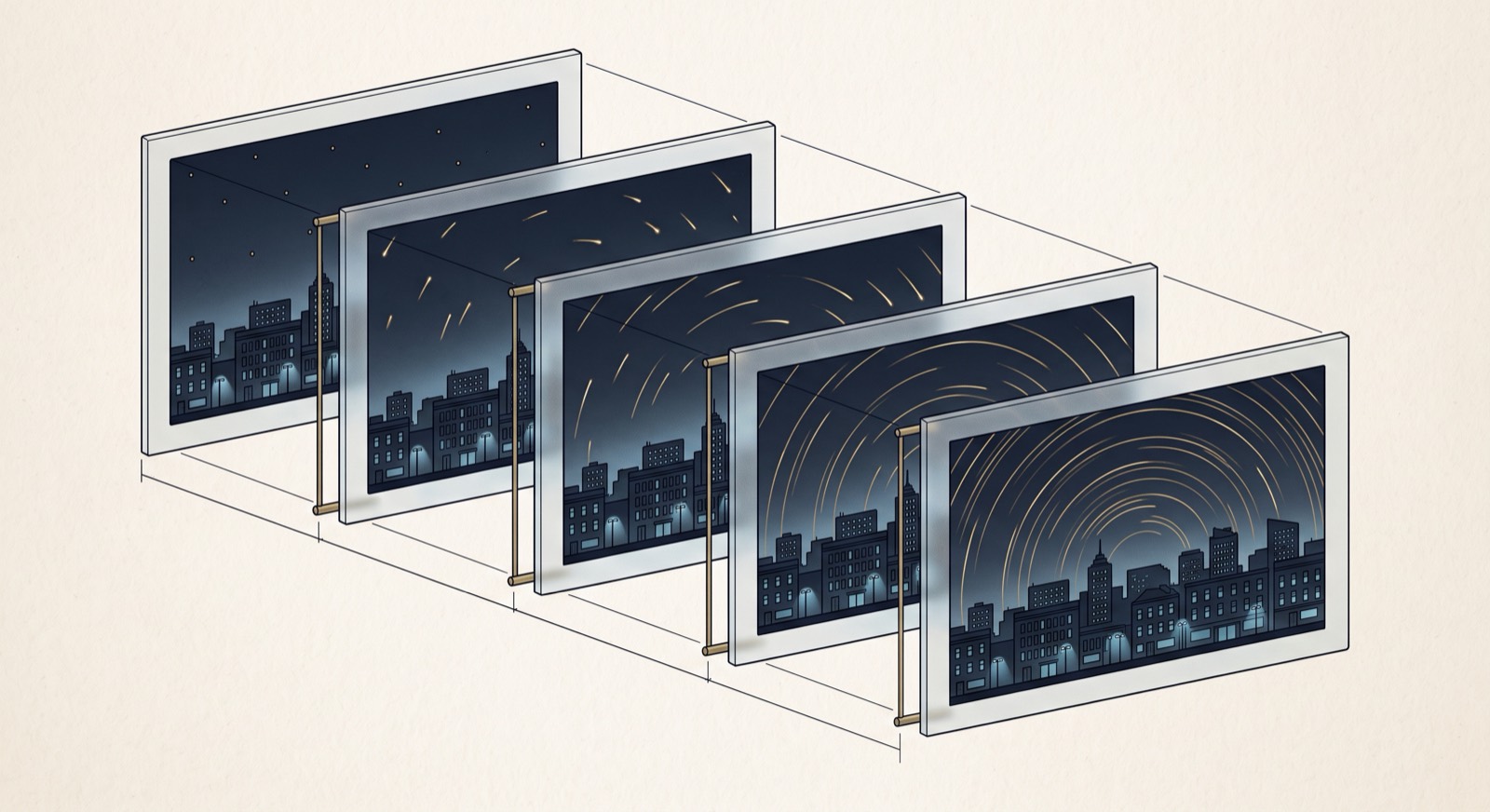
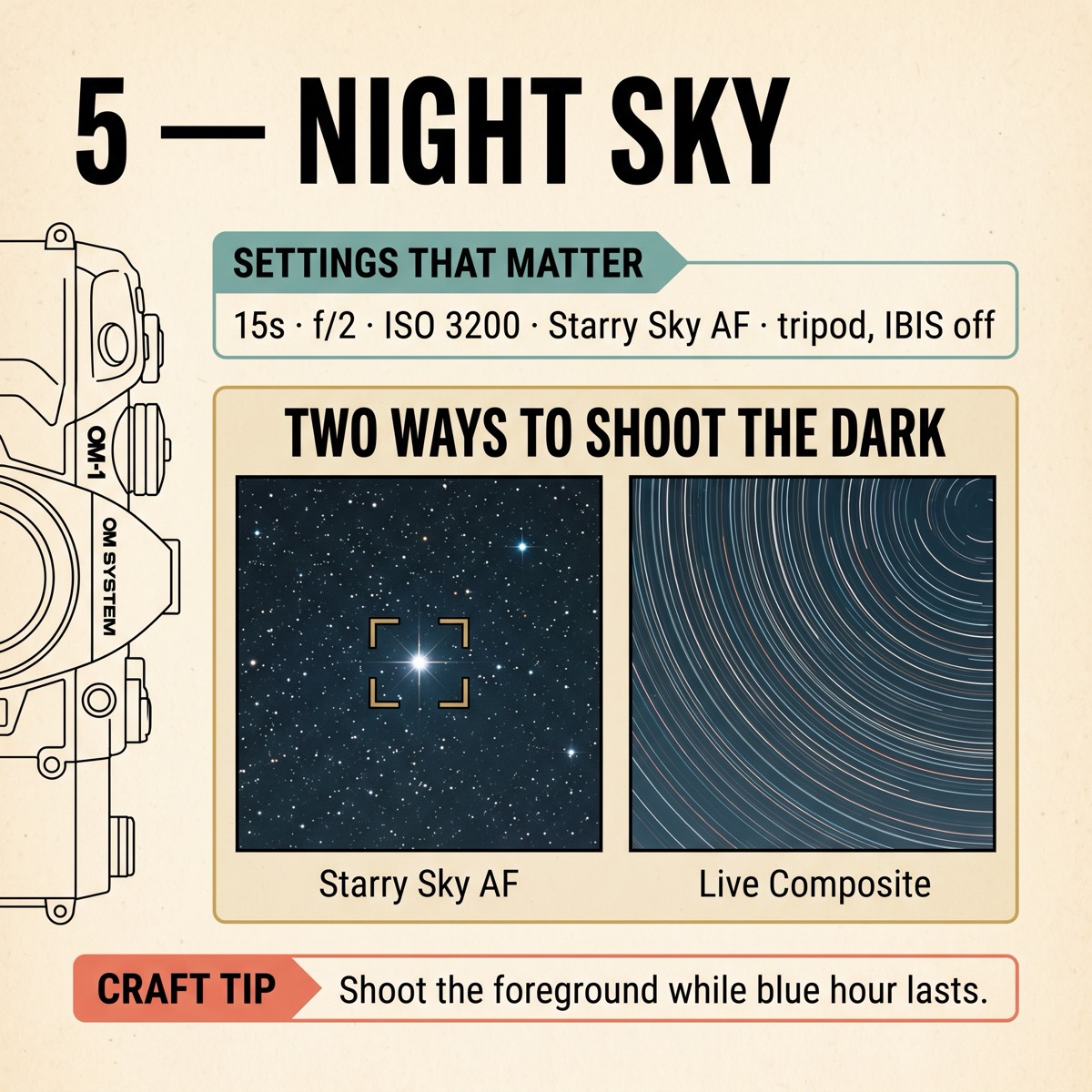
One base exposure, then the sensor adds only new light — star trails draw themselves across the EVF while the city stays unblown. Fireworks, light painting, lightning. Hours of accumulation without touching the base ambient: the mode that looks like cheating.
Handheld High Res · 50MP
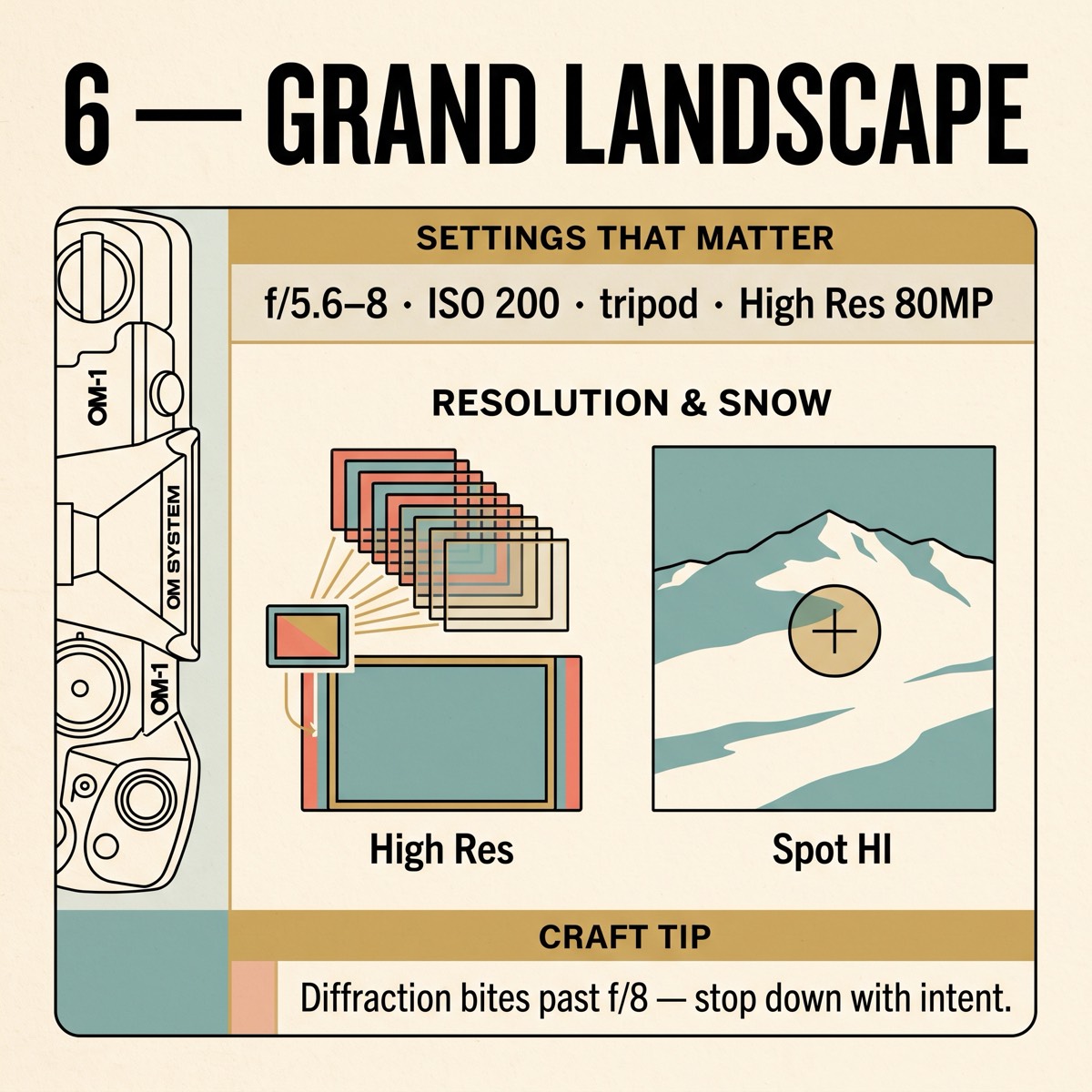
Sensor-shift stacks eight frames into a 50MP file, no tripod (80MP with one). IBIS supplies the micro-jitter. Needs a mostly-still scene — architecture, landscapes in calm air. The 2× system suddenly prints like medium format on a good day.
In-Body Focus Stacking
Up to 15 frames merged in camera (999 raw frames via bracketing) with compatible lenses — macro depth without software. f/4–5.6 per slice beats f/11 diffraction. The 60mm and 90mm macros were designed around this (§09).
Starry Sky AF
An AF mode that focuses on stars — actual astrometry, Speed or Accuracy flavors. Wide-open primes land pin-sharp Milky Way frames in seconds. Pair with Live Composite for trails, or 8–15s singles for the core (§13).
Live Time & Bulb
Long exposures that develop before your eyes — the EVF updates mid-exposure so you end it when the frame is done, not when the math said. The B position on the dial hides all three Live modes; visit it on purpose.
Live Composite, frame by frame — only new light is added, so trails grow while the skyline holds the exposure it had in frame one · rendered illustration (Gemini)
Live ND, demystified — a burst of ordinary frames averaged into one silky exposure, previewed live before you commit · rendered illustration (Gemini)
06 — Speed
The Moment Before You Pressed
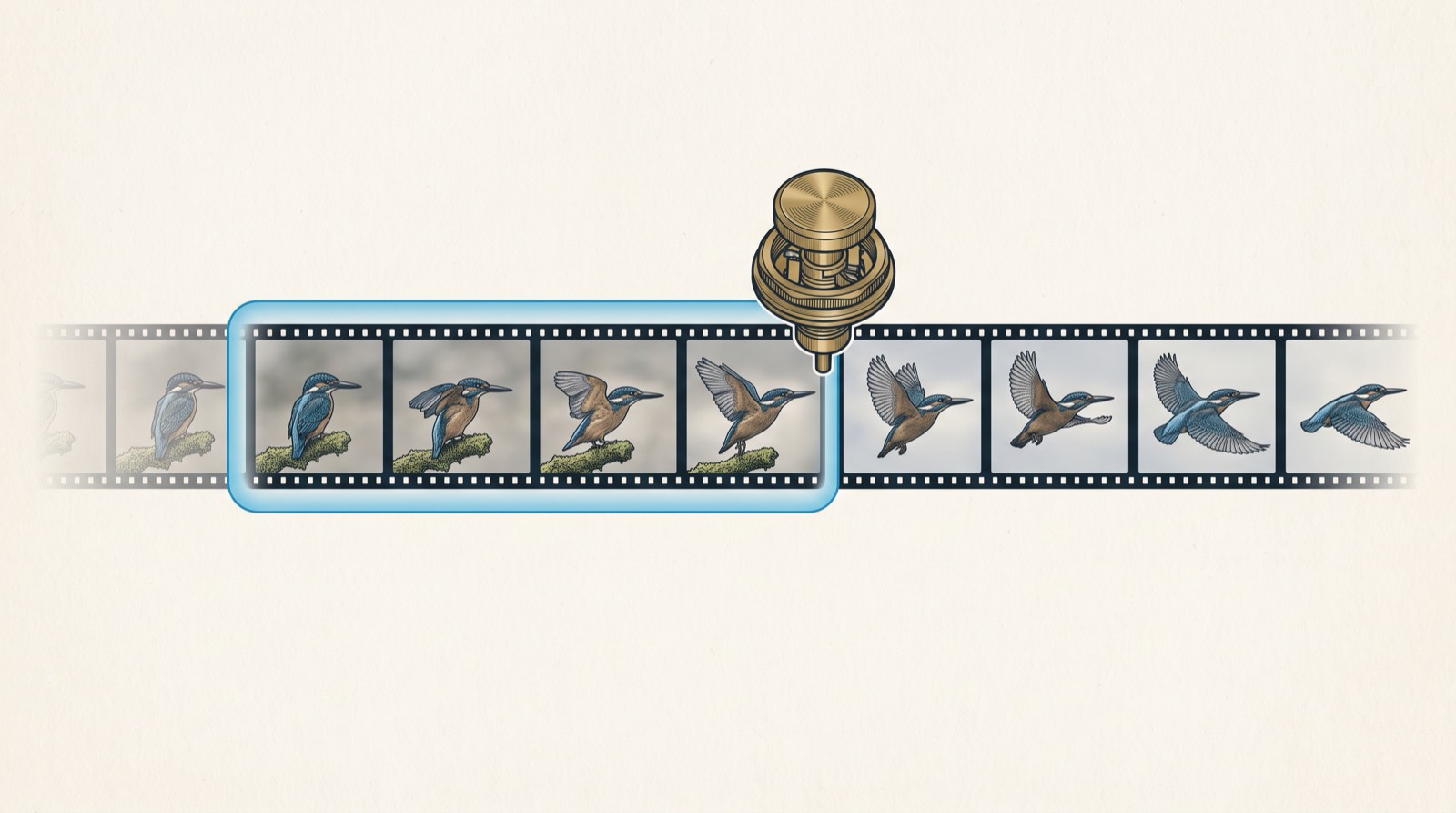
ProCapture is the honest cheat: half-press and the camera silently rolls a buffer; full-press keeps up to 70 frames from before your reflexes fired. The kingfisher already left — you have the takeoff anyway. With SH2 at 50fps with C-AF (25fps with any lens) and a 120fps blackout-free finder, the OM-1’s speed story is simple: the decisive moment stops being a reflex test.
ProCap Discipline
Set pre-shutter frames to ~35 and a frame limit — unlimited 50fps ProCap fills cards and buries keepers. Half-press early and breathe; the buffer is your patience. Best on perched-to-flight, splashes, bat-on-ball.
Which Burst When
SH2 50fps: needs the fast PRO lenses, C-AF live. SH2 25fps: any lens, still silent. Mech 10fps: flicker-proof under bad gym light. The e-shutter’s stacked readout means banding and rolling skew are rare — silent is the default here, not the compromise.
Buffer & Cards
50fps eats ~90 raws in under two seconds; a V90 UHS-II in slot 1 keeps the pipe open (slot 2 UHS-II too, use it as overflow, not mirror, on burst days). Cull on the camera ruthlessly — star ratings survive into Lightroom.
Blackout-Free Means Panning
The 120fps EVF never blinks during bursts — you watch the bird through the sequence instead of reconstructing it. That, not the frame rate, is what raises the keeper count: tracking is a vision problem before it’s an AF problem.
ProCapture — the shutter press marks the end of the kept frames, not the start: the takeoff you reacted to was already recorded · rendered illustration (Gemini)
07 — Stabilization
Seconds, Handheld
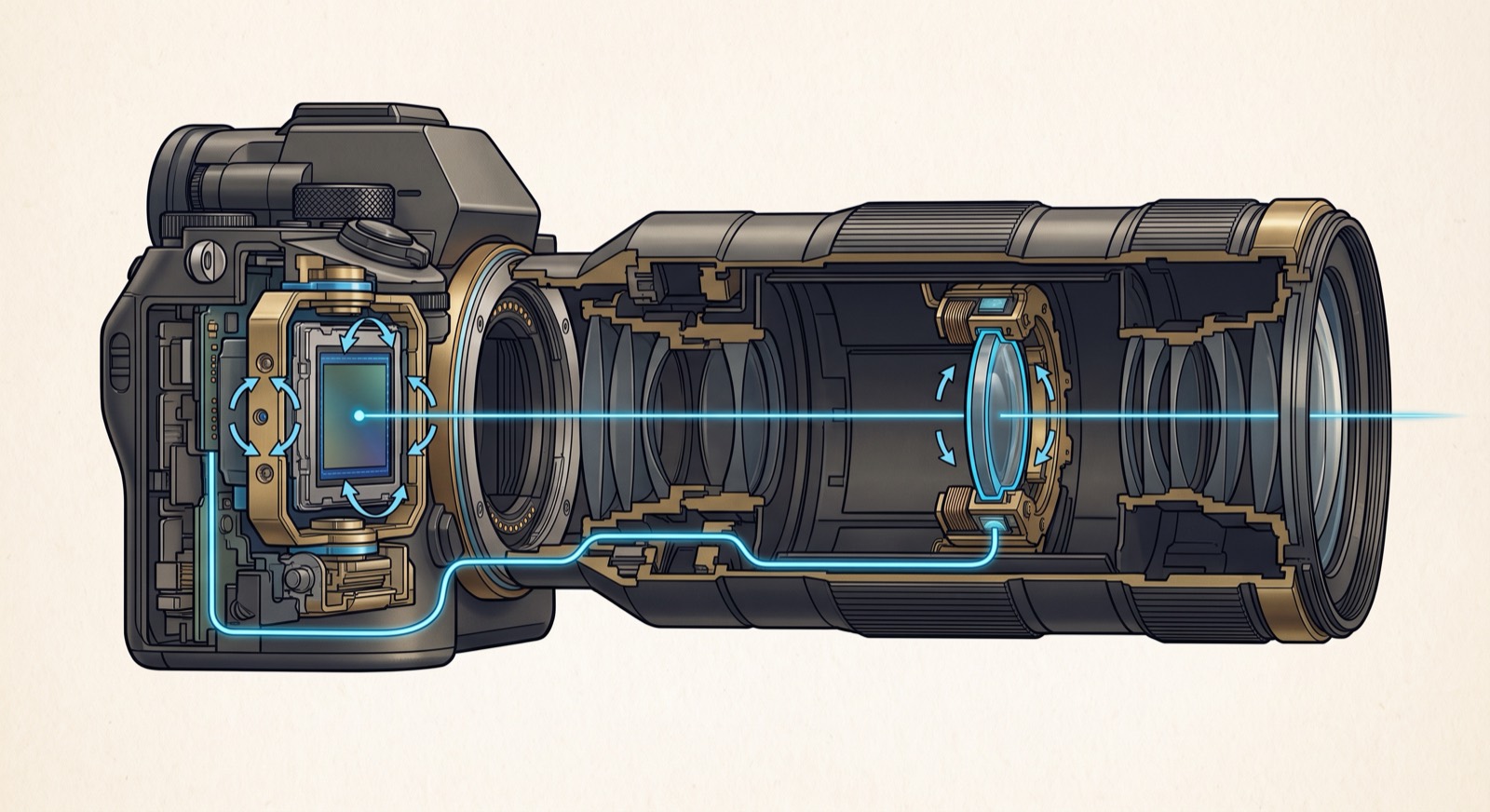
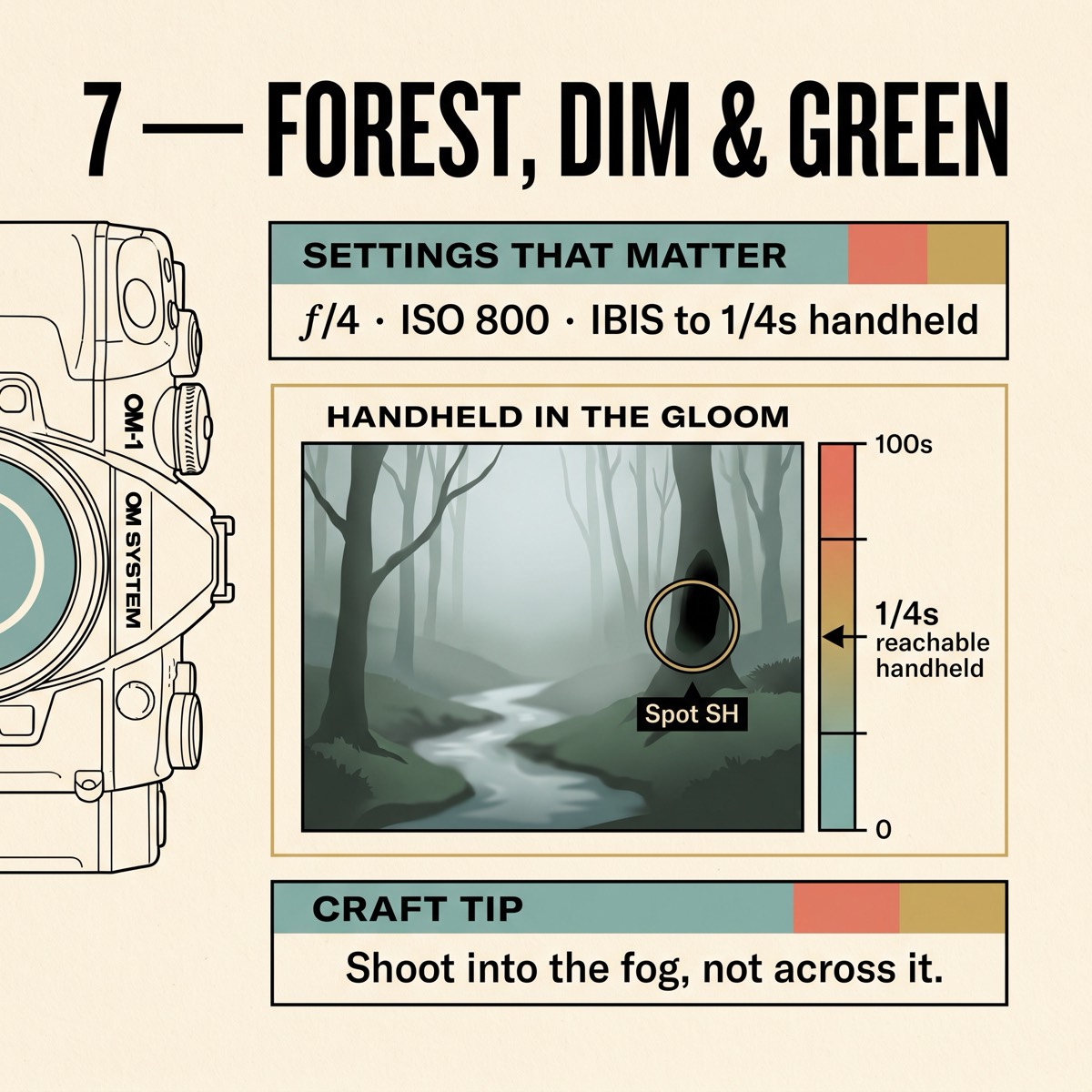
The OM-1’s IBIS is rated 7 stops, and 8 with Sync-IS lenses (12-100 f/4, 300 f/4, 150-400) where body and lens stabilizers steer together. In practice that reads as: 2–4 second handheld exposures land, waterfalls go silky without a tripod, and the 600mm-e end of a zoom holds steady enough to compose like a normal lens. It cannot freeze subjects — the physics disclaimer never changes.
The Handheld-Seconds Kit
Elbows in, strap tensioned, exhale, 3-frame burst — the middle frame wins. Start at 1s and work up; 4s is real with Sync-IS and a wall to lean on. IBIS + Live ND (§05) is the tripod you didn’t pack.
Long-Lens Steadiness
At 600–800mm-e the finder itself is stabilized — compose first, then half-press and let IS settle a beat before the burst. Brace the lens foot, not the body. IS-Priority in menus if you value viewfinder calm over the last half-stop.
When to Turn It Off
Rigid tripod + long exposure: IBIS auto-detects and stands down, but Live Composite marathons deserve a manual OFF. Panning: leave IS on — the OM-1 detects the sweep and drops the horizontal axis on its own.
What 8 Stops Buys Daily
Base-ISO dusk streets, sharp 1/4s forest interiors (§13), museum interiors at ISO 400 instead of 6400 — the deep-DOF sensor plus impossible shutter speeds is how MFT climbs back two low-light stops it gave away on paper.
A 4-second handheld frame and a blurred bird are the same photograph to IBIS — it never sees the subject move
Sync-IS — body cage and lens element steering as one system, which is where the 7th and 8th stops come from · rendered cutaway (Gemini)
08 — Weather
Built for the Bad Days
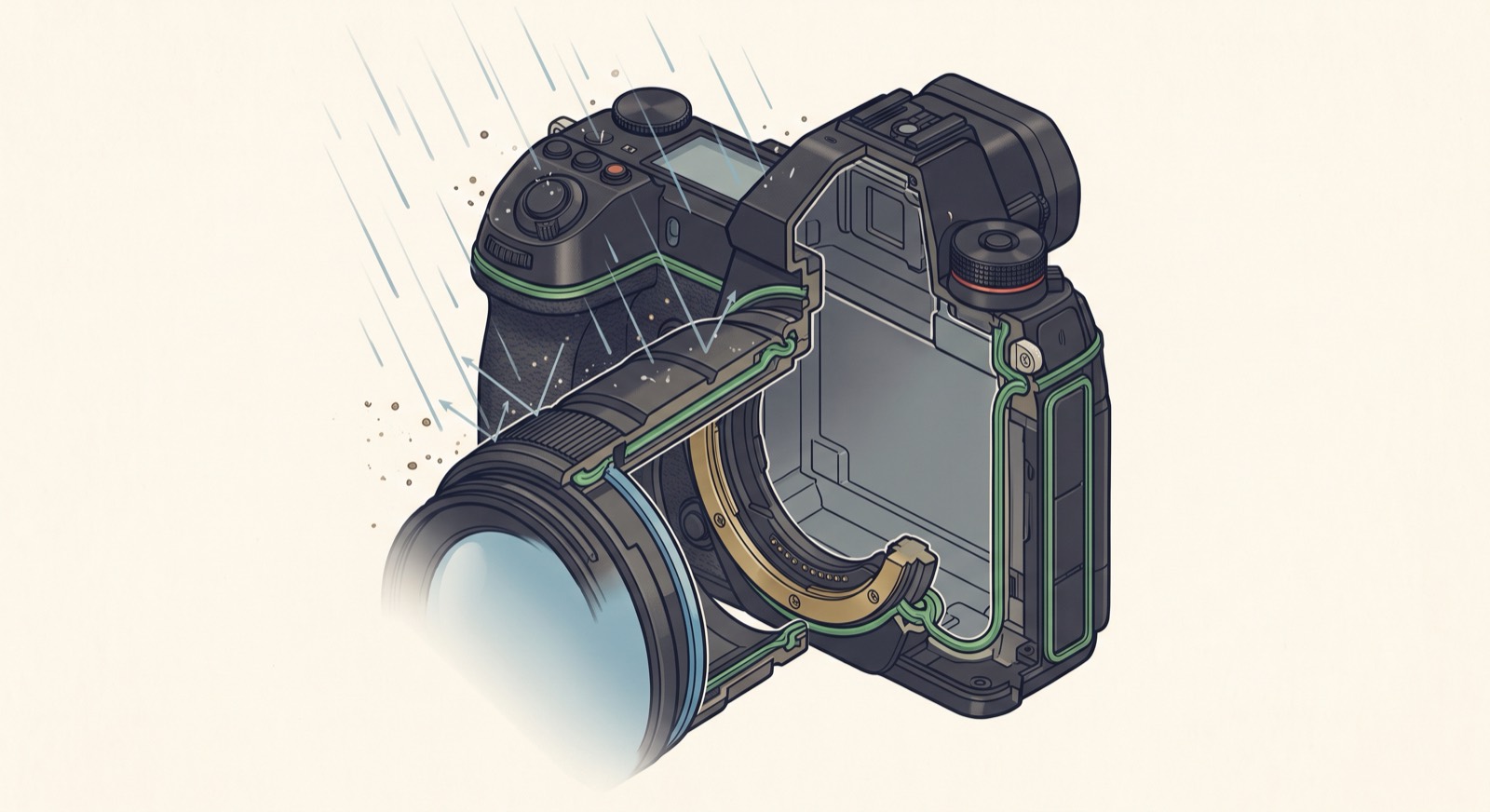
The OM-1 is rated IP53 with a sealed lens — a real ingress-protection certification, not marketing "resistance" — and freezeproof to −10°C. This is the camera you keep shooting while others bag theirs: storm light, spray, dust, snow. The photographs nobody else stayed out for are the entire dividend.
Rain Ritual
Sealed body + sealed lens = shoot through it; wipe with a cloth, shade the front element with your hand or hood. The one rule: no lens swaps in falling water — change under a jacket or not at all. Dry the gasket lines at night, cap off.
Cold Ritual
Cold kills batteries, not cameras: spares warm in an inner pocket, swap fast. Exhale away from the EVF. −10°C is the rating; below it the camera usually keeps going after the shooter quits.
The Transition Kill-Zone
Condensation happens going cold → warm: bag the camera outside, let it reach room temperature sealed. Same in reverse for tropical humidity. The weather sealing protects from water, not from dew forming inside a cold lens.
Coast & Dust
Salt spray: fine while shooting, but fresh-water-damp wipe the same evening — salt crystals abrade seals over months. Dust: the sensor shake + sealed body make the OM-1 the sanest choice for deserts and volcanic grit.
What IP53 looks like from inside — continuous gasket lines at every seam, mount to card door, deflecting rain and dust before they find a path · rendered cutaway (Gemini)
09 — Glass
The Lens Map, by Mission
Buy lenses by mission, not focal length — and read every number twice (framing ×2, depth two stops deeper). The system’s crown jewels are its weather-sealed PRO zooms and two macros with no full-frame equal per gram:
Everyday · 12-40 f/2.8 PRO
24–80mm-e, sealed, close-focusing, clutch MF. The default first lens — reportage to environmental portrait, and its 0.3× near-macro moments surprise people. II version = same optics, better coatings.
One-Lens Travel · 12-100 f/4
24–200mm-e with Sync-IS — the 8-stop partner (§07). The single-lens trip answered: city wides to compressed ridgelines, handheld seconds at dusk. f/4 on MFT is deep — embrace it, this is the sunny-trip lens.
Reach · 100-400 or 300 f/4
200–800mm-e zoom for flexibility, or the 600mm-e f/4 prime with Sync-IS for serious birds. Add MC-14/MC-20 teleconverters and the prime hits 1200mm-e handheld — the sentence that sells the whole system.
Macro · 60 f/2.8 or 90 f/3.5
The 90mm PRO does 2× native — 4× equivalent — sealed, Sync-IS, stacking-native (§05). Nothing in full frame touches this working envelope handheld. The 60mm is the light, older, still-excellent path in.
Fast Primes · 17 / 25 / 45
The f/1.2 PRO trio renders genuinely shallow (f/2.4-e depth) with pro AF speed; the f/1.8 trio gives 80% of it at a third the weight and price. 45/1.8 is the sleeper portrait lens of the entire format.
Wide · 8-25 f/4 PRO
16–50mm-e in one sealed ring — landscape and architecture without the filter-thread drama of the 7-14. Pairs with HHHR (§05) for files that print far beyond what 20MP suggests.
10 — Overlap
Two Lenses, One Number, Different Pictures
Own the 12–40 and the 40–150 and you own 40mm twice. Set both to 40, photograph the same thing, and the two files don’t match — the second one usually looks better, and the tempting explanation is that the heavier lens is simply the better lens. Some of that is true. Most of it isn’t. Here is what actually happens, in the order it matters.
The part that isn’t the lens
Perspective comes from where you stand, not from what you screwed on. Same spot, same 40mm, same f-number — the geometry and the depth of field are identical. If two 40mm frames look like different focal lengths, your feet moved, not the optics.
And your feet do move, reliably, because of what else is in the barrel. Reach for the long zoom and you have already decided you are staying back; reach for the standard zoom and you are willing to walk in. Across one photographer’s library — 247 frames at 40mm on the 12–40, 276 on the 40–150 — the typical working distance more than doubles when the long lens is on the camera, and the near end vanishes entirely, because a lens that focuses no closer than 0.7m simply cannot be used there.
247 and 276 frames at exactly 40mm, focus distance read from the raw files
The near end is the standard zoom’s private territory and worth knowing about. The 12–40 focuses to 0.20m and reaches 0.3× magnification; at 40mm the long zoom manages roughly 0.065× before it runs out of focus travel. That is about four and a half times more subject, at the same marked focal length. It gets there partly by cheating — at its closest the 12–40’s “40” behaves like something nearer 35mm. Every zoom does this; it only becomes visible at the extremes.
So Why Does the Big One Look Sharper?
Three reasons, and the first one is a habit rather than a lens.
You stop the small lens down and shoot the big one wide open. At 40mm, nearly half the standard-zoom frames sit at f/8 or smaller, against roughly a quarter of the telephoto ones. On a 20 MP Micro Four Thirds sensor the pixels are 3.36 µm apart, and by f/9 the smallest dot the lens can draw is already 3.6 pixels wide. You are handing one lens a two-stop handicap and then judging the results side by side.
40mm is the worst place on one lens and nearly the best on the other. It is the far end of the 12–40’s travel, where a standard zoom is always working hardest; it is the near end of the 40–150’s, which is where a fast telephoto zoom is most relaxed. Published measurements agree: the 12–40 softens slightly at 40mm and prefers f/4, while the 40–150 is excellent in the centre at 40mm from f/2.8 and only tails off near 150.
And the big barrel is barely trying. Both lenses need the same 14.3mm opening to give f/2.8 at 40mm. For the 12–40 that is everything it has. For the 40–150 — built to hold f/2.8 all the way to 150mm, which needs a 53.6mm opening — it is about a quarter of the diameter and a fifteenth of the area, taken from the calm middle of a much larger optical path. That is what the extra 378 grams and the fatter filter thread are actually for, and it is why the wide end of a fast telephoto zoom is nearly always its best setting.
Maximum aperture — both f/2.8, so the same light and the same depth of field at the same distance. Perspective — a function of your position only. Exposure — the dials mean what they say on either lens.
Genuinely different
Where 40mm sits in each zoom’s range, and how much of its aperture the lens is using to get there. Close focus — 0.20m against 0.70m. Blades — seven against nine, so 14-point sunstars against 18-point once you stop down.
The hidden bill
Reaching 12mm at f/2.8 costs the standard zoom 8.5% barrel distortion, straightened in software before you ever see the file — which means stretched, resampled corners. The telephoto zoom’s worst is 2%, corrected to almost nothing.
What the small one owns
Half a metre of close focus the other lens cannot reach at all, 0.3× magnification, and 378 fewer grams around your neck. At two metres and closer there is no contest, because there is no competitor.
What to do about it
Most of the gap is yours to close: shoot the standard zoom at 40mm between f/4 and f/5.6. That is where its own optimum sits and where the smallest drawable dot stays under two pixels. What you cannot close is the last of the edge performance — at 40mm the long lens really is better glass. Just make sure you are losing to the lens and not to your own habit of stopping down.
11 — Techniques
Field Recipes
Six repeatable recipes that string the previous sections together — set them up once as C-modes (§02) and the field work becomes pointing and patience.
Bird-in-Flight Ladder
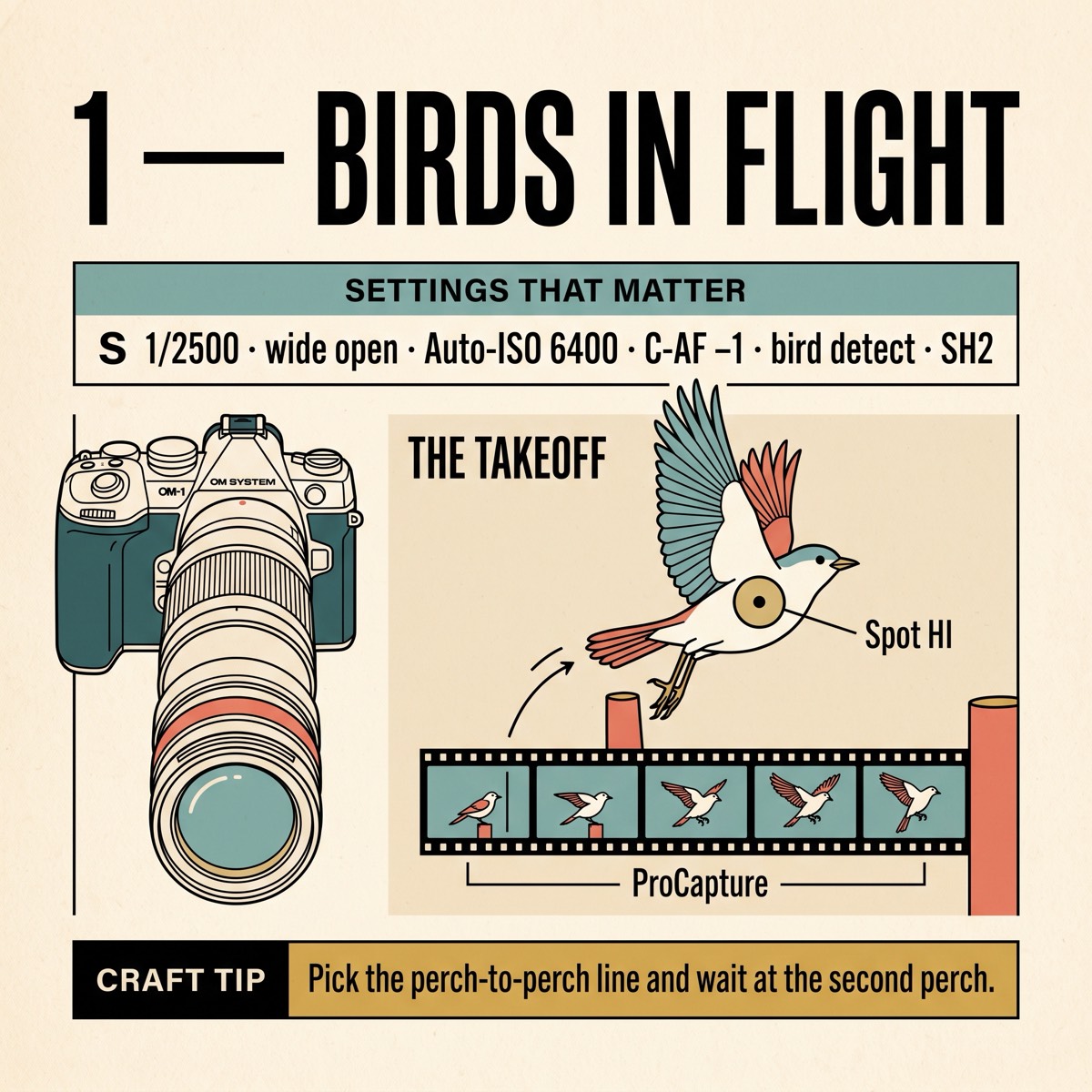
S 1/2500 · wide open · Auto-ISO cap 6400 · C-AF −1 · bird detect · SH2 25/50. Background before bird: reposition until sky or water sits behind the flight line. Track through the EVF with both eyes open; burst on the wingbeat rhythm.
Waterfall Without a Tripod
Live ND32–64 (§05) · f/5.6 · ISO 200 · IBIS braced (§07). Preview the silk live, anchor on rocks, fire a clean 1/250 frame too — the pair often composites best. Polarizer still owns the wet-rock glare.
Macro Stack, Field Grade
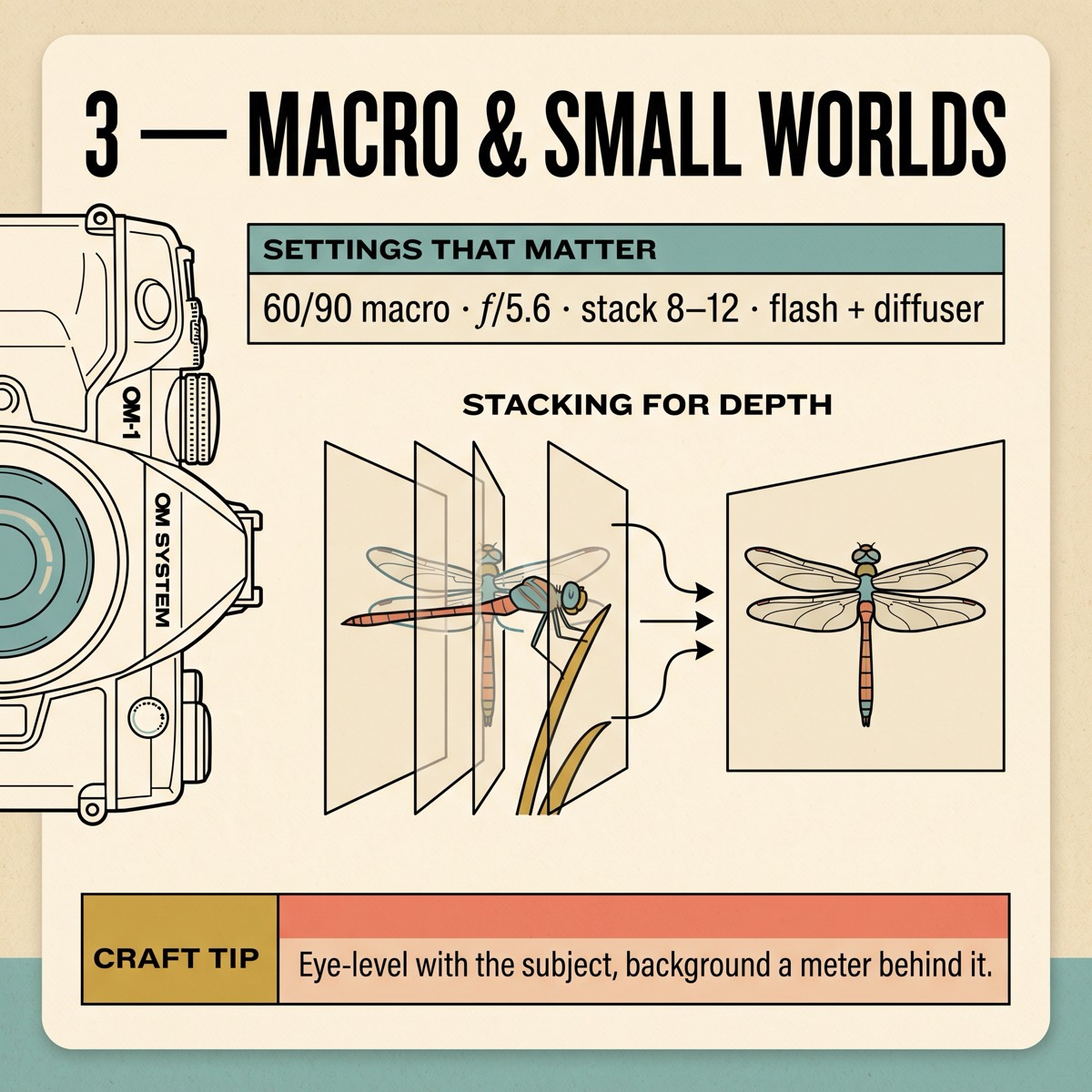
f/4–5.6 · stack 8–12 · flash + diffuser — flash freezes what wind moves, stacking buys the depth f/11 would have smeared with diffraction. ProCap the moments between gusts. Focus on the near eye; let the stack walk backward.
Milky Way, Fast
12mm f/2 (or 8-25 wide) · 15s · ISO 3200 · Starry Sky AF (§05) · IBIS off, tripod. Shoot the core, then flip to Live Composite and let trails draw for the second image the same night. −10°C rating means the camera outlasts your toes (§08).
The 800mm-e Discipline
Long glass magnifies technique: 1/(2× equivalent) shutter unless braced, IS settle-beat before bursts, AF limiter fencing the near field (§04), and heat shimmer as the real ceiling — distance work belongs to cold mornings.
Exposing MFT Files
Protect highlights; the shadows lift cleanly for two stops. In hard light bias −⅓ EV, or better: Spot HI the brightest thing that must hold detail (§03). At ISO 6400+ expose generously — underexposed MFT is where the format’s critics live.
12 — Setup
Deep Menu, Shallow Field Life
The OM menu is famously deep. The strategy is the same minimalism as its rangefinder sibling: one honest afternoon of setup, four C-banks, then never open the menu outdoors again.
Once, in the Menus
Back-button AF (AF-ON, half-press focus OFF) · spot metering linked to AF target (§03) · release priority OFF in S-AF (sharp beats fast) · EVF 120fps · e-shutter default · RAW+JPEG to slot 1 V90.
The Four Banks (§02)
C1 birds · C2 landscape · C3 macro · C4 night. Save from a fully-configured state, and re-save the bank the moment you improve a recipe — stale banks are how C-modes die. Name them in-menu so future-you trusts them.
Power & Cards
BLX-1 ≈ 500 frames (thousands on burst days) — two spares for a full wild day, warm pocket in winter (§08). USB-C PD charges in-camera: the power bank that tops your phone tops the camera at lunch.
Gems in the Depths
OI.Share app pulls JPEGs and GPS logs · focus peaking + magnify on the clutch lenses · anti-flicker scan for gym light · custom self-timer (e.g. 3 frames, 2s apart) as a poor-man’s intervalometer · in-camera raw develop for field edits.
13 — Field Missions
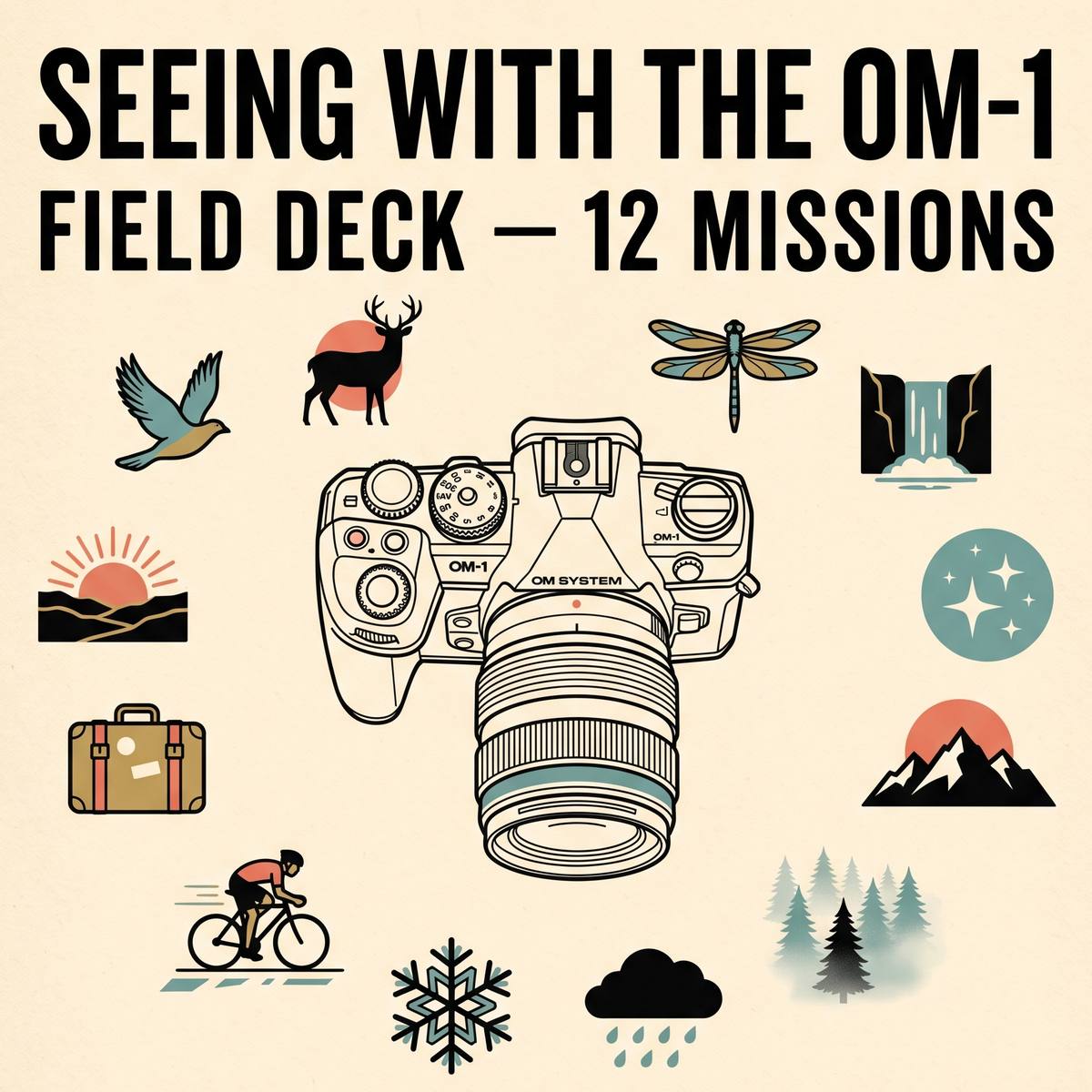
Twelve Days Out
Twelve days this camera was built for — each one a bank you can save (§02) and a reason the format exists. Baselines assume the §12 setup; the notes name only what changes: settings, the metering move (§03), and the thing nobody tells you until you have stood there.
Birds in Flight
C1: S 1/2500 · wide open · ISO auto-6400 · bird detect · SH2. ProCapture armed for takeoffs (§06). White birds: Spot HI the plumage (§03). Craft: pick the perch-to-perch line and wait at the second perch.
Wildlife · Mammals
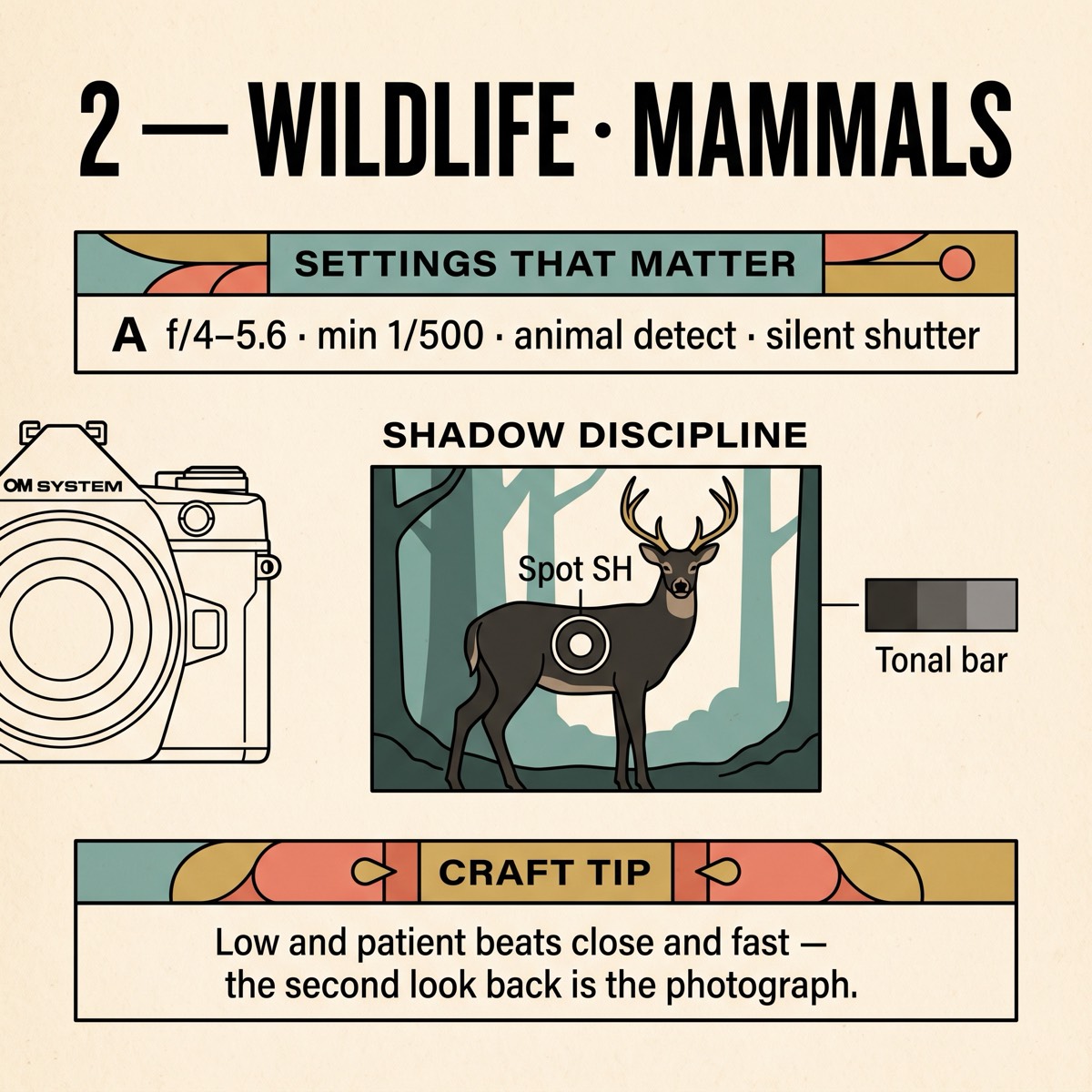
A f/4–5.6 · min 1/500 · animal detect · silent shutter. Forest shade: Spot SH the dark fur, let it be dark (§03). Craft: low and patient beats close and fast; the second look back is the photograph.
Macro & Small Worlds
C3: 60/90 macro · f/5.6 · stack 8–12 (§05) · flash + diffuser. Wind is the enemy — ProCap the lull (§06). Craft: eye-level with the subject, background a full meter behind it.
Waterfalls & Silk
Live ND32–64 · f/5.6 · ISO 200 · braced (§07). The EVF previews the silk — stop when texture just dissolves (§05). Craft: anchor sharp rocks in the foreground; wet stone loves a polarizer.
Night Sky
C4: 15s · f/2 · ISO 3200 · Starry Sky AF · tripod, IBIS off. Then Live Composite for trails — watch them draw (§05). Craft: foreground first while blue hour lasts; the sky composites over it.
Grand Landscape
C2: f/5.6–8 · ISO 200 · tripod HHHR 80MP (§05) — diffraction bites past f/8 on MFT, stop down with intent. Snow: Spot HI the snowfield (§03) — winter’s hardest exposure made trivial.
Forest, Dim & Green
f/4 · ISO 800 · IBIS to 1/4s for statics (§07). Streams blur free, handheld. Meter: Spot SH the deep hollows — keep the gloom (§03). Craft: shoot into the fog, not across it.
Rain & Storm
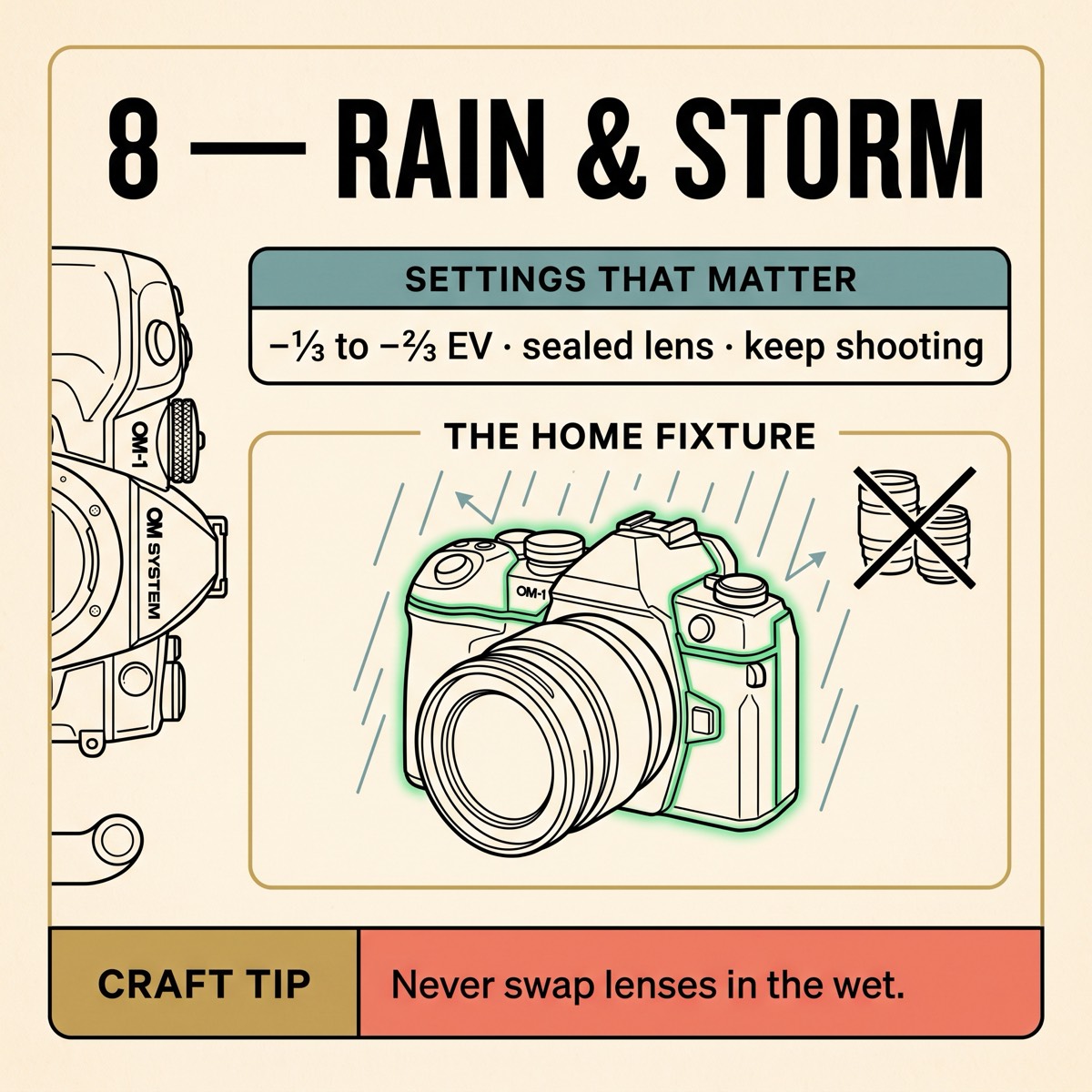
The OM-1’s home fixture (§08): keep shooting, wipe, never swap lenses in the wet. Dark skies read bright to ESP — −⅓ to −⅔ EV. Craft: backlit rain streaks at 1/60 against dark buildings.
Snow & Ice
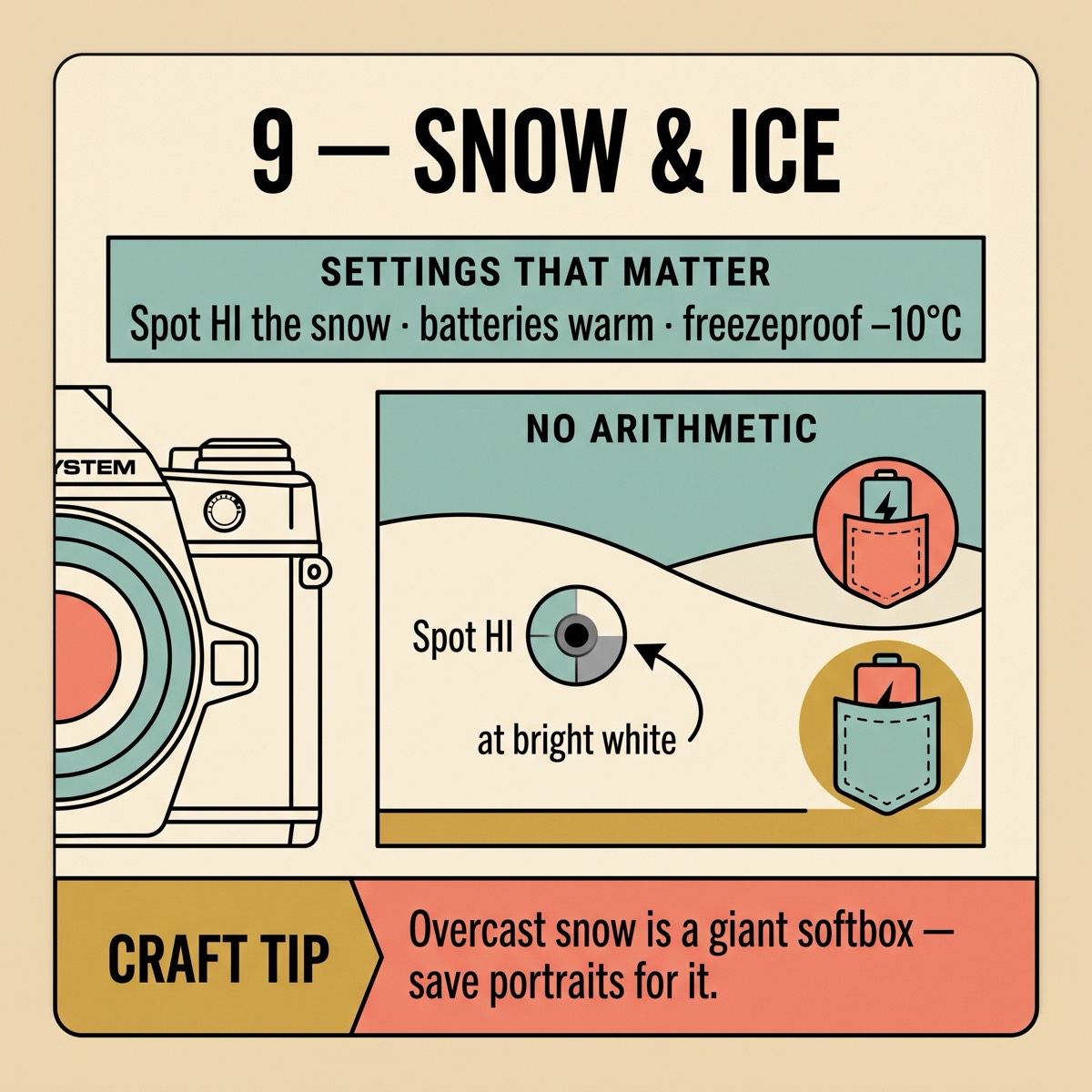
Spot HI the snow (§03) — no +1⅔ arithmetic here. Batteries warm, spares rotated (§08); freezeproof means the camera quits after you do. Craft: overcast snow is a giant softbox — save portraits for it.
Action & Sports
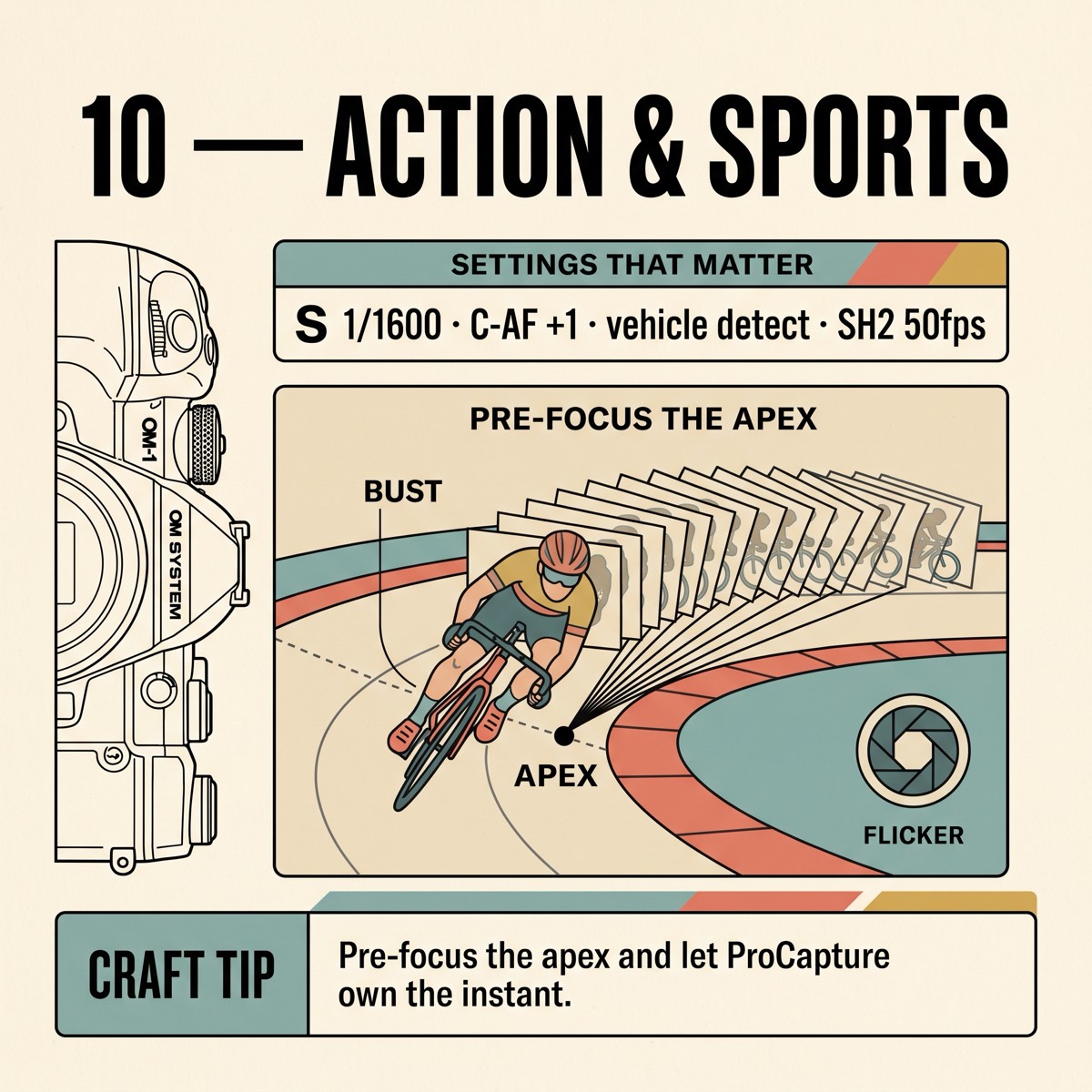
S 1/1600 · C-AF +1 · sport/vehicle detect · SH2 50 (§06). Mech shutter under flickery gym light (§12 anti-flicker). Craft: pre-focus the apex — corner exit, bar clearance — and let ProCap own the instant.
Travel, One Lens
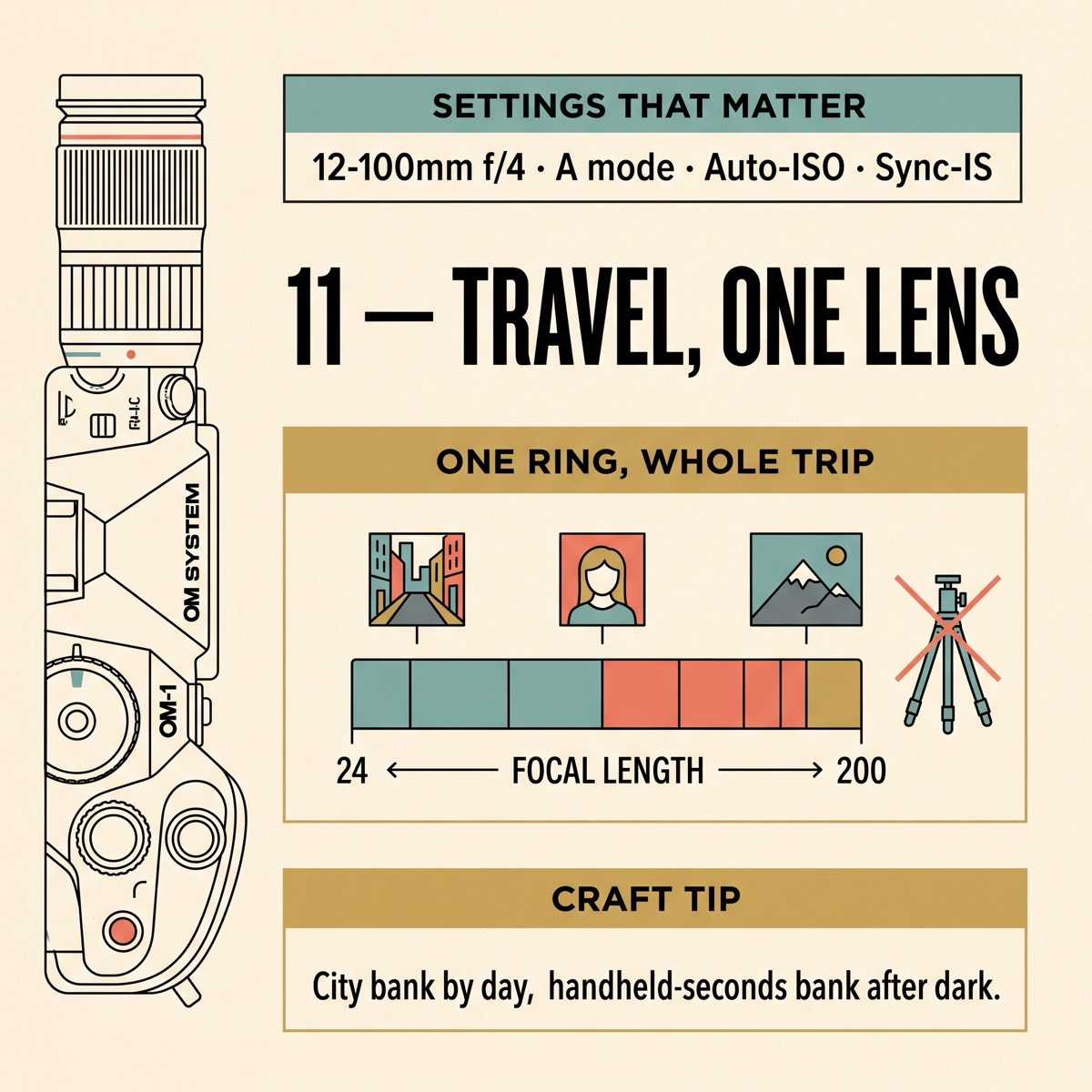
12-100 f/4 (§09) · A mode · Auto-ISO — 24–200-e with 8-stop Sync-IS is the entire kit (§07). Craft: city C-bank by day, handheld-seconds C-bank after dark; the tripod stays home on purpose.
Golden Hour, Long
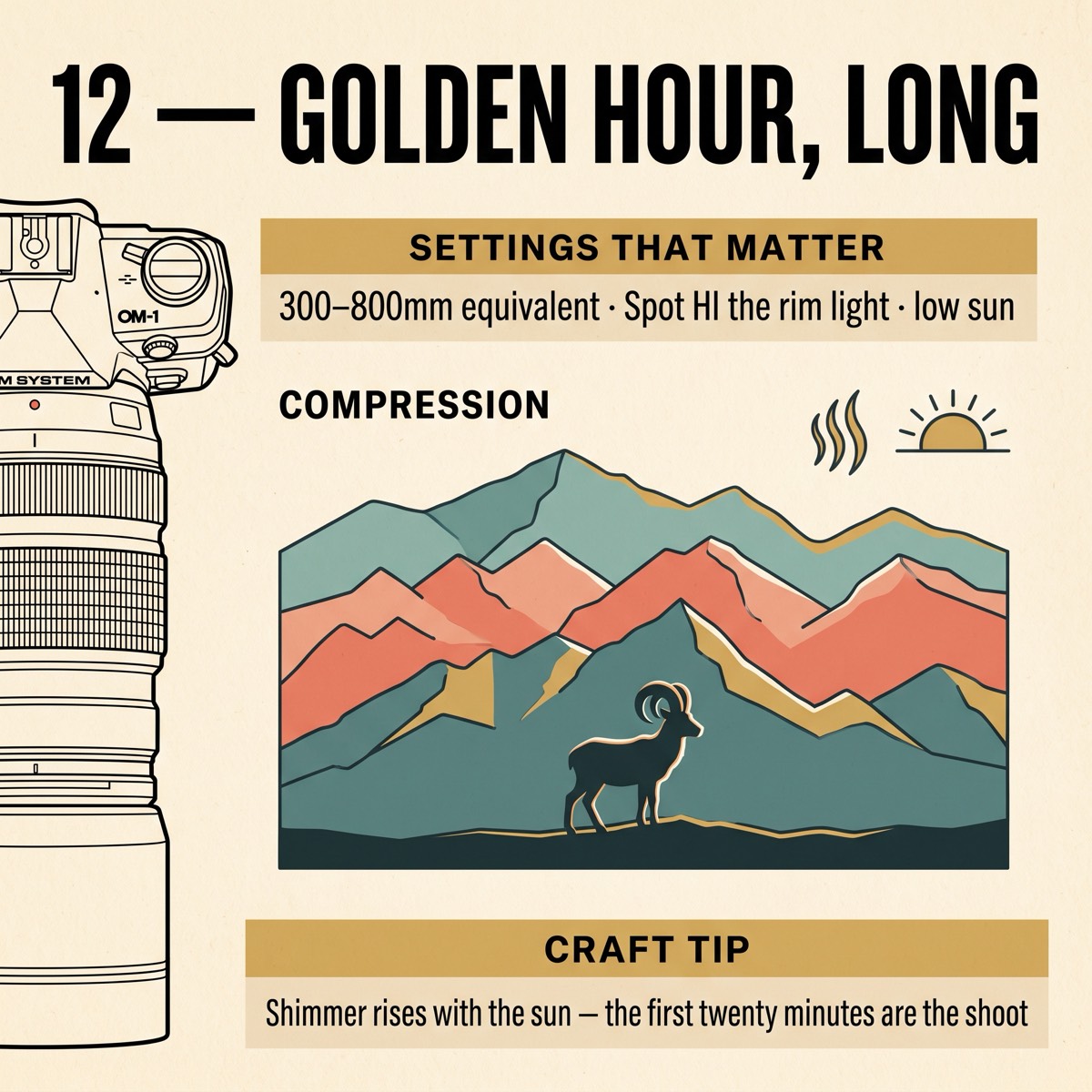
300–800mm-e at the low sun (§09): compressed ridgelines, rim-lit wildlife, layered haze. Spot HI the rim light (§03), let everything else fall. Craft: shimmer rises with the sun — the first twenty minutes are the shoot.